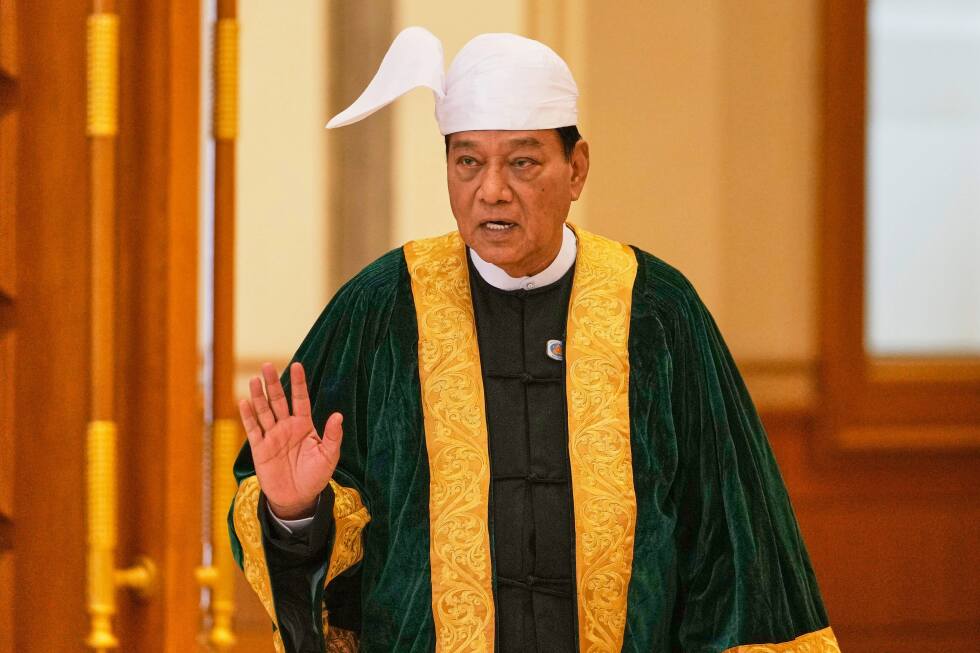
Myanmar’s Parliament commenced proceedings on Monday to select the nation’s next president, initiating what appears to be a carefully choreographed transition from direct military rule to a nominally elected government. This political maneuver comes exactly five years after the military seized power by ousting Aung San Suu Kyi’s democratically elected administration.
The process gained momentum as Senior General Min Aung Hlaing, the head of the military-led government, formally relinquished his concurrent position as commander-in-chief of the armed forces. This strategic resignation fulfills a constitutional requirement that prohibits the president from holding both offices simultaneously, effectively clearing the path for his anticipated ascension to the presidency.
General Min Aung Hlaing emerges as one of three presidential nominees, though his victory appears virtually assured given the military’s entrenched political dominance. The legislature remains heavily stacked with military-appointed representatives and lawmakers from army-backed parties, creating an insurmountable majority for any opposition candidates.
The selection mechanism involves three distinct groups—the Lower House, Upper House, and military bloc—each proposing vice presidential candidates. From these nominations, the 586-member legislature will conduct a vote, with the top candidate assuming the presidency and the remaining two becoming vice presidents. This elaborate process could conclude as early as Thursday.
This political theater unfolds against the backdrop of Myanmar’s devastating civil conflict, which has engulfed significant portions of the country. The recent parliamentary elections, conducted in limited constituencies due to security concerns, faced widespread criticism from pro-democracy advocates who denounced them as illegitimate exercises designed to sanction continued military dominance.
The absence of meaningful opposition further underscores the predetermined nature of this transition. Major political parties, including Suu Kyi’s National League for Democracy, were either barred from participation or boycotted what they considered fundamentally unfair electoral conditions. Suu Kyi herself remains imprisoned on politically motivated charges while her party faced forced dissolution in 2023.
Min Aung Hlaing, who has commanded Myanmar’s military since 2011, transferred formal control of the armed forces to his close aide General Ye Win Oo during a ceremony in the capital Naypyitaw. The 69-year-old general’s international reputation remains tarnished by the military’s brutal 2017 campaign against Rohingya Muslims, which the United Nations has characterized as ethnic cleansing.