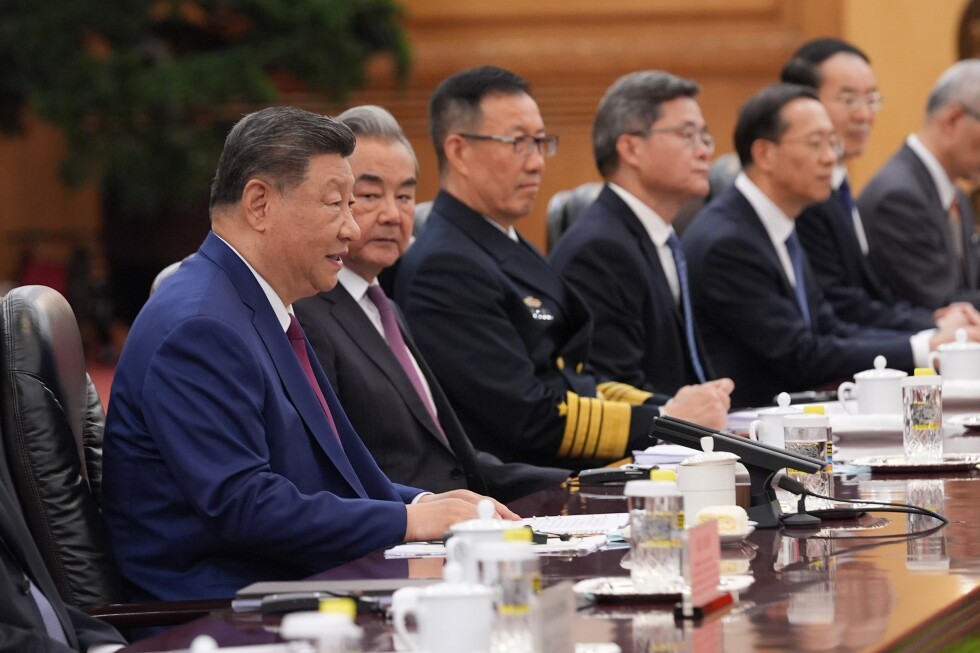
In a high-stakes diplomatic summit between Chinese leader Xi Jinping and former U.S. President Donald Trump, Beijing has delivered its starkest warning to Washington in recent years over the long-running Taiwan dispute, emphasizing that mishandling the issue could trigger direct confrontation between the two global powers.
According to an official readout released by China’s Ministry of Foreign Affairs, Xi framed the Taiwan question as the single most sensitive and consequential issue shaping the future of bilateral relations between Beijing and Washington. Striking an uncompromising tone, Xi stated that Taiwan independence and cross-Strait peace are fundamentally incompatible, incompatible as fire and water. He added that a constructive approach to the issue would pave the way for overall stability in U.S.-China ties, while mismanagement would lead to open clashes and even full conflict that would put the entire bilateral relationship in catastrophic jeopardy.
The historically separate governance of China and Taiwan dates back to the end of the Chinese civil war in 1949, when defeated Nationalist Party forces retreated to the island after the Communist Party claimed victory on the mainland. Over the following decades, Taiwan transitioned from decades of martial law to a fully functional multi-party democracy, a status that Beijing has never recognized. China continues to claim the self-governing island of 23 million people as an integral part of its territory, reserving the right to retake it by force if necessary. Cross-Strait relations have deteriorated sharply since 2016, when Tsai Ing-wen of the pro-sovereignty Democratic Progressive Party was elected president of Taiwan. Beijing responded by cutting off all official bilateral dialogue with Taipei, and in recent years has ramped up military pressure, deploying warships and fighter jets to air and sea spaces close to the island on an almost daily basis. Beyond military coercion, Beijing has also successfully poached a number of Taiwan’s remaining formal diplomatic allies, steadily isolating the island on the global stage.
The U.S. maintains no official diplomatic relations with Taiwan but is the island’s largest and most critical unofficial ally, bound by domestic law to ensure Taiwan has the capability to defend itself against potential aggression. For decades, Washington has maintained a policy of “strategic ambiguity”, refusing to explicitly confirm whether it would intervene militarily if China launched an attack on the island. Following Xi’s comments, then-U.S. Secretary of State Marco Rubio reaffirmed that long-standing U.S. policy on Taiwan remained unchanged, while warning that a military seizure of Taiwan by force would be a catastrophic mistake for Beijing.
Beyond its geopolitical significance, Taiwan holds a critical position in the global tech supply chain: it is the world’s leading manufacturer of advanced semiconductors, AI servers, and high-precision instruments, and the global AI boom of recent years has pushed the island’s top technology firms to record-breaking revenue and profit levels.
Regional analysts note that Xi’s unusually stern rhetoric reflects growing anxiety in Beijing over shifting U.S. policy and deepening ties between Washington and Taipei. In December preceding the summit, the Trump administration announced an $11 billion arms package for Taiwan — the largest ever offered to the island — and Trump has repeatedly pressured Taipei to increase its own defense spending.
William Yang, senior Northeast Asia analyst at the International Crisis Group, explained that Beijing’s forceful readout of the summit carries a clear signal. “If China had secured any meaningful concession on Taiwan from Trump, it would have been reflected in Beijing’s official statement. The absence of any such mention and the relatively stern tone suggest Trump may not have budged on Taiwan in principle,” Yang said.
Ma Chun-wei, a scholar of cross-Strait relations at Taiwan’s Tamkang University, added that Beijing is also concerned that the Trump administration has begun to deviate from long-standing standardized diplomatic language on the Taiwan issue. While the U.S. has for decades acknowledged Beijing’s position on Taiwan while maintaining unofficial ties with the island, the Trump administration’s December national security strategy only reaffirmed a commitment to opposing any unilateral change to the status quo, a framing that experts say leaves room for interpretation that worries Beijing.
For Xi, Ma noted, taking a hard line on the Taiwan issue is also a matter of domestic political credibility: “For Xi Jinping, he must show that the Taiwan issue is in China’s hands. He must demonstrate this image, or else he would be criticized,” Ma explained.
The report was filed from Bangkok by AP correspondents, with additional contributions from Simina Mistreanu in Bangkok and Michelle L. Price in Washington.