As the deadline set by U.S. President Donald Trump for Iran to reach a negotiated deal ticks down, military and legal experts are raising sharp questions about both the practicality and legitimacy of his sweeping threats to destroy massive swathes of Iran’s civilian infrastructure. In a series of escalating statements beginning Monday, Trump promised to wipe out “every bridge” and power station across Iran within just four hours if no agreement was reached by 20:00 EST Tuesday, going so far as to warn that “a whole civilization will die” should Iran fail to meet his demands.
Legal and military analysts interviewed by the BBC universally frame these threats as an unprecedented step for a sitting U.S. president, with international law experts noting that deliberate targeting of civilian infrastructure qualifies as a war crime under established international conventions. Trump dismissed these concerns outright during a Monday press briefing, brushing off questions about the humanitarian and legal implications of his proposed action.
Beyond legal concerns, former senior U.S. defense officials and military analysts agree that Trump’s promise to eliminate all of Iran’s bridges and key civilian sites in a single four-hour window is logistically impossible. Spanning a territory roughly one-third the size of the continental United States, Iran hosts a vast network of infrastructure spread across thousands of locations across the country. While U.S. intelligence has solid data on the location of major nuclear sites and key energy facilities, experts say it cannot map and destroy every relevant civilian target across such a large nation in such a compressed time frame.
“To meet this threat literally would be an absolute herculean task. And would it have the desired strategic effect?” a former senior U.S. defense official, speaking on condition of anonymity, told reporters. “Trump is almost struggling to come up with a new level of threat that he can say with words that will move the strategic needle more in favour of the U.S. here.”
While a widespread attack on Iran’s power sector is more logistically feasible than eliminating every bridge in the country, analysts say even that would fail to deliver the outcome Trump seeks. Most of Iran’s power plants and oil refineries are concentrated in three coastal provinces along the Persian Gulf: Bushehr, Khuzestan, and Hormozgan. Striking these sites would certainly deal a major blow to Iran’s economy and oil export capacity, Miad Maleki, a former senior U.S. Treasury official who led Iran sanctions programs and now serves as a senior fellow at the Foundation for Defense of Democracies, explained, noting that any disruption in these three provinces would cut Iran’s regime off from critical oil revenue and access to the Strait of Hormuz.
U.S. Vice President JD Vance confirmed Tuesday during a press briefing in Budapest that the U.S. has already carried out airstrikes on military targets on Kharg Island, which handles roughly 90% of Iran’s total oil exports. Vance emphasized that the strikes did not represent a shift in U.S. strategy, adding that negotiations would continue through Trump’s deadline but warning that the U.S. is prepared to inflict “much greater pain” on Iran’s economy if no deal is reached. “So they’ve got to know, we’ve got tools in our toolkit that we so far haven’t decided to use. The president of the United States can decide to use them, and he will decide to use them, if the Iranians don’t change their course of conduct,” Vance said. The White House later moved to quash speculation that Vance’s comments referenced a potential nuclear strike on Iran.
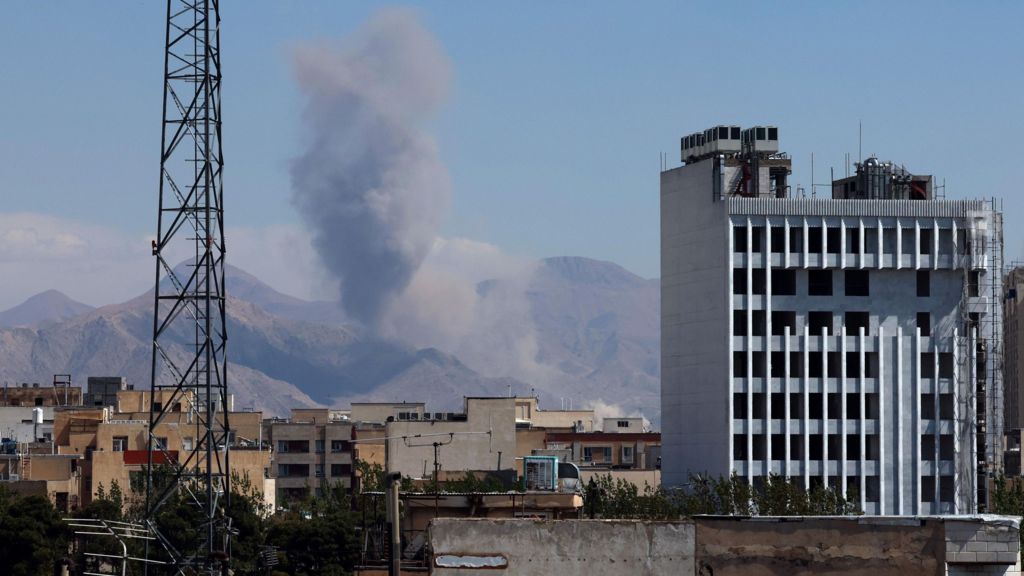
Limited strikes on civilian infrastructure have already occurred: Iran’s state media reported Tuesday that a joint U.S.-Israeli airstrike targeted a bridge in the holy city of Qom, marking the second such attack on a major Iranian bridge after Trump confirmed an airstrike on Iran’s largest bridge last week. Joint U.S.-Israeli operations have continued to hit multiple targets across Iran as of Tuesday, with video and images showing plumes of smoke rising over the capital Tehran.
As of Tuesday, direct talks between U.S. and Iranian officials have commenced after weeks of indirect negotiations failed to narrow gaps between the two sides. Despite the resumption of direct dialogue, the parties remain far apart on core sticking points, including the future of Iran’s oil sector, the status of its nuclear program, and governance of the Strait of Hormuz. Trump has named special envoy Steve Witkoff, his son-in-law Jared Kushner, and Vice President Vance as lead negotiators, but a senior anonymous U.S. official clarified that Witkoff and Kushner are leading daily negotiations, with Vance only set to join directly if a final deal appears imminent.
Trump appears to be betting that widespread attacks that disable Iran’s power grid will stoke public pressure on Iran’s regime to accept a deal, but analysts say that calculation is flawed. Even before the current conflict began in late February, Iranians were already grappling with chronic, widespread power outages, and the regime is unlikely to view additional blackouts as motivation to concede to U.S. demands, Maleki argued. “This is not a wartime issue. The Iranian people are already dealing with a completely dysfunctional energy and power sector,” he said.
Furthermore, attacks on Iran’s energy infrastructure could undermine Trump’s own core goal of reopening the Strait of Hormuz, which Iran has effectively closed to most oil tanker traffic. The closure has already roiled global energy markets and sent oil prices soaring. Jason Campbell, a former Department of Defense official who served under both Trump and former President Joe Biden and now is a senior fellow at the Middle East Institute, noted that Trump has failed to make a convincing case that escalation will deliver the U.S. its desired outcomes. After nearly six weeks of conflict, Iran’s regime has already demonstrated a high tolerance for disruption and is unlikely to cave to U.S. demands, Campbell said, noting that for Iran’s leadership, the conflict is “an existential fight not just for the country but for the regime.”