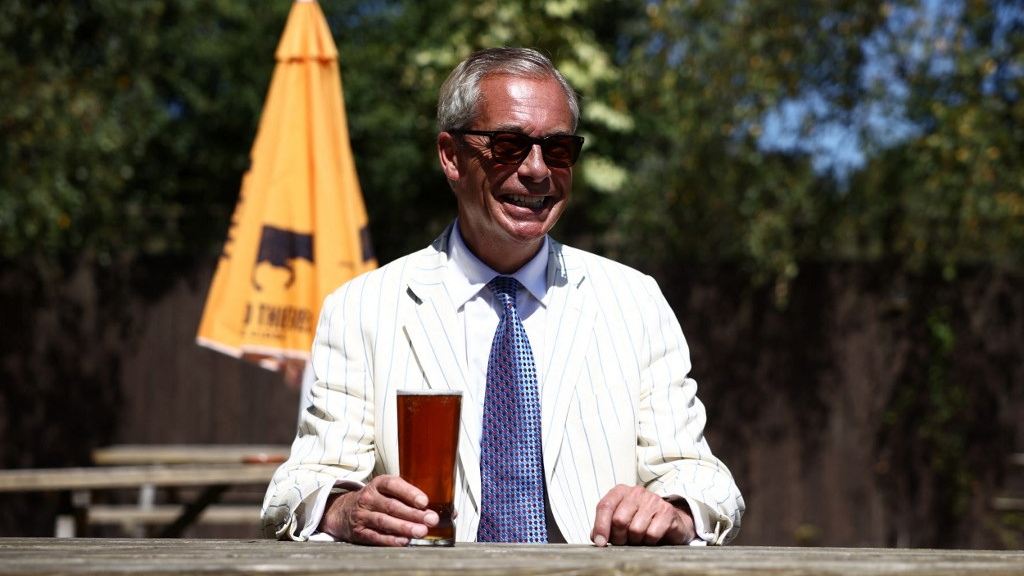
Twelve months ago, Nigel Farage stood at the pinnacle of British political influence. As leader of the Reform UK party, his movement commanded commanding leads in national opinion polls, with Farage and his allies dictating the terms of the UK’s national political conversation. Keir Starmer’s governing Labour Party found itself stuck in a reactive posture, and many prominent political commentators openly speculated that a Reform UK general election victory was no longer a question of if, but when.
Today, that political momentum has vanished entirely, and Farage’s own long-term political future is now hanging in the balance, tied up in a parliamentary ethics investigation over an undeclared £5 million ($6.74 million) gift from Thailand-based crypto billionaire Christopher Harborne. To clear his name and put his fate to voters, Farage resigned his seat as the Member of Parliament for Clacton, a coastal constituency in eastern England, last month, triggering a special by-election.
When votes were counted in the early hours of Friday, official results confirmed Farage had retained the seat with 22,239 votes – a slight increase of 1,000 votes over his 2024 general election majority, secured on a lower overall voter turnout than the previous contest. But what exactly did this win deliver for the veteran Brexit architect?
From the start of the campaign, the contest followed an unusual path: all major mainstream UK parties, including Labour and the Conservatives, made the decision to boycott the by-election, arguing it was an unnecessary political stunt staged by Farage for personal gain. With no big-party candidates on the ballot, the field swelled to 34 contenders, a chaotic mix of independent candidates, representatives from tiny minor parties, and novelty joke candidates – including three hopefuls from the Official Monster Raving Loony Party, a long-running UK satirical political group.
Farage’s closest competitor ended up being a novelty candidate who performs under the name Count Binface, a self-described “intergalactic space warrior” who campaigns while wearing a full costume shaped like a waste bin. In a result that stunned many political observers, Count Binface secured 9,455 votes, equal to 26.9% of the total vote share, against Farage’s 63.3% – an unusually strong performance for a satirical candidate.
That strong showing for a novelty contender has left Farage’s victory ringing hollow. Attempting to spin the result, Farage attempted to frame Count Binface as a proxy for the political “establishment” he has long railed against – a narrative that has gained little traction with the general public. Responding to Farage’s accusation from the vote count, Count Binface delivered a cutting rebuke:
“Someone who has been an MP, been an MEP, who was one of the chief architects of Brexit and one of the dominant figures in British politics over the last 20 years, and is reputedly a member of the East India gentleman’s club, which apparently does not admit women – I would say that’s arguably slightly more establishment than a lone wolf space warrior with a Ceefax fixation,” he said. “But you know what? It’s up to you.”
Notably, Farage himself was absent from the official vote count. He claimed police advice over alleged plans to disrupt the result forced his absence, but acting returning officer Ian Davidson clarified that the decision to skip the count was Farage’s personal choice. Political observers have widely speculated Farage avoided the event to avoid being photographed alongside his unlikely rival. Instead of attending the count, Farage appeared at “Farage Fest”, a campaign celebration held on a farm on the outskirts of Clacton complete with festival tents and a ferris wheel, where he hailed the result as a “resounding victory” and claimed “the result in Clacton speaks for itself.”
But few independent analysts accept that framing. A year on from Farage’s poll peak, the political landscape has shifted dramatically: new Prime Minister Andy Burnham now sets the national political agenda, the Labour government is enjoying a steady boost in national polling, and there is growing speculation Burnham could call an early snap general election this autumn if current polling trends hold.
Farage is no longer the figure dictating the terms of national political debate; instead, he is clearly on the defensive. To rebuild Reform UK’s political standing and advance its policy platform of national restructuring and mass deportations, Farage will need far more than a by-election win against a field of novelty and minor candidates.
Worse for Farage, his return to Parliament means the suspended parliamentary investigation into the undeclared £5 million gift has now resumed, and the cloud of ethics scrutiny hanging over his political career has returned. Whether he can survive this controversy politically remains an open question.
For his part, Count Binface has already claimed a victory of his own: “I came first in the Clacton by-election! Of the candidates who bothered to turn up for the results.”