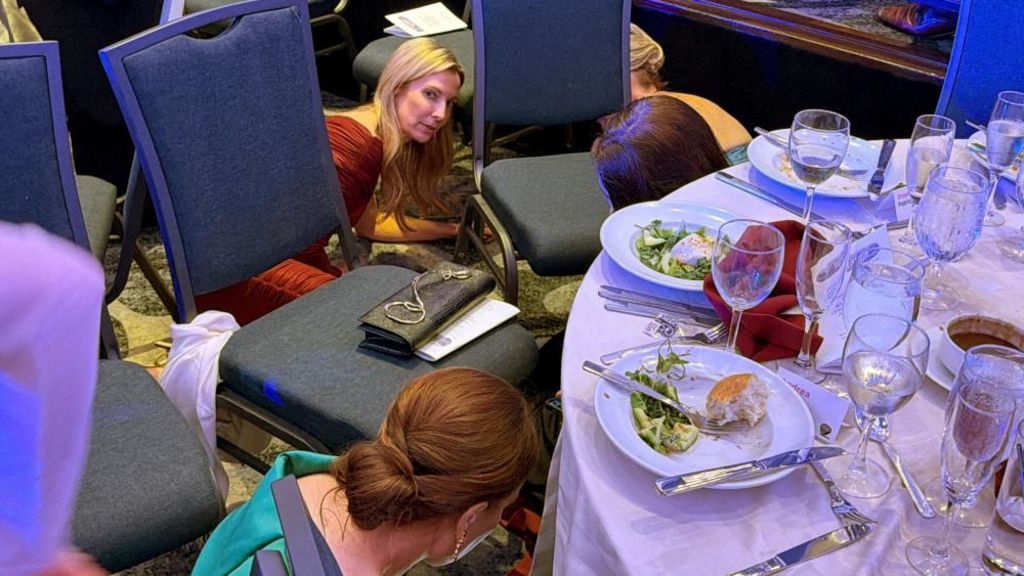
It was a routine Saturday night at the Washington Hilton’s ballroom for the annual White House Correspondents’ Dinner, until the moment veteran reporter Gary O’Donoghue set down his knife and fork. A low, booming rumble rolling from the direction of the main entrance caught his attention — a sound that would instantly trigger familiar dread for a journalist who has covered multiple mass shooting incidents and assassination attempts.
As a blind reporter, O’Donoghue relies heavily on audio cues to parse his surroundings, and the noise immediately struck him as the distinct thud of semi-automatic gunfire. Moments later, he heard glass shatter across the room, before feeling the head of his colleague Daniel brush past him as the man dove for cover under the table. Without hesitation, O’Donoghue followed, dropping to his knees beneath the tablecloth as fear raced through his mind.
This was not the first time O’Donoghue had found himself in the middle of an assassination attempt against a sitting U.S. president. Just 21 months earlier, he was on the ground in Butler, Pennsylvania, when a shooter opened fire on then-candidate Donald Trump, coming inches away from taking the former president’s life. As panic erupted across the ballroom that night in D.C., with hundreds of attendees screaming and scrambling for safety, this experience left O’Donoghue bracing for the worst.
Unlike the chaotic aftermath of the Butler attempt, the ballroom quickly settled into a terrified hush, with thousands of attendees dropping under tables within seconds of the first shots. For five to ten long minutes, those hiding waited in breathless silence, uncertain whether the gunman had breached the ballroom and was preparing to open fire on the crowd of 2,500 political leaders, journalists, and public figures gathered for the event.
Multiple witnesses confirmed that Secret Service agents immediately moved to evacuate former president and current 2026 officeholder Donald Trump, First Lady Melania Trump, and Vice President JD Vance from the stage moments after the incident. Other agents, clad in full tactical gear including helmets and bulletproof vests, took positions across the room with weapons drawn, scanning the crowd for any additional potential threats.
O’Donoghue shared small, human details that put the chaos in perspective: just minutes before the shooting, he had run into Health Secretary RFK Jr. in a small anteroom off the ballroom, where the secretary told him he was simply hungry and ready for the dinner to begin. Kennedy was seated just a few tables behind O’Donoghue when the shots rang out. Roughly 30 meters closer to the main entrance, FBI Director Kash Patel also took cover on the floor alongside other attendees, shielding his girlfriend from potential harm as a Secret Service agent rushed across the ballroom to secure his position.
In the aftermath of the incident, O’Donoghue says one question weighed more heavily on his mind than any other: How could a potential shooter get this close to the president, for the second time in less than two years? In the hours leading up to the dinner, all roads surrounding the Washington Hilton had been fully closed and secured by local law enforcement, but venue security itself felt surprisingly lax. O’Donoghue recalls that the ticket checker at the entrance only glanced at his credential from a distance of roughly six feet, with no closer inspection. When he went through screening to enter the ballroom, an agent waved a wand over his person but did not investigate the device that triggered the alarm from items in his inner jacket pocket, nor did they ask him to empty his pockets for a closer search.
In the end, O’Donoghue notes, the security detail matched that of a typical White House Correspondents’ Dinner where no sitting president is in attendance — a fatal oversight that left thousands of people vulnerable. For the duration of the post-incident lockdown, attendees struggled to get cellular service to report on the incident or gather updates on what had unfolded outside the ballroom. Even as O’Donoghue tried to push thoughts of worst-case scenarios out of his mind, he couldn’t shake the emotional weight of the moment. As a reporter covering U.S. politics, he wondered, how many more close calls must the country endure before a catastrophic tragedy occurs that ends the pattern of near-misses that have become a grim new normal for political events.