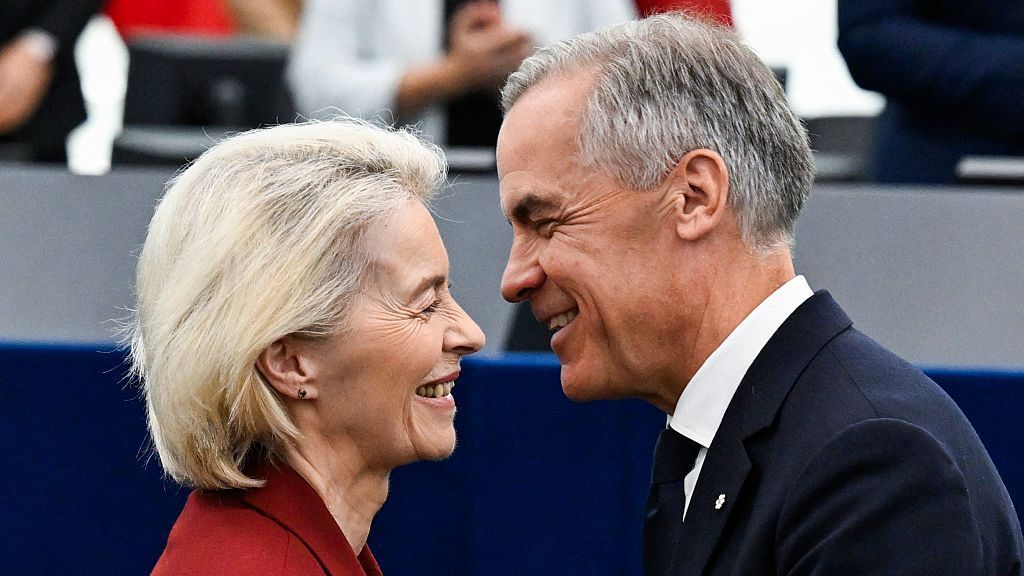
A new chapter in transatlantic relations has opened after European Commission President Ursula von der Leyen put forward a groundbreaking proposal: designating Canada as the European Union’s first ever associate member, a status not currently defined in any existing EU treaty. The proposal, outlined during her annual State of the Union address this week, has sparked widespread debate over what this unprecedented partnership would look like, how it would reshape global geopolitics, and whether it can even overcome the significant procedural and political hurdles standing in its way.
Canadian Prime Minister Mark Carney has quickly embraced the ambition, framing the potential partnership as a unique alignment tailored to shared values and pressing modern challenges, rather than a step toward full EU membership. Speaking to reporters and addressing the European Parliament on Thursday, Carney made clear that Canada has no intention of seeking full integration into the bloc, nor does it aim to form a competing third power bloc that would disrupt existing global alliances. “We do not seek power to dominate others,” Carney emphasized, positioning the closer partnership as a response to what he called the “current geopolitical rupture” reshaping global trade and security.
That rupture is widely understood as a reference to strained trade relations between Canada and its largest trading partner, the United States, fueled by President Donald Trump’s aggressive tariff policies and the collapse of bilateral trade negotiations in recent months. Carney laid out a clear roadmap of priority areas where he says Canada and the EU can deepen cooperation to mutual benefit, spanning cutting-edge artificial intelligence governance, secure supply chains for critical minerals, expanded defence industrial collaboration, strengthened energy security, and joint advancement in the space sector. He also confirmed Canada is eager to join the EU’s Erasmus Plus programme, the popular mobility initiative that enables cross-border student study and work exchanges. The UK is already set to rejoin the scheme in 2027, and Canada would become the eighth non-EU participant if its bid succeeds.
On energy, Carney highlighted a mutually beneficial arrangement: Canada can deliver large-scale volumes of liquefied natural gas (LNG) and low-carbon hydrogen to help Europe shore up its energy security after years of market disruption, while Canada would gain access to European expertise and leadership in clean energy technology innovation.
For all the outlined shared priorities, however, critical details about what associate membership would actually entail remain entirely unclear. Unlike existing partnership models, EU associate membership does not exist under current EU law, and creating the new legal framework would require years of negotiations, unanimous approval from all 27 EU member states, and formal ratification in every national legislature — a process that often stalls on competing national priorities.
Skepticism is already brewing within the bloc. Some member states argue that expanding existing trade and defence agreements between Brussels and Ottawa would be a more efficient path forward, rather than building an entirely new category of membership from scratch. The EU is already Canada’s second-largest trading partner, and the two sides have operated under the Comprehensive Economic and Trade Agreement (CETA) for more than a decade. Even so, CETA has yet to be ratified by several EU member states, and the existing deal does not eliminate all cross-border checks between Canada and the bloc, leaving analysts to question whether associate membership would address that gap.
Another open question is what associate membership would mean for Canada’s access to the EU single market. If Canada were to gain full access to the single market, it would be required to adopt all EU regulatory standards without holding any voting seats or decision-making power in Brussels — a dynamic similar to the arrangement that Norway, Iceland, Liechtenstein, and Switzerland currently hold. That shift would require a major overhaul of Canada’s existing regulatory framework, which has long been aligned with the United States, its largest economic partner.
Geopolitical friction could also emerge from the proposal. Multiple countries across the Western Balkans and Eastern Europe — including Albania, Bosnia and Herzegovina, Montenegro, North Macedonia, Serbia, Georgia, and Moldova — have been working for years toward full EU accession. While EU leaders have stated that a new associate partnership with Canada would not slow these countries’ progress, any perception that Ottawa is receiving special, accelerated treatment could create internal tension within the bloc’s expansion process.
Finally, the proposal has already drawn a hostile response from U.S. President Donald Trump, who has dismissed the prospect of Canada’s associate membership as “laughable” and threatened to impose additional tariffs on the European Union if the plan moves forward. For all the enthusiasm from Carney and von der Leyen, the road to creating the EU’s first associate member is littered with political, procedural, and geopolitical obstacles that will take years to untangle.