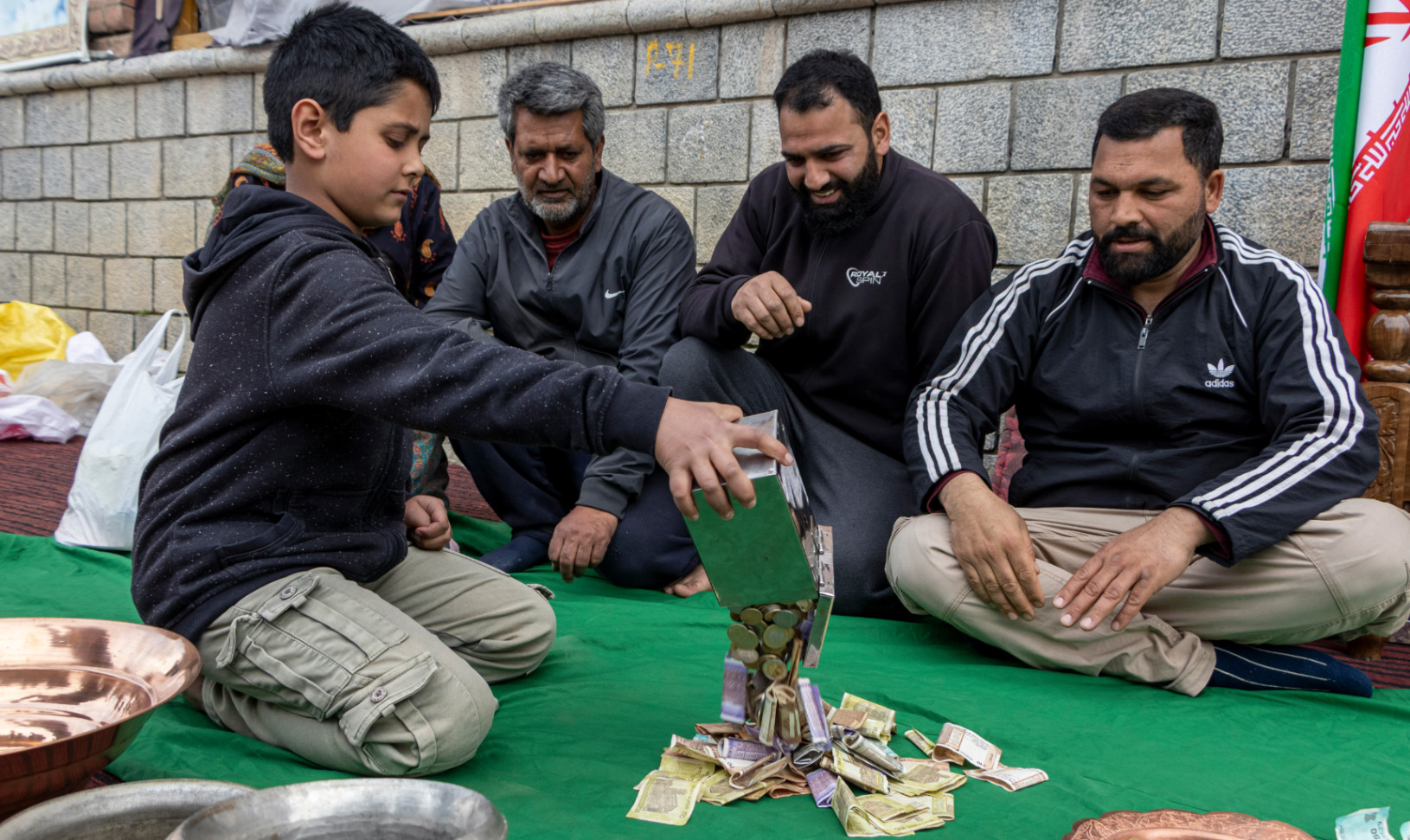
Across the Kashmir Valley, an extraordinary humanitarian movement has emerged in response to the ongoing conflict in Iran. Communities are donating their most precious possessions—family heirlooms, life savings, and essential livelihood assets—to support civilians affected by the war.
In Budgam, central Kashmir, Masrat Mukhtar donated the gold earrings her father gave her, a symbolic gesture replicated throughout the region during Eid al-Fitr celebrations. The tradition of collecting copper utensils for daughters’ weddings has been redirected toward wartime relief, with families choosing instead to support “daughters who lost mothers and sisters in the attacks,” explained 73-year-old Tahera Jan from Srinagar’s Zadibal neighborhood.
The scale of sacrifice is profound: Sadakat Ali Mir, a 24-year-old mini truck driver, donated one of his two vehicles, effectively surrendering half his livelihood. “I heard the mosque call and decided to give half my livelihood,” he stated, referencing the historical Battle of Karbala as inspiration for such sacrifice. Similarly, Bilal Ahmad Gazi donated his cherished scooter, stating, “The situation in Iran feels like losing a family member.”
Notably, the humanitarian effort transcends sectarian divisions. While Shia Muslims (approximately 10-15% of Jammu and Kashmir’s population) have been at the forefront, Sunni communities have participated significantly—sometimes comprising nearly half of all donors—by observing simpler Eid celebrations and redirecting resources. Shopkeepers closed early, families served modest meals, and all demonstrated what Sunni trader Shameen Khan described as “deliberate choice rather than obligation.”
The response draws upon centuries-deep cultural connections between Kashmir and Persia, dating back to the 14th century when Mir Syed Ali Hamadani arrived from Persia with 700 followers, introducing crafts, architecture, and language that forever shaped Kashmiri culture. This historical bond earned Kashmir the enduring epithet “Iran-e-Sagheer” (Little Iran) from philosopher-poet Allama Muhammad Iqbal.
Despite strict security measures implemented since India revoked the region’s semi-autonomy in 2019, large mourning processions filled Srinagar’s streets following Ayatollah Khamenei’s killing. Black flags hung from windows, portraits of Iranian leaders appeared in public parks, and thousands marched through Lal Chowk in tightly controlled but striking demonstrations.
Organizers have developed coordinated relief efforts informed by specific needs in Iran. Students at the Islamic University of Science and Technology organized supply drives, while local doctors assembled tailored medical kits. As social activist Ilyas Bhat observed, “This is coordinated action shaped by knowledge of need, not a loose or symbolic gesture.”
The Iranian Embassy in New Delhi expressed profound gratitude, acknowledging the “humanitarian support and heartfelt solidarity” from Kashmir. Their social media post highlighted a widow’s donation of gold kept as a memento of her husband who died 28 years earlier, noting how “tears and pure emotions bring comfort to Iran.”
Lecturer Sakina Hassan, who studies humanitarian practice, emphasized the deeper significance: “People are not only parting with objects—they are extending memory, inheritance, and care into another space.” As Mukhtar watched volunteers wrap her earrings, she envisioned them bringing comfort in Iranian hospital wards, embodying the persistent bond between Kashmir and its namesake through time and conflict.