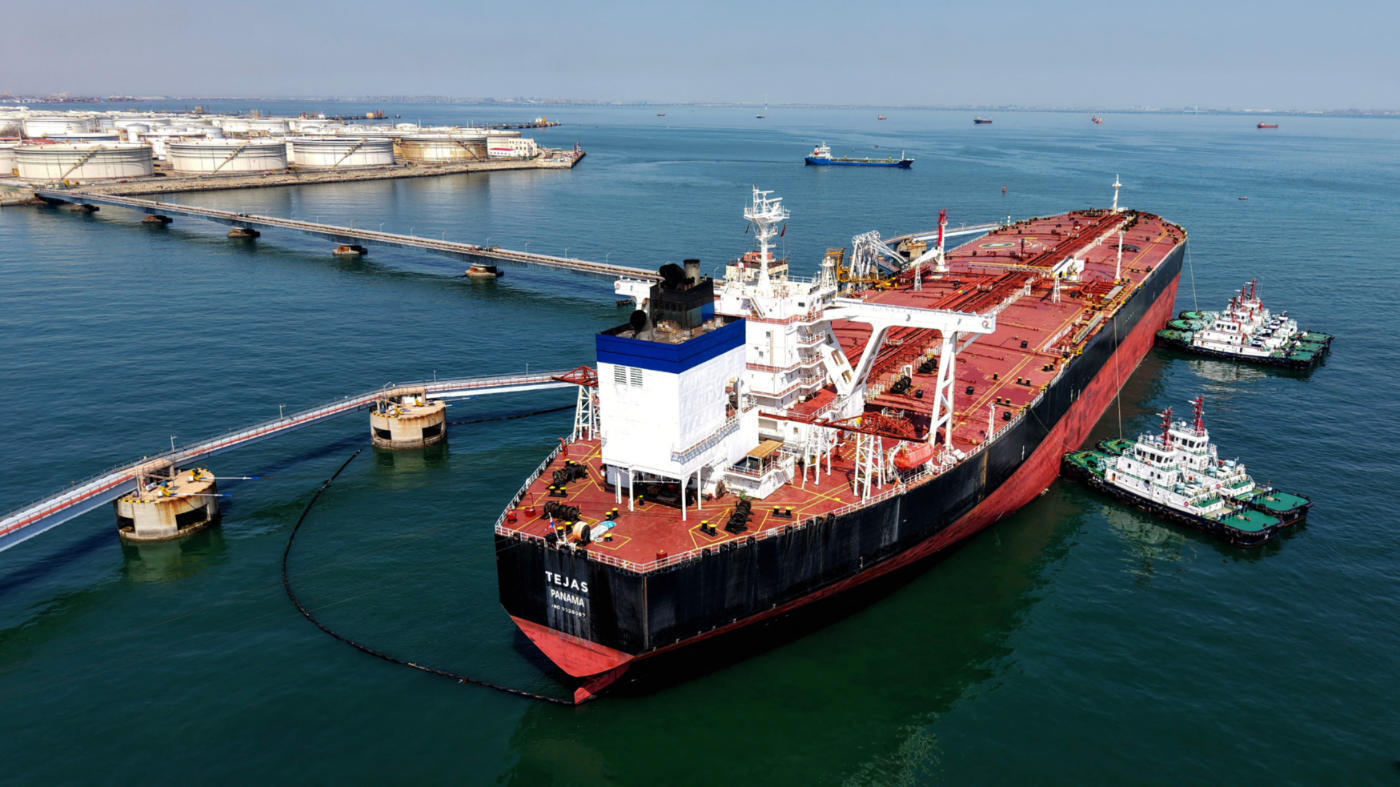
Following the sudden collapse of a negotiated peace agreement aimed at ending the US-Israeli standoff with Iran, Washington has reinstated a full naval blockade of all Iranian commercial ports, intensifying a decades-long campaign to cut the Islamic Republic off from global oil markets.
Iran, which holds the world’s third-largest proven crude oil reserves, has faced sweeping US sanctions designed to isolate its energy sector from international shipping for nearly 30 years. First introduced by the Clinton administration in 1996 over concerns about Iran’s nuclear program and its support for regional groups opposed to US influence, these restrictions were drastically expanded after former President Donald Trump withdrew from the multilateral Joint Comprehensive Plan of Action (JCPOA) nuclear deal in 2018. Cut off from the US-dominated global financial system that relies on dollar transactions, most major international shipping firms have avoided handling Iranian oil to avoid crippling secondary sanctions. In response, Iran built a sprawling network of unconventional vessels known as the “shadow fleet” — also called dark or ghost fleets — to sustain critical oil export revenues.
Shadow tankers operate on the margins of the global shipping industry, designed explicitly to skirt western sanctions on sanctioned countries. In addition to Iran, Russia (which faces widespread western oil sanctions following its invasion of Ukraine) and, until recently, Venezuela also rely on these networks. Most of the vessels are aging ships that evade detection by disabling mandatory location tracking systems or broadcasting falsified position data to marine monitoring databases. They are typically registered under “flags of convenience” — flags issued by countries with low shipping taxes, lax regulatory oversight, and opaque ownership disclosure rules, including Bermuda, Liberia, Panama, Malta, and the Marshall Islands. This structure intentionally obscures the ultimate ownership of the ships: many trace back to Iranian billionaires with ties to the Islamic Revolutionary Guard Corps, while others are owned by business interests in China, Iran’s largest crude customer. Crews are most often recruited from Iran, China, and South Asian maritime labor markets.
Before the reimposition of the US blockade, industry analysts estimated Iran’s shadow fleet numbered roughly 400 vessels, though exact counts vary. The fleet relies heavily on ship-to-ship transfers at sea, where crude is unloaded from an Iran-departed tanker to a second vessel before reaching its final destination. While these transfers are not inherently illegal, they add an additional layer of opacity that makes tracing the origin of the cargo extremely difficult.
Unlike the US, European Union, and Canada, which have implemented full bans on domestic entities purchasing Iranian oil, most other countries do not prohibit Iranian crude imports under their own national laws. However, Washington’s far-reaching secondary sanctions authorize penalties and asset freezes for any entity worldwide — regardless of nationality — that buys, transports, or finances Iranian oil, forcing most legitimate commercial operators to steer clear. At the international level, there are no binding UN sanctions on Iranian oil trade, as China and Russia have repeatedly used their veto power on the UN Security Council to block western-led sanctions resolutions against Iran. This means Iranian oil trade is not inherently illegal under international law, though many shadow fleet vessels violate binding International Maritime Organization (IMO) rules on environmental protection, maritime safety, and labor standards.
Enforcement of IMO regulations falls primarily to flag states and port authorities, leaving most violations unaddressed outside territorial waters, where vessels are protected by international freedom of navigation laws. The age of most shadow tankers — many are over 20 years old, and some exceed 30 — creates major environmental and safety risks. Older vessels have a far higher risk of catastrophic oil spills, and disabling location tracking increases the likelihood of collisions at sea. In 2018, the Iranian-owned shadow tanker *Sanchi* collided with another cargo ship off the coast of Shanghai, sinking the vessel, killing all 32 crew members, and spilling nearly 1 million barrels of crude into the East China Sea. Even large-scale spills from very large crude carriers — which can carry more than 2 million barrels of oil, double the amount released during the 2010 Deepwater Horizon disaster — remain a persistent threat.
China remains the largest buyer of Iranian crude, importing an estimated 1.4 million barrels per day in 2025, according to analytics firm Kpler — equal to 12% of China’s total crude oil imports. To avoid US secondary sanctions, China does not officially record these imports, instead mislabeling Iranian crude as originating from Malaysia or Indonesia. Analysts have long identified discrepancies between Chinese import data and the Southeast Asian countries’ export figures that confirm this practice. Iran sells its crude to China at a steep discount to global market prices, with payments settled in Chinese renminbi through Chinese financial institutions. The vast majority of these purchases are made by small, independent “teapot refineries” in China’s northeastern Shandong province; large state-owned Chinese refiners generally avoid Iranian oil to limit their exposure to US sanctions.
Laleh Khalili, a professor of Gulf Studies at the University of Exeter and leading expert on global oil shipping, notes that China’s economic size and massive energy demand give it the leverage to disregard US sanctions. “China has enough economic power to not have to obey the US sanctions regime. And that economic power goes hand-in-hand with an extreme need for oil,” Khalili explained to Middle East Eye. Beyond Iran, China also uses shadow fleet networks to import discounted crude from Russia, and previously from Venezuela. Beyond major energy trade, Iran’s shadow fleet has also been linked to jet fuel sales to Myanmar’s military junta during the country’s ongoing civil war, drawing sharp criticism from human rights groups over fuel supplies used for air strikes against civilian targets.
The new US naval blockade, which launched in April 2026 when the USS Rafael Peralta began interception operations off Iran’s coast, is the cornerstone of a broader western crackdown on shadow fleets that undermine the effectiveness of unilateral US sanctions. However, marine intelligence outlets have already documented that multiple Iranian tankers have successfully evaded the blockade. Even before the recent escalation, the US and United Kingdom had been intercepting shadow tankers linked to Iranian, Russian, and Venezuelan oil shipments, even in international waters. A common tactic is pressuring flag states to revoke a vessel’s registration, rendering it stateless, in violation of international law, and eligible for seizure by western forces. “When this happens, the seizure might technically fall under the letter of the law,” Khalili said. “But it’s also a form of the projection of US power, as it’s very much the US forcing the flag states to place those ships outside of the law.”
Washington has also pressured Malaysia to crack down on shadow tankers that exploit regulatory loopholes allowing unregulated ship-to-ship transfers in the Eastern Outer Port Limits, part of Malaysia’s territorial waters, though enforcement to date has been inconsistent. Western powers have launched a dedicated Shadow Fleet Task Force to coordinate crackdown efforts, and have sanctioned individual identified vessels to bar them from accessing global maritime infrastructure. The US has also extended sanctions to some Chinese teapot refineries that purchase Iranian crude, but Beijing has pushed back aggressively, ordering all Chinese companies to refuse compliance with what it calls illegal unilateral US sanctions. “The Chinese government has consistently opposed unilateral sanctions that lack authorisation from the United Nations and a basis in international law,” Beijing said in a May 2026 statement.