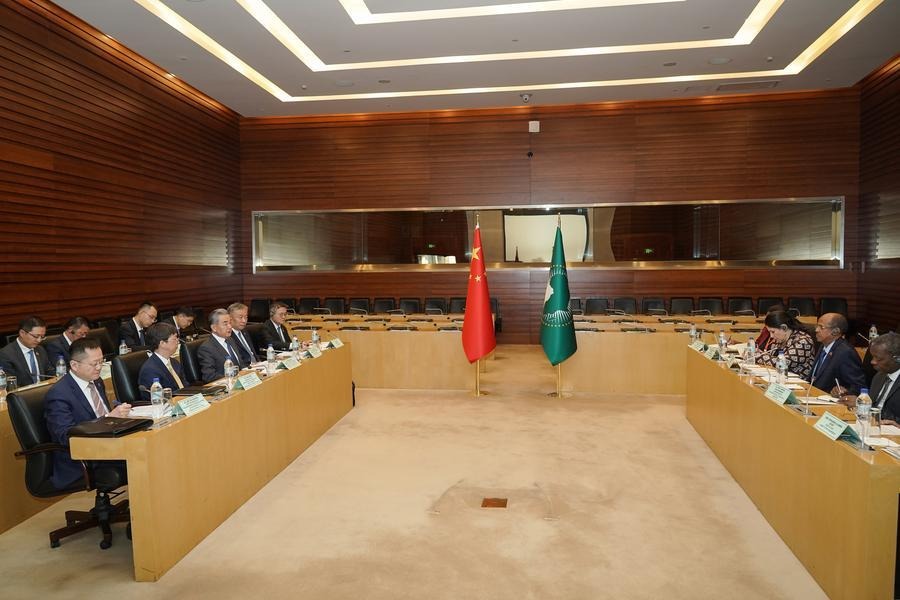
Chinese Foreign Minister Wang Yi’s recent tour of African nations has underscored Beijing’s enduring commitment to strengthening South-South cooperation amid global uncertainties. The visit, which included stops at the African Union headquarters in Addis Ababa along with Ethiopia, Tanzania, and Lesotho, represents the 36th consecutive year that China’s top diplomat has chosen Africa for their first overseas trip of the year.
During the strategic engagements, Minister Wang and AU Commission Chairperson Mahmoud Ali Youssouf convened the ninth China-AU Strategic Dialogue, culminating in the official launch of the 2026 China-Africa Year of People-to-People Exchanges. This initiative, established during the 2024 Forum on China-Africa Cooperation Beijing summit, aims to foster deeper connections through educational, cultural, media, and youth engagement programs.
African analysts have characterized the diplomatic mission as a landmark moment in China-Africa relations. Dr. Al-Sawy Al-Sawy Ahmed, former dean of the Faculty of Arts at Suez Canal University, noted that the visit exemplifies a comprehensive approach integrating political, diplomatic, and economic dimensions. “This tour reflects Beijing’s commitment to strengthening partnerships through enduring development initiatives and collaborative projects that directly benefit local populations while promoting long-term stability,” Ahmed observed.
Substantive outcomes from the visit include China’s expansion of zero-tariff treatment to all 53 African nations with diplomatic ties to Beijing, a move designed to boost African exports to Chinese markets. Additionally, China reaffirmed its commitment to modernize the Tanzania-Zambia Railway and stimulate integrated development along the economic corridor.
Hany Soliman, director of the Arab Center for Research and Studies, described the agreements as exemplifying China’s unique approach to combining economic support with long-term development planning. “These initiatives underscore a model of South-South cooperation that balances immediate developmental needs with harmonious, integrated growth while strengthening Africa’s position on the world stage,” Soliman stated.
Ghada Gaber, a Cairo-based specialist in China-Africa relations, emphasized that the timing and substance of the visit demonstrate how bilateral relations have evolved beyond traditional economic frameworks into deeper political, civilizational, and humanitarian engagement. “This visit transcends short-term, interest-driven considerations and embodies a shared vision grounded in mutual respect and the principle of a ‘shared future for humanity’,” Gaber noted.
The diplomatic mission also highlighted China’s support for Africa’s expanding role in global governance and institutional reform, positioning the partnership as a counterbalance to traditional Western power structures while advocating for the interests of developing nations on the international stage.