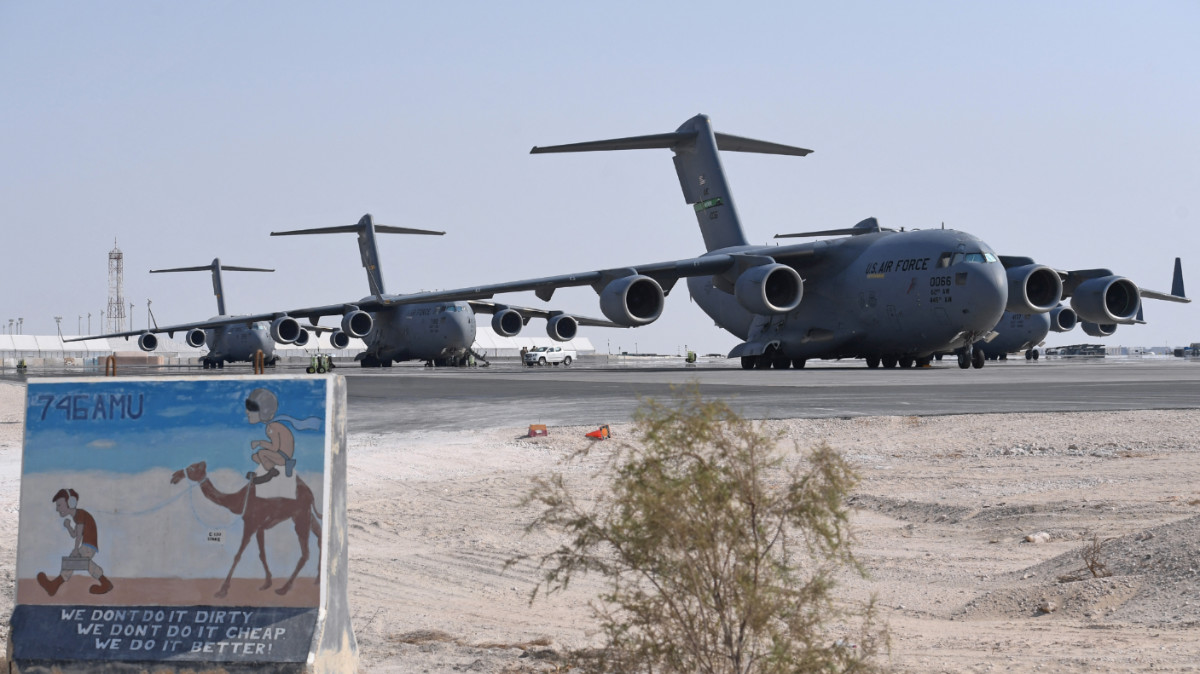
When the United States completed construction of Logistical Support Area (LSA) Jenkins on Saudi Arabia’s Red Sea coast near Yanbu back in 2022, few anticipated how quickly this relatively remote outpost would become the blueprint for America’s entire regional military strategy. Today, multiple current and former U.S. officials, military analysts, and intelligence leaders confirm that stepped-up activity at LSA Jenkins is a direct response to a stark new reality: Iran’s advanced missile and drone arsenal has rendered large, fixed U.S. military bases close to Iranian shores dangerously vulnerable.
For decades, large, permanently manned forward bases have anchored U.S. military dominance across the Persian Gulf. But the outbreak of the U.S.-Israeli campaign against Iran has upended that long-standing model. As Iranian projectile attacks repeatedly targeted U.S. installations within range of its coast, activity at the more distant LSA Jenkins surged, insiders tell Middle East Eye. The base’s entire purpose, explains Abbas Dahouk, former U.S. defense and army attaché to Saudi Arabia, is to underpin Washington’s Iran strategy by providing critical strategic depth far beyond the reach of Iran’s immediate strike capabilities.
Tehran has made the full withdrawal of U.S. military forces from all regional bases a core demand for any long-term ceasefire agreement. While Washington has shown no indication it will meet that demand outright, the proven accuracy and effectiveness of Iranian missiles and drones—reportedly aided by Chinese and Russian satellite intelligence—has sparked urgent internal debate over the future of large U.S. bases across the Gulf. Remarkably, multiple sources confirm that U.S. leadership is already leaning toward drawing down forces from the very installations Tehran is demanding it abandon.
David Petraeus, former CIA director and former head of all U.S. military forces in the Middle East, acknowledged this shifting calculus in May comments to Bloomberg. “The truth is that we are not as inclined to occupy these bases now that we have seen what the Iranians can throw at them,” Petraeus said, noting the threat landscape is far more challenging than when he led U.S. Central Command. He added that the current CentCom commander has already broken with long-standing practice of locating command leadership in the same time zone as deployed forces, instead running military operations remotely from Tampa, Florida.
This new reality was underscored in recent weeks when a fragile ceasefire between Washington and Tehran collapsed, triggering fresh hostilities. After the U.S. launched new strikes, Iran retaliated with ballistic missile attacks targeting U.S. bases in Kuwait. While U.S. Central Command claimed it intercepted all incoming missiles, commercial satellite imagery from Soar Atlas revealed a destroyed shelter at Kuwait’s Ali al-Salem Air Base, plus extensive damage to a terminal at Kuwait International Airport—a casualty Tehran blamed on a malfunctioning U.S. Patriot interceptor.
The attack laid bare the unsustainable position of large U.S. bases in Kuwait, which currently hosts more U.S. troops—roughly 14,000—than any other Middle Eastern country, including the major installations of Camp Arifjan and Ali al-Salem Air Base. Both bases have come under repeated intense Iranian attack. “The war has exposed the vulnerability of all fixed bases,” notes Mark Cancian, senior military analyst at the Center for International and Strategic Studies. “The US is reevaluating its posture in the Middle East, and there’s likely to be changes. I wouldn’t be surprised if these bases were reduced in scope.”
Multiple U.S. officials and analysts, speaking on condition of anonymity to Middle East Eye, say the future of U.S. military presence in the region will increasingly mirror the LSA Jenkins model: smaller, more dispersed installations located farther from Iran, making them far harder targets for Iranian strikes. This shift aligns with a gradual transition Washington began 20 years ago, when it moved away from the dense fixed-base model established in Kuwait after the 1991 Gulf War toward a framework built on negotiated access rather than permanent occupation.
Today, the U.S. maintains a spectrum of basing arrangements across Gulf states. Kuwait, Bahrain, and Qatar host full-time permanent U.S. troop deployments, while Oman has no permanent U.S. bases, instead holding a standing agreement that grants pre-negotiated access to ports and airspace. Notably, Oman has experienced far fewer attacks than its Gulf neighbors since the outbreak of hostilities with Iran. Currently, around 2,700 U.S. troops are deployed to Saudi Arabia—half the number stationed there two decades ago, reflecting the ongoing shift toward a more flexible posture.
“It sounds like semantics, but the type of agreement does make a difference for the US and host country. The Gulf states are very sensitive to the language they use on how US troops are hosted. And it leaves the US presence more nimble,” a U.S. defense consultant who advises the Pentagon told Middle East Eye on condition of anonymity. “This war will force a light footprint approach like Oman that prioritises access.”
Kuwait’s unique geography, positioned at the northern tip of the Gulf, leaves it uniquely exposed to missile and drone attacks from Iran and allied Iraqi militias—a vulnerability that has forced the U.S. to already evacuate many personnel from its large Kuwaiti bases. Compounding this challenge is the growing strain on U.S. air defense stockpiles: in the opening weeks of the war, Gulf states were denied requests for additional interceptor missiles, and a May Washington Post report revealed the U.S. has only 200 Terminal High Altitude Area Defense (THAAD) interceptors remaining in its global stockpile.
“Defending all of these bases would stretch US interceptors,” Dahouk explained. “The US had to make a choice between hardening the bases and risking lives or evacuating. We evacuated.”
Former U.S. ambassador to Kuwait Douglas Silliman noted that retaining a large permanent U.S. presence in Kuwait would require major new investments to harden existing facilities, many of which were built decades ago to lower defensive standards. “Many US military facilities in Kuwait are not as hardened as some other US facilities in the region. If the US and Kuwait would like to keep a significant US presence after the Iran war – and I think it’s likely that both sides will want to – they will have to invest in hardening those facilities,” he said.
This shift toward more distant, flexible positions is already underway. Middle East Eye first reported that after Iran heavily damaged the large Prince Sultan Air Base southeast of Riyadh earlier this year, the U.S. secured access to Saudi Arabia’s Taif Air Base, located farther from Iranian strike ranges.
Iran’s effective control of the Strait of Hormuz has also created new sustainment challenges for the U.S. Navy, which has been effectively locked out of the key waterway. Today, the U.S. Fifth Fleet is based in Bahrain’s Persian Gulf waters, U.S. Central Command is headquartered in Qatar, Al Dhafra Air Base operates in the UAE, and Jebel Ali Port remains the most frequent stop for U.S. naval vessels in the region—all now within easy reach of Iranian capabilities.
Ironically, the shift to Red Sea access was foreshadowed more than a decade ago. Dahouk recalls that in 2015, then-Saudi Defense Minister and current Crown Prince Mohammed bin Salman offered the U.S. port access to Jizan on Saudi Arabia’s Red Sea coast, an offer that received serious internal consideration at the time. “An additional port call option without having to transit through the Persian Gulf would reduce reliance on Jebel Ali Port,” Dahouk notes—a solution that looks far more necessary today than it did a decade ago.