One month after a historic mass migration event that saw over 72,000 people cross into Ceuta — Spain’s North African exclave bordering Morocco — the tense standoff between long-term local residents and the remaining stranded migrants has boiled over into open violence, exposing deep rifts in Spanish national politics and reigniting a long-running territorial dispute between Madrid and Rabat.
On 30 and 31 July, tens of thousands of migrants, most of whom swam around a reinforced border fence to enter Ceuta from Moroccan territory, staged the largest single mass crossing at the Spanish-Moroccan border in modern history. Ceuta’s mayor confirms that at least 100 migrants lost their lives during the dangerous crossing. While the vast majority of arrivals returned to Morocco within hours of entering the exclave, several thousand — including a large number of unaccompanied children — have remained in Ceuta, sleeping rough on public beaches and city streets with limited access to basic services.
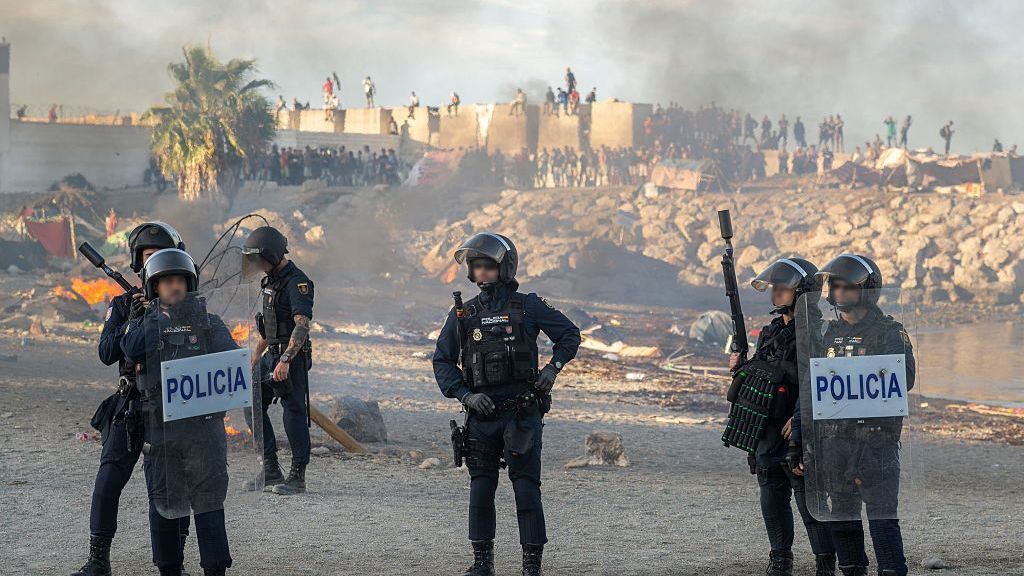
Anti-migrant demonstrations that began earlier this month initially stayed largely peaceful, but growing frustration over public safety strains and pressure on local public services has pushed protests toward increasing violence. On Thursday, dozens of local residents blocked Red Cross aid workers from distributing food and clean water to the stranded migrants. Following the blockade, a group of demonstrators set fire to informal migrant encampments on Trampolín Beach, the primary site where migrants have been sheltering, and violent clashes broke out between protesters and local police.
The Thursday violence came just hours after Spanish authorities arrested 12 migrants on charges of stone-throwing against a Spanish military vehicle. The attack shattered the vehicle’s windows and left all four military personnel inside injured. That same morning, local media received multiple reports of civilian vigilante groups patrolling city streets to hunt down and chase migrants. Multiple journalists and media crews covering the unrest have also reported being threatened by demonstrators.
The crisis has put the national Socialist-led government of Prime Minister Pedro Sánchez under intense fire from opposition parties, who accuse the administration of failing to manage the emergency effectively. Ceuta’s conservative mayor Juan Jesús Vivas, a member of the center-right opposition People’s Party (PP), framed the unrest as a consequence of unaddressed pressure on the exclave’s residents, telling Spanish broadcaster Antena 3 that “this is a city which has been under pressure, which has the right to normality,” adding that “the dignity of Spain is a stake right now in Ceuta.”
Sánchez’s government has hit back at opposition criticism, blaming right-wing parties for stoking public division and anti-migrant sentiment to score political points. In a statement to a congressional committee, Spanish Interior Minister Fernando Grande-Marlaska noted that “we have heard during these weeks rhetoric and comments that contribute to the stigmatisation of immigrants and which feed social division at a moment when what we need is responsibility and statesmanship.”
A far-right Vox Party lawmaker, José María Figaredo, is currently under investigation for a potential hate crime following comments he made shortly after the mass crossing, when he called for migrants to be “hunted down, one by one.” PP congressmember Javier Celaya, who represents Ceuta, doubled down on opposition rhetoric Friday, arguing that “the [government] treats the invaders as victims when the real victims are us, the people of Ceuta.”
Local frustrations have been amplified by the national government’s recent plan to relocate stranded migrants from beach encampments into underused public buildings, including local sports centers, to process asylum claims in an orderly fashion and return those ineligible for protection to Morocco. Vivas and many local residents oppose the plan, citing concerns that relocation would move migrants into densely populated residential areas, worsening perceived public safety risks.
Earlier this week, the national government took over central management of the crisis from local authorities, after widespread criticism of its initial slow response to the emergency. Defense Minister Margarita Robles issued a public apology to Ceuta residents who “may have felt, or who even still feel, abandoned or not sufficiently cared,” as the administration unveiled plans to overhaul Spain’s outdated national immigration laws. On Friday, all political parties represented in Ceuta’s local assembly signed a joint statement condemning the recent wave of violence.
Beyond the domestic unrest, the crisis has also reignited longstanding geopolitical tensions between Spain and Morocco. Right-wing and far-left politicians in Spain have accused Morocco of orchestrating the mass crossing to exert political pressure on Madrid, pointing to past instances where Morocco has adjusted border enforcement to advance its political claims. Prime Minister Sánchez and his Socialist Party reject that accusation, framing Morocco as a reliable diplomatic partner that facilitated the immediate return of most migrants after the crossing.
Morocco has reaffirmed its longstanding territorial claim to both Ceuta and its sister autonomous exclave Melilla, drawing a sharp rebuke from the Spanish government. Spanish Foreign Minister José Manuel Albares told congressional leaders that he “roundly rejected” Morocco’s claims, stating clearly: “I don’t speak about, nor have I spoken about, nor are we going to speak about Spain’s territorial integrity with Morocco or with anyone else.”