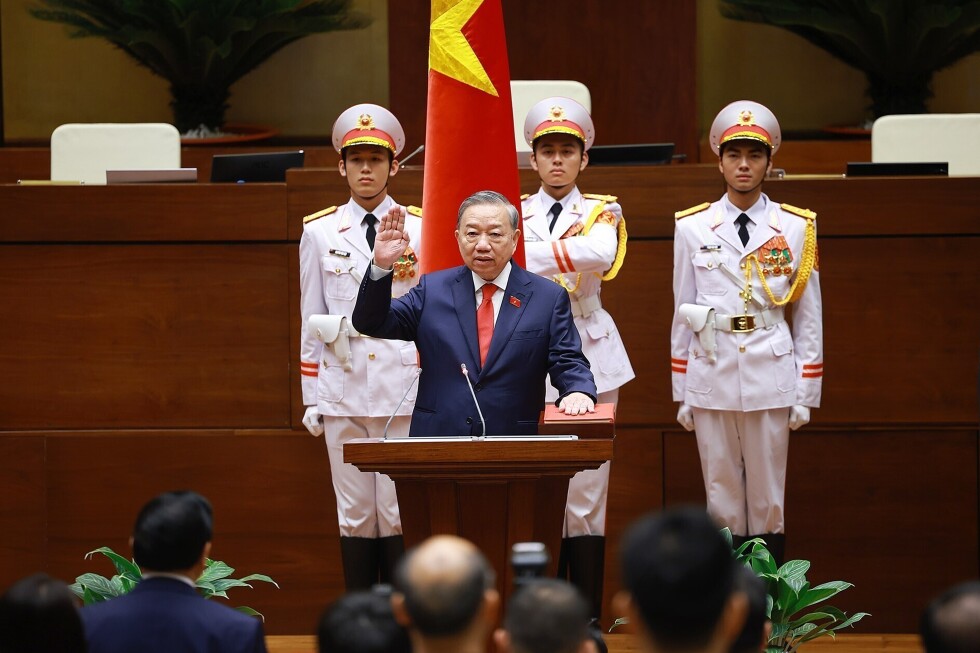
In a historic vote that reshapes Vietnam’s long-standing governing framework, Vietnam’s National Assembly has unanimously confirmed Communist Party General Secretary To Lam as the country’s new president for a five-year term, bringing the top posts of both the ruling party and the state under the control of a single leader. The landmark appointment breaks from decades of collective power-sharing tradition in Vietnam, where the two top leadership positions have customarily been held by separate individuals to balance authority – an alignment that now mirrors the concentrated power structures seen in neighboring China and Laos.
The outcome was widely anticipated by regional political analysts, who flagged the power consolidation as a likely next step after Lam was re-elected to lead the Communist Party during its national congress in January. This is not the first time Lam has held both leadership posts: he briefly assumed both roles in early 2024 following the death of his predecessor as party chief, Nguyen Phu Trong.
After his formal swearing-in, the 69-year-old newly minted president addressed the National Assembly, outlining his core policy priorities. He emphasized that maintaining national peace and political stability would be his top focus, framing that stability as the non-negotiable foundation for Vietnam to achieve fast, long-term economic growth. “We aim to improve people’s livelihoods so all can share the benefits of development,” Lam told the assembled legislators.
Regional experts say the concentration of power in Lam’s hands is the most significant shift in Vietnam’s political landscape since the country launched its 1980s doi moi reform process, which transitioned Vietnam from a closed state-run economy to a market-oriented system open to global foreign investment. Nguyen Khac Giang, a Vietnam researcher at Singapore’s ISEAS–Yusof Ishak Institute, notes that Lam now holds a far stronger policy mandate and much greater room for political maneuver to advance his policy agenda than any Vietnamese leader has enjoyed since the 1980s reforms began.
“The opportunity is obvious. Faster decision-making, greater policy coherence, and a better chance of pushing difficult reforms at a pivotal moment,” Giang explained. “But the risk is that concentration of power can move faster than institutional reform.”
To Lam’s rise to the pinnacle of Vietnamese politics caps a decades-long career that began in Vietnam’s internal security services, rising through the ranks of the national police force to eventually take charge of the Ministry of Public Security. His ascent was accelerated by his role leading the sweeping national anti-corruption campaign launched by his predecessor Nguyen Phu Trong, when he served as public security minister.
Since taking over as party chief, Lam has already overseen the most ambitious restructuring of Vietnam’s state bureaucracy since the 1980s. His reform agenda to date has included cutting redundant civil service positions, merging overlapping government ministries, redrawing internal provincial administrative boundaries, and advancing large-scale national infrastructure projects. His core economic focus centers on boosting private sector growth and upgrading national economic performance, with the goal of moving Vietnam beyond its current labor- and export-led growth model – a model that has lifted tens of millions of Vietnamese out of poverty and built a large manufacturing-focused middle class over the past three decades. Under Lam’s leadership, the country has set an ambitious target of hitting 10% or higher annual economic growth over the course of his five-year presidential term.
Despite the clear policy opening created by concentrated power, significant challenges remain on multiple fronts. The immediate hurdle is translating Lam’s ambitious economic vision into tangible progress, against a backdrop of a global economy disrupted by energy market shocks stemming from the ongoing conflict in Iran. Vietnam’s first-quarter economic growth came in at an annualized 7.8% this year, up from 7.1% in 2025, but still missed the government’s 9.1% target and was slower than the expansion recorded in the final quarter of 2025.
Beyond economic headwinds, Lam also faces political hurdles to build cross-party consensus for his reform plans, and must continue navigating the delicate balancing act that defines Vietnam’s pragmatic foreign policy. The country currently faces growing trade pressure from the United States over its bilateral trade surplus, while also needing to maintain stable relations with China – Vietnam’s largest single trading partner, and a competing claimant to territorial sovereignty in the South China Sea.
“Vietnam has benefited from a careful balancing strategy in foreign policy, but maintaining that position will become harder in a more turbulent world,” Giang added.