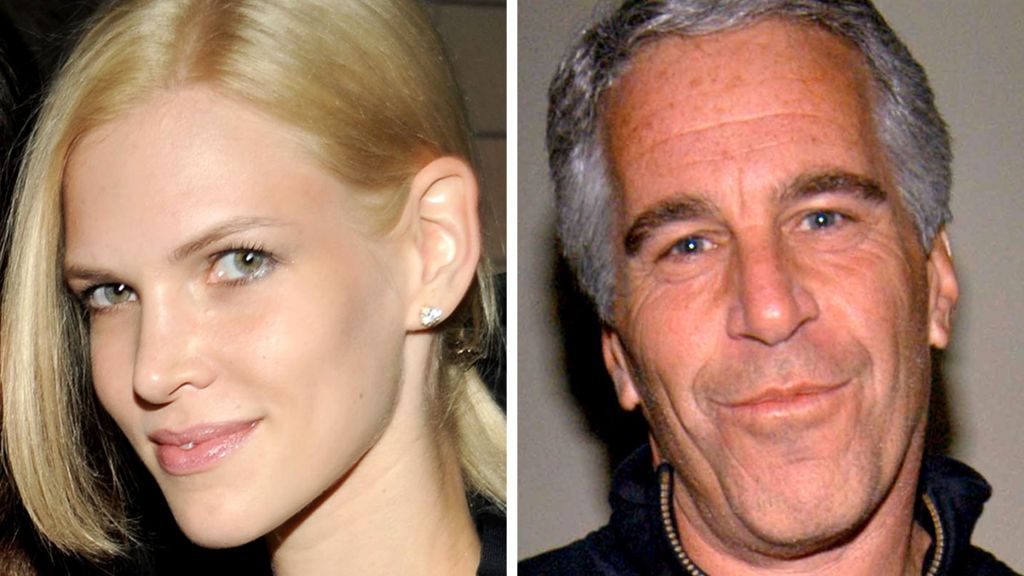
For nearly a decade after Jeffrey Epstein’s death in prison while awaiting sex trafficking charges, one of his closest partners has remained out of the public eye – but new scrutiny of court documents, private emails and first-hand accounts is pulling Nadia Marcinko into the center of ongoing questions about Epstein’s criminal network.
Marcinko, a former Slovakian model who trained as a professional pilot, was Epstein’s primary romantic partner for seven years following the end of his sexual relationship with Ghislaine Maxwell, newly analyzed correspondence from Epstein’s personal files confirms. Their connection began in 2003, when 18-year-old Marcinko, then working for a modeling agency run by Epstein’s close associate Jean-Luc Brunel, was introduced to the 50-year-old financier at a New York birthday party. Brunel arranged Marcinko’s U.S. visa, and Epstein funded Brunel’s agency to the tune of $1 million, creating an immediate power imbalance that would shape their entire relationship.
Born into a stable, upper-middle-class Slovakian family, Marcinko was described by childhood classmates as deeply reserved – a “little grey mouse” who was pushed into modeling as a teenager. Within days of their first meeting, Epstein invited her to his Palm Beach mansion, then to his private Caribbean island Little St. James, and the pair quickly became constant companions. Emails show the pair marked September 17 as their relationship anniversary for years, and by 2009, Epstein acknowledged to a third party that he was “in love with nadia.”
But the warm exchanges in their correspondence are paired with clear evidence of Epstein’s coercive, controlling behavior. He dictated every detail of Marcinko’s life, requiring her to master domestic skills, complete a fixed reading schedule, and get his approval for any item brought into their shared home, according to a 2009 email. In a heavily redacted Department of Justice document released earlier this year, Marcinko (identified by matching testimony details) told investigators Epstein controlled her weight and clothing, forced her to undergo multiple plastic surgeries, and physically abused her – including choking her and throwing her down a flight of stairs. In one archived email, Marcinko herself accuses Epstein of “abusive partner behavior.”
A recurring theme through years of emails is Epstein’s demand that Marcinko recruit other women to satisfy his sexual desires. Marcinko complied with these requests, writing in a 2006 message: “I will do what I can, even though if this is simply about you having sex with someone else, I don’t know how it makes our relationship better. I will try to find girls whenever we are in New York.” The BBC’s review of the files found no direct evidence Marcinko ever recruited underage girls, but legal experts note that deceptive recruitment of adults for sexual exploitation can still qualify as trafficking. Even at the height of her involvement, Marcinko acknowledged her discomfort with the dynamic, writing in 2006: “Since I met you, my life revolves around you, there is nothing else I have and it makes me feel very uneasy.”
During Epstein’s 13-month 2008-2009 prison sentence for a 2008 conviction of soliciting sex from a minor, prison records show Marcinko visited him at least 67 times. That same period, Epstein paid for her to train as a commercial pilot, a skill she pursued enthusiastically, earning multiple certifications and working toward financial independence. After Epstein’s release, their relationship intensified, with emails revealing the pair attempted to start a family together in 2009. They finally split in 2010 after a particularly violent assault, Marcinko told investigators, though she remained connected to Epstein for years afterward: she worked as a co-pilot for his private jet starting in 2012, and Epstein agreed to double her annual income from aviation work as late as 2015.
In a striking turn, Marcinko began cooperating with the FBI’s Epstein investigation in 2018, a year before Epstein’s second arrest and death in prison. In 2022, when her U.S. visa expired, the FBI supported her application for permanent residency, stating in court filings that she had been “recruited, harbored and obtained by Jeffrey Epstein and others for purposes of a coercive sexual relationship.” Since that ruling, she has dropped out of public view, with public records linking her to a New York Zen Buddhist center as recently as 2024. Her legal team has previously stated she is a victim of Epstein’s abuse, working through trauma and plans to speak out publicly to support other survivors one day.
Today, Marcinko finds herself facing new calls for investigation. She was one of four women granted immunity from prosecution as part of Epstein’s controversial 2008 plea deal, and while two of the other women – Sarah Kellen and Lesley Groff – are set to be questioned by U.S. congressional investigators this year, Representative Anna Paulina Luna, a Republican member of the House Oversight Committee, has called for all four women (including Marcinko and Adriana Ross) to be probed, claiming all were complicit in the trafficking of minors.
The case of Marcinko raises a nuanced, critical question that legal experts are still grappling with: Can a person who was a victim of coercive control also be considered an accomplice to crimes committed under that coercion? Bridgette Carr, a clinical law professor at the University of Michigan who specializes in human trafficking victim advocacy, says the key distinction lies in whether a victim was able to escape the perpetrator’s power before committing criminal acts. “The line I draw is whether the victim has ever been away from the power and control of the perpetrator,” Carr explains. “What matters is whether it’s reasonable that [the victim] would believe that that perpetrator [still] has power over them.”
For outsiders, the full scope of the choices Marcinko made during her 15-year association with Epstein can never be fully known, but one 2012 email she sent to Epstein offers a rare glimpse into her own conflicted conscience: “I do not want to be with you, but it upsets me to see you use the same exact patterns to seduce, manipulate, and ultimately control and hurt other girls. I don’t even like them and I actually feel guilty about knowing how they will end up. I know what you are capable of and I will always be protective of you out of pure loyalty and stubbornness, but my conscience is far from clear.” The BBC reached out to Marcinko for comment for this report, and received no response.