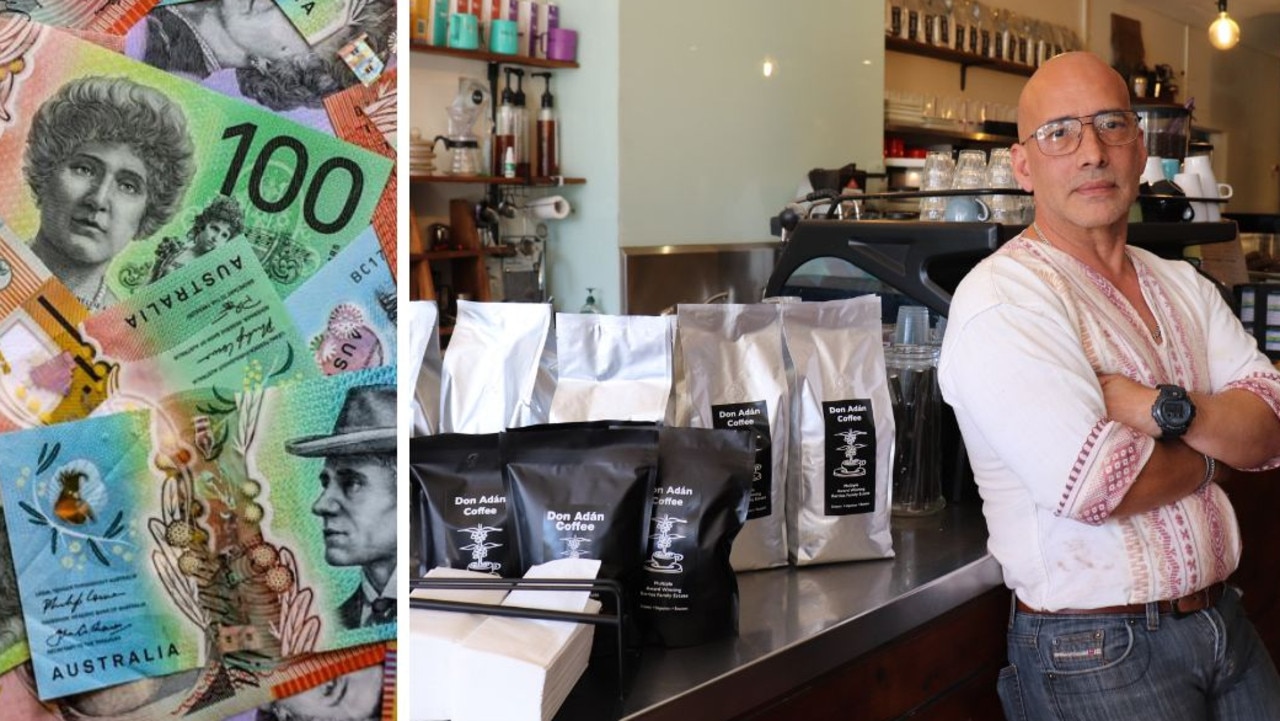
Thirty years after leaving Ecuador to build his coffee legacy in Australia, Gerardo Barrios, owner of Don Adan Coffee, is sounding a stark alarm: small businesses across the country are facing the harshest operating conditions in modern history, and he would never launch his business if he were starting out today.
Barrios’ family ties to coffee stretch back nine generations, all the way to the era of Napoleon III, blending Ecuadorian heritage with Australian local enterprise across his two cafe locations. But even with deep industry roots and loyal community support, cascading cost increases are squeezing already razor-thin profit margins to breaking point.
“Every additional cost matters,” Barrios explained in an interview with NewsWire. “When you’re dealing with rising wages, utilities and supply costs all at the same time – every extra dollar is money that could help a local business grow and employ people.”
Australia’s national minimum wage rose to $26.44 an hour ($1004.90 weekly) starting July 1 this year, a change designed to support working households but one that has added immediate strain to small business cash flow. While economists argue higher wages will boost broader consumer spending, Barrios says the immediate impact for small operators has left almost no breathing room for working capital. “The cash flow for businesses is now almost non-existent,” he said.
Barrios’ experience aligns with the first-ever AMP Bank GO small business cost pressure index, which found overall operating costs for Australian small businesses have surged by almost 25% since the start of the COVID-19 pandemic, with no relief in sight. AMP Bank GO director John Arnott says cost increases will keep climbing through 2027, driven largely by rising wage bills, which account for roughly half of the index’s total weighting.
“Small businesses are caught in the middle. Their own bills keep rising, but their customers are watching every dollar,” Arnott said. “Many have absorbed as much as they can, but there comes a point where those costs have to show up somewhere.” That means Australian consumers should prepare for another round of price increases as struggling operators look to recoup lost revenue.
Arnott noted that public discussion about post-pandemic cost pressures has focused almost exclusively on household budgets, leaving small business struggles largely out of the spotlight. The index was created to fill that gap, he said, and feedback from hundreds of small operators confirms conditions are the worst they have ever seen. Common stories from business owners include laying off staff for the first time in decades, and openly questioning whether they can keep their doors open long-term.
Barrios has been proactive in working with suppliers to negotiate bulk discounts to avoid passing full cost increases to his customers, aiming to keep sales volumes steady while protecting his customer base. “Rather than just raising the price, we have to look at ways that we can maintain high volumes that will make sure that we have consistency of sales,” he explained. “And then we can go to our suppliers and say, look, I’m doing this many coffees. This is how much value I can bring to you. You surely can give me a 5 per cent discount.”
But underlying structural pressures from the pandemic continue to weigh heavily on surviving businesses. Barrios says public perception of small business support during COVID is deeply distorted by the former Scott Morrison government’s JobKeeper program, which delivered $1500 per fortnight to eligible workers to prevent mass layoffs during lockdowns. Official reviews found 38% of the first $70 billion in JobKeeper payments went to businesses that recorded no sales declines, but Barrios points out that payments went directly to workers, not to business owners to cover fixed operating costs.
“I didn’t get JobKeeper, my staff got JobKeeper,” he said. “I had to get loans worth hundreds of thousands of dollars, just to stay afloat, many coffee shops closed… So the ones that stay to stay afloat like me, we have to borrow money. Since we borrowed that money from Covid, the interest rates went up 16 times. So everybody was talking about the mortgage cliff but nobody was talking about the business loan cliff.”
Insurance costs have also emerged as one of the fastest-growing expenses for small businesses, compounding pressure from wages, supply chains, and debt servicing.
Despite the severe challenges, Barrios holds fast to the core community value that local coffee shops bring to Australian life, and has a message for consumers. At his two cafes alone, 20 children can trace their existence back to connections their parents made at his shop, and the business serves as a vital social hub for isolated community members who rely on daily visits for social connection.
“I didn’t want to whinge about rising costs but instead provide a space for my patrons to have a good life together,” he said. “I’m going to provide a space for you to have a good life and all we want you to do is support us. This is the value we bring to the community but we’re going to be one of the very few coffee shops still providing this space as we are disappearing.”