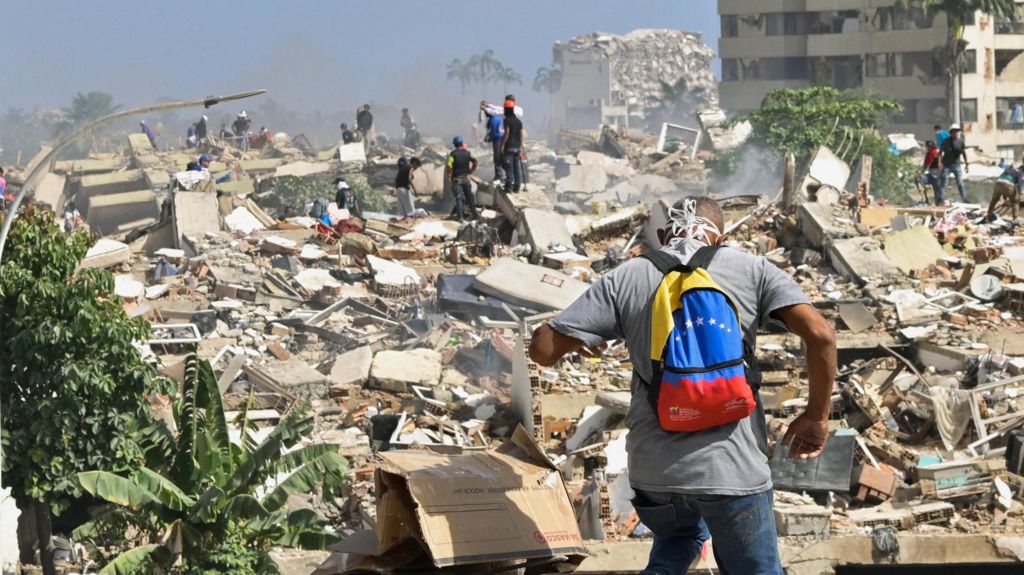
In a devastating geological event that has shaken Venezuela to its core, two massive back-to-back earthquakes struck the nation’s northern regions last Wednesday, leaving a trail of death, destruction, and urgent humanitarian need that has drawn a coordinated global response. The second of the two tremors registered a magnitude of 7.5, marking one of the most powerful seismic events to hit the South American country in more than a century.
Official government updates confirm the disaster has already claimed at least 920 lives, left 3,360 people injured, and left at least 172 individuals still trapped beneath collapsed infrastructure, with hundreds more reported missing. Authorities warn the final death toll is expected to climb as rescue teams work to clear rubble and reach cut-off areas. The coastal state of La Guaira, located just north of the capital Caracas and home to Venezuela’s primary international airport and one of its two largest commercial ports, has borne the brunt of the destruction.
For dozens of families across the hardest-hit region, every passing minute brings a agonizing mix of hope and despair. Natacha Diaz, a resident of La Guaira, is among those clinging to faith as she waits for news of her two daughters, ages 22 and 23, who were working as manicurists inside a collapsed local shopping mall when the quakes hit. “They were with their friends. I just want them to be found. I have faith and hope that they are there,” Diaz told the BBC. “I just want them back with me. They are all I have, please.”
Dozens of structures across northern Venezuela have been reduced to rubble, including multiple hospitals, shopping centers, and residential buildings, with more than 1,000 additional critical infrastructure sites sustaining major damage. Surviving medical facilities have been stretched far beyond capacity, treating injured patients in makeshift outdoor care tents. Long before the disaster struck, Venezuela’s decades-long economic crisis and chronic underinvestment had left the country’s healthcare system severely under-resourced, a gap that has been thrown into sharp relief by the earthquake emergency. “All our hospitals lack supplies, lack medicines, we are not able to provide medical attention to our people in a normal day,” Dr. Pedro Javier Fernandez told the BBC. “Now with this tragedy, the emergency is even bigger and it’s more difficult to face than in other countries.”
Initial rescue efforts were hampered by broken communications links, damaged and blocked roadways, and a critical shortage of heavy equipment and supplies, forcing many first responders and civilian volunteers to dig through debris with their bare hands in a race to pull survivors out. In recent days, hundreds of international search-and-rescue teams have arrived in the country to bolster local efforts, with more personnel and aid en route. A British military flight carrying specialist rescue teams from 14 UK fire services, search dogs, and drone detection equipment departed from RAF Brize Norton on Friday, joining teams already deployed from the United States, the Netherlands, Mexico, and Switzerland. The U.S. has also committed $150 million in humanitarian aid, alongside deploying warships and cargo planes to support relief operations.
Jan Egeland, secretary general of the Norwegian Refugee Council, said international teams on the ground have already witnessed “horrific damage” across the affected regions, noting that Venezuela’s pre-existing crumbling infrastructure left the nation uniquely vulnerable to such a disaster. “Venezuela was ill-prepared and vulnerable in an emergency situation because of its already crumbling infrastructure following decades of underinvestment,” Egeland told the BBC.
Amid the widespread grief and destruction, small moments of hope have lifted morale across the country. In one widely broadcast story on state television, three young siblings were pulled alive from the rubble of a collapsed building in La Guaira, emerging covered in dust after being trapped for days. “Come here, my child, come here,” a rescuer called out to the first child, followed by a young girl, and then the third sibling, who emerged sobbing but alive.
The disaster has also already claimed notable victims, including Andrea, the wife of Venezuelan footballer Héctor Bello, who died while shielding and saving their toddler daughter during the collapse. “I’ll tell her the story of how you saved her, my love – how you gave your own life for our daughter, how you were a brave woman who never abandoned her, even as you took your last breaths,” Bello wrote in an emotional Instagram post. Foreign casualties have also been confirmed: one Portuguese national, two Brazilian citizens, and four Spanish nationals are among the dead, while 106 Spanish citizens remain unaccounted for, per Spanish foreign ministry reports.
Beyond La Guaira, multiple other states across northern Venezuela have felt the impact of the disaster, with the capital Caracas seeing heavy damage in the upscale neighborhoods of Los Palos Grandes and Altamira. More than 214 aftershocks have been recorded since the initial twin quakes, with most concentrated along the northern coastline spanning La Guaira, Aragua, Carabobo, and Falcón.
The earthquake comes at a moment of extreme political uncertainty for Venezuela. Less than six months ago, long-time leftist leader Nicolás Maduro, who had governed the country since 2013, was seized by U.S. forces in Caracas and extradited to New York to face federal drug trafficking charges. Maduro’s ally, former vice president Delcy Rodríguez, stepped into the role of acting president, a move that has been contested by opposition supporters who had expected the U.S. to install opposition leader María Corina Machado to lead the interim government.
Venezuelan opposition leader Leopoldo Lopez, who lives in exile in Spain, described the scale of the devastation as “huge” and said the population remains in “shock.” He criticized the interim government’s inability to mount a timely, large-scale rescue response, but praised the outpouring of grassroots support from Venezuelan civil society. The United Nations has pledged to coordinate the international humanitarian response, with the UN’s humanitarian chief Tom Fletcher saying, “I want people to know in Venezuela that help is coming.”