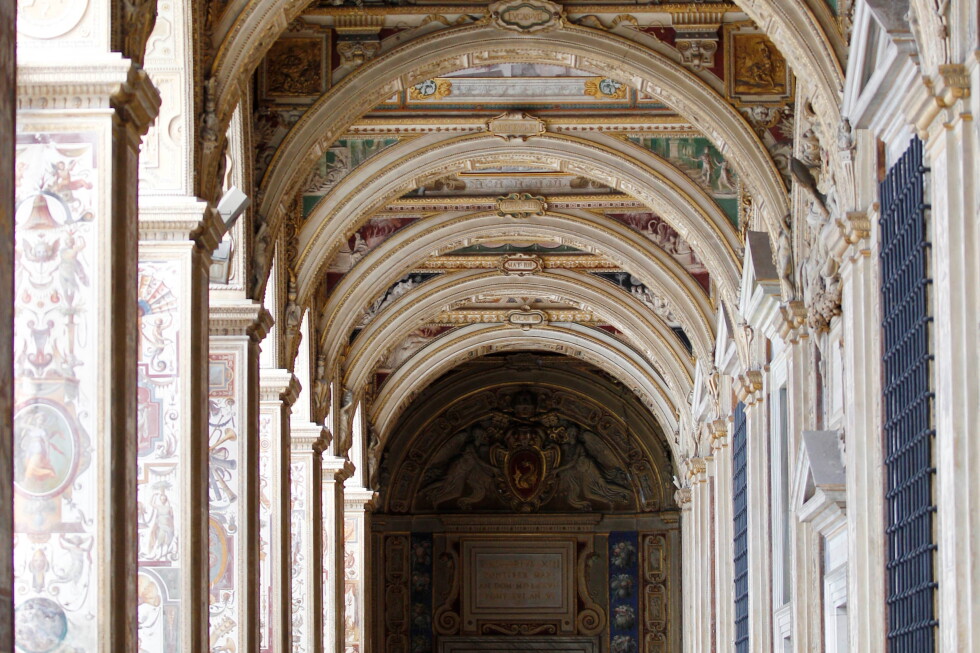
Nestled in the most restricted inner corridors of the Vatican’s Apostolic Palace, a Renaissance masterpiece unseen by nearly all the visiting public is set to receive its first comprehensive conservation effort in more than five centuries. The Raphael Loggia, a 65-meter-long, 4-meter-wide corridor walked exclusively by popes, heads of state, and privileged invited guests, was designed by the iconic Renaissance master Raphael, and Vatican Museums officially launched the five-year, $5.5 million restoration project at a press conference Wednesday.
Widely regarded as one of the pinnacles of Renaissance figurative art, the loggia occupies a sunlit second-floor space overlooking the Apostolic Palace’s San Damaso courtyard. Closed to general tourists, the corridor treats only the lucky few granted audiences with the pope or the Secretariat of State to its sprawling decorative scheme: vivid scenes from both the Old and New Testaments, intricate botanical motifs rendered in vibrant paint and textured stucco, spread across 12 distinct arched bays. Its artistic influence extended far beyond Vatican walls, with full-scale replicas produced by cultural institutions around the world, including a prominent full-scale copy at St. Petersburg’s State Hermitage Museum.
Completed between 1517 and 1519, the loggia stands as one of Raphael’s final commissions for Pope Leo X, a companion project to his better-known, publicly accessible works that draw millions of visitors to the Vatican Museums each year — the Raphael Rooms and his celebrated tapestry series, both of which have been the subject of previous major restoration work. Today, current Pope Leo XIV, who returned to full-time residence in the Apostolic Palace after his predecessor Pope Francis chose to stay elsewhere, traverses the loggia regularly on his way to public and private audiences, with his private apartments located just upstairs from the corridor.
Centuries of neglect and environmental damage have left the masterpiece in a fragile state, restoration leaders explained. Until 1813, the corridor remained open to the elements, leaving the paintings and stucco exposed to rain, wind, and extreme temperature shifts that caused gradual but irreversible decay. Even after windows were installed to close off the space, the enclosed structure trapped heat and humidity, creating conditions that accelerated degradation of the water-soluble pigments Raphael used.
To avoid damaging the fragile artwork, restorers will abandon traditional wet cleaning and chemical solvent methods in favor of a precision-based approach: hand-held lasers will gently clean grime from the stucco and painted surfaces without compromising the original pigments. The project is a collaboration between the Vatican Museums and the New York-based World Monuments Fund, with full financing coming from the Stephen A. Schwarzman Foundation. In total, the foundation is committing more than $14 million to the broader initiative: $5.5 million for the core restoration work, with the remaining funds allocated to digitizing high-resolution images of the loggia to make the hidden masterpiece accessible to the global public, producing a feature documentary following the restoration process, and endowing a permanent art restoration training program at a Swiss university.
In addition to conserving the existing artwork, the Vatican will also replace the loggia’s current arched windows with specialized protective glass that filters out harmful ultraviolet solar radiation, preventing future fading and environmental damage. The Associated Press’ religion coverage, which produced this report, receives support through a collaboration with The Conversation U.S. via funding from the Lilly Endowment Inc., with the AP retaining full editorial responsibility for all content.