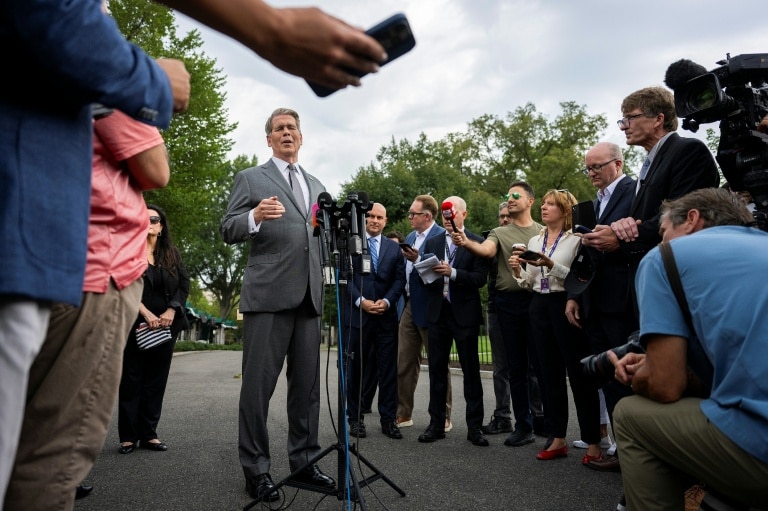
Six months into a grinding, stalemated war between the US-led coalition and Iran, Washington has launched a sweeping new sanctions campaign labeled an “economic asphyxiation” of the Iranian regime, according to an announcement from US Treasury Secretary Scott Bessent on Monday.
Bessent framed the new measures as an “economic D-Day” for Tehran, outlining a strategy to cut off every remaining economic lifeline connecting Iran to the global economy. The plan expands Washington’s secondary sanctions regime, which targets third-party entities that continue to do business with Iran, and carries a stark warning: any country that refuses to join the US-led campaign will face isolation alongside Tehran.
Notably, the announcement did not name specific target countries beyond Iran or lay out a clear timeline for implementation, but it does map out new sanctions coverage that reaches across key sectors of Iran’s economy. Expanded penalties will target Iran’s digital assets, technology trade, gold reserves, aviation industry and commercial shipping networks. The Treasury Department also issued immediate sanctions against 60 individuals, companies and vessels accused of supporting Iran’s oil revenue generation, weapons procurement and cyber activity. These sanctioned entities are spread across the globe, with locations including the United Arab Emirates, Hong Kong (China), Singapore and multiple European states.
In a sharp escalation of financial pressure, Bessent vowed that any entity found facilitating money laundering on Iran’s behalf will be cut off from the US dollar financial system, a penalty that effectively excludes most major global institutions from transacting with the world’s reserve currency. He added that President Donald Trump has been personally engaging with world leaders via phone, urging them to sever economic interactions with Tehran. When asked whether major Chinese banks, which have historically facilitated Iranian oil purchases, would face penalties under the new regime, Bessent replied that “no one is above the reach of US sanctions.”
Iran has already pushed back forcefully against the new measures. Deputy Foreign Minister Kazem Gharibabadi framed the US’s announcement as an implicit admission of military failure, questioning why Washington would need to launch what it calls the “largest financial invasion in history” if it had achieved its war objectives.
“Is this a victory or an admission of America’s defeat?” Gharibabadi said in a social media post ahead of the US announcement, warning third countries against aligning with Washington’s campaign.
The current war, launched by the US and Israel in February, was initially justified over concerns about Iran’s nuclear program, but fighting and political focus have quickly shifted to the Strait of Hormuz, the strategic chokepoint that carries roughly a fifth of the world’s daily oil and gas supplies. Since the outbreak of war, Tehran has imposed a full blockade on most traffic through the strait — a move it never took in pre-war years — that has driven up global energy prices and fueled inflation, creating significant domestic political pressure on Trump ahead of November’s midterm elections.
Iran has a long history of evading crippling Western sanctions: for decades before the current war, Tehran maintained steady oil exports (mostly to China) via complex, opaque international financial networks. But data from maritime analytics firm Kpler shows that the US naval blockade around Iran has cut Iran’s daily oil exports through the Strait of Hormuz from 2 million barrels pre-war to just 400,000 barrels by mid-August.
For ordinary Iranian citizens, the new sanctions are expected to amplify already devastating economic hardship. Years of rampant inflation have already pushed millions of Iranians into financial precarity, sparking massive anti-government protests late last year and early this year. In an interview with AFP, Sarah Hassanbeigi, a 32-year-old Tehran-based pharmacist, captured the widespread public exhaustion: “I don’t think people can really take this much longer.”
In a separate change to policy, the US also announced it would suspend all sanctions exemptions for cross-border educational payments between the US and Iran, cutting off another remaining financial link between the two countries.
Despite the escalating economic pressure, diplomatic efforts to end the conflict continue to move forward. Last week, Iranian President Masoud Pezeshkian — a figure widely considered a relative moderate within the Iranian political system — stated that Tehran is in a position of strength and should seek to end the war immediately. Pezeshkian’s comment came shortly after Supreme Leader Mojtaba Khamenei appointed hardline figures to key national security posts, signaling a continued split in elite perspectives on the conflict.
On Monday, a Pakistani delegation led by army chief Asim Munir traveled to Tehran to meet with Iranian Parliament Speaker Mohammad Bagher Ghalibaf, who also serves as Iran’s chief negotiator for peace talks. Pakistan has previously emerged as a leading mediator in conflict negotiations, helping broker an April ceasefire that ultimately collapsed. As a major trading partner of Iran, Pakistan could now face secondary sanctions penalties under the new US framework. Following the Pakistani visit, Oman’s foreign minister is scheduled to travel to Iran on Tuesday for talks focused on reaching a new agreement to regulate commercial passage through the Strait of Hormuz.