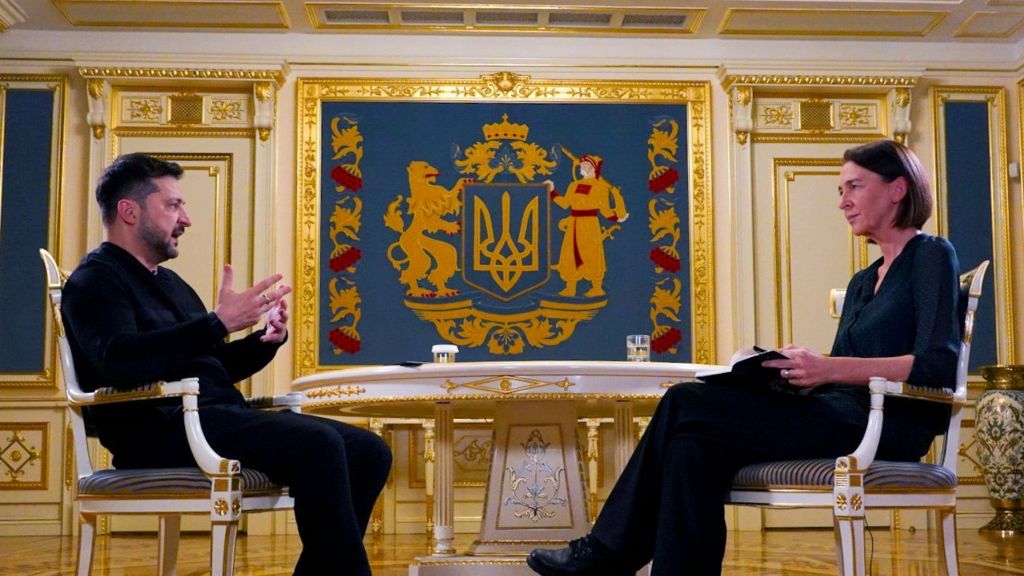
In a wide-ranging, unvarnished interview conducted from his central Kyiv office, Ukrainian President Volodymyr Zelensky laid bare mounting frustrations with U.S. policy toward his country, warning that holdups in critical anti-ballistic missile deliveries are directly costing Ukrainian civilian and service member lives, while Washington’s current approach to ongoing Russia-Ukraine peace negotiations lacks sufficient pressure on the invading Kremlin regime.
A particularly striking point of contention Zelensky highlighted was recent social media activity from former U.S. president and current sitting U.S. leader Donald Trump, who shared a photograph of himself embracing Russian President Vladimir Putin with the caption labeling the long-time authoritarian leader as his “friend.” Speaking directly in English during the BBC sit-down, Zelensky did not mince words on the optics: “Of course it’s up to the President of the United States, but… it’s strange. He’s an aggressor, and a killer…He can’t be a friend. Just cannot be.” Zelensky went on to draw a direct historical parallel, noting that such a display of camaraderie with a leader waging a full-scale unprovoked invasion would be equivalent to publicly embracing Adolf Hitler during the Second World War.
The sharp public remarks mark a notable shift in Zelensky’s carefully calibrated public posture toward the U.S. following a tense, high-stakes face-to-face encounter with Trump in the Oval Office earlier in 2025. Since that meeting, two U.S. appointed envoys have led mediation efforts to broker a formal peace deal to end five consecutive years of devastating full-scale Russian incursion, but Zelensky and his administration have repeatedly observed that the U.S. negotiating team appears far more aligned with Moscow’s core demands than Kyiv’s foundational red lines.
The most recent round of diplomatic talks, hosted in Abu Dhabi earlier this month, yielded no tangible forward progress at all. When asked to characterize the outcome of the closed-door sessions, Zelensky offered a grim assessment: “The more we know, the more problems.” Negotiators are currently scheduled to reconvene for a new round of talks in December, but critical structural uncertainties hang over the upcoming sessions. Trump claimed in a Thursday post on his Truth Social platform that he had personally urged Putin to “pull back all military aggression against territories throughout Europe” during a bilateral summit held in China the previous week, and expressed confidence that a finalized Ukraine peace deal was “a strong possibility.” But public statements out of the Kremlin show Russian negotiators have fully reverted to their original, uncompromising hardline positions on every core negotiating point, and Zelensky confirmed there is no clarity as of yet whether European diplomatic representatives will even be granted a seat at the December talks table, despite earlier public assurances from U.S. envoys that European stakeholders would be included.
Against this fragile diplomatic backdrop, Ukraine’s civilian population faces an escalating, unprecedented wave of deadly Russian aerial assaults. Daily ballistic missile and jet-powered drone strikes targeting critical energy infrastructure, road bridges, and dense urban population centers have pushed civilian casualty rates to their highest level since the full-scale invasion began. Round-the-clock air raid alerts have become a draining, constant feature of daily life across the country, as residents brace for what Zelensky warns will be a brutal, high-risk winter of sustained attacks intended to break Ukrainian morale. Many Kyiv residents have already fled the capital ahead of the cold season, and countless local small businesses have shuttered permanently, as rolling blackouts and repeated strikes on logistics networks have driven operating costs far beyond sustainable levels. Recent Russian attacks on bridges spanning the wide Dnipro River appear to be a deliberate tactic to split the capital in two and cut off critical supply lines. “[Russia] wants us to run away, of course,” Zelensky told the BBC. “People can go, but we will try to defend our capital in any way. We need our capital. Without a capital, you don’t have a country.”
While Ukrainian air defense forces have improved their interception rate of Russia’s fastest low-flying drones to roughly 70%, Zelensky emphasized that the country faces a catastrophic shortfall of interceptor missiles designed to take out incoming ballistic weapons, a gap he says is directly exacerbated by U.S. delays in delivering promised Patriot air defense systems. “It’s a pity they made a focus on the Middle East and they help them more… It’s a pity. We have huge questions with this,” Zelensky stated plainly. “The deficit of these missiles – that is people’s lives.” He also confirmed that U.S.-owned Starlink satellite internet service, and its military-grade counterpart Starshield, remain restricted across Russian-occupied swathes of Ukrainian territory, a technical barrier that has severely hampered the effectiveness of Ukrainian defensive drone units, who report their interceptor drones can no longer keep pace with incoming Russian Shahed attack drones, allowing the weapons to penetrate deep into unprotected Ukrainian territory unchallenged. When pressed to identify which party imposed the restrictions, Zelensky said accountability was muddled: “Technically SpaceX, politically – I don’t know, I really don’t know. It’s like… ping pong. We are asking one side, they say it’s the other.”
Zelensky also defended Ukraine’s recent wave of expanded long-range strikes on Russian military assets, including oil refineries, and a targeted attack that sank the Russian warship Merkury docked in eastern Libya earlier that week. The attack drew public criticism from Italian Prime Minister Giorgia Meloni, who warned the strike risked spilling the Ukraine conflict into the broader Mediterranean region, a development she called unacceptable. Zelensky pushed back, describing the Merkury as an “absolutely fair goal,” and confirmed that all long-range Ukrainian strikes are fully coordinated with Ukraine’s international partners, though he declined to share further operational details. Throughout the interview, Zelensky repeatedly urged the United States to move past its stated posture of neutrality in the conflict, and to lean into its global standing as a powerful, respected nation to act as a genuine, forceful advocate for a just peace that holds Russia accountable for its aggression. “When you try to be very neutral with the aggressor… it means you support victims and you support also aggressor. It’s not right,” he argued. U.S. administration officials have previously defended their neutral stance as a necessary prerequisite to brokering a long-term, durable peace agreement that both sides will honor.