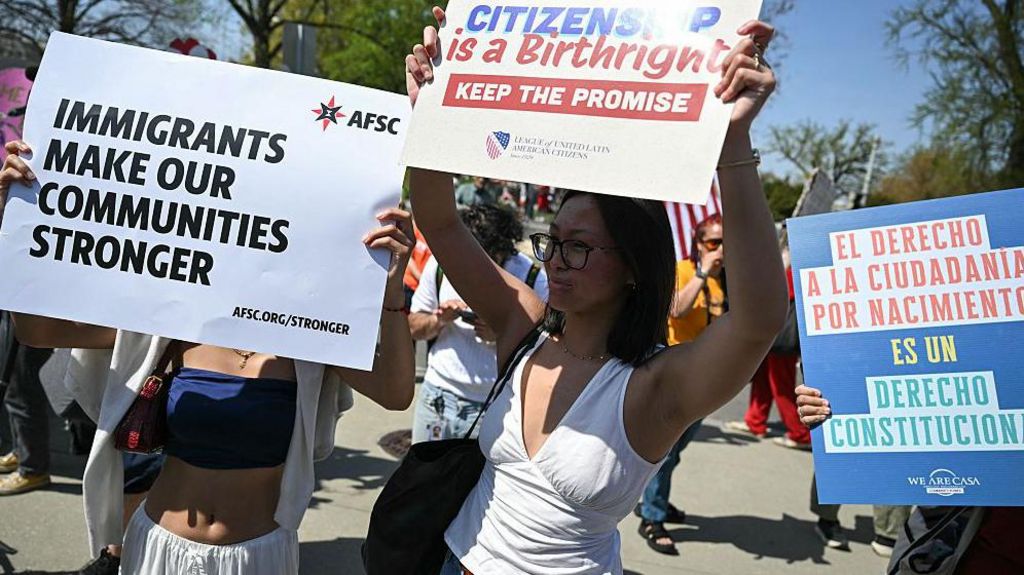
In a landmark decision that has reshaped the trajectory of U.S. immigration policy and dealt a critical setback to former President Donald Trump’s long-held policy goals, the U.S. Supreme Court has voted 6-3 to reaffirm that all children born on U.S. soil hold a constitutional right to birthright citizenship, directly rejecting Trump’s bid to overturn the 150-year-old established practice.
Writing for the court’s majority, Chief Justice John Roberts anchored the ruling in the text and intent of the 14th Amendment, clarifying that even children born to parents who are in the United States either unlawfully or on a temporary status qualify as full U.S. citizens from birth. “Citizenship, then and now, was the right to have rights – to freely participate in our political community,” Roberts wrote in his opinion. “The Framers of the Fourteenth Amendment extended that promise to ‘every free-born person in this land’, and we keep that promise today.” This longstanding policy has been a cornerstone of U.S. immigration and citizenship law since the 14th Amendment was ratified in 1868, following the U.S. Civil War, and has been repeatedly upheld by previous Supreme Court rulings over the decades.
Trump had pushed to curtail birthright citizenship via executive action, arguing that the children of undocumented immigrants and temporary visa holders do not meet the 14th Amendment’s requirement of being “subject to the jurisdiction thereof” and thus are not eligible for automatic citizenship. The case carried such high stakes for the president that he made a rare public appearance at the Supreme Court in April to observe the oral arguments.
Following the ruling’s release, Trump reacted on his social platform Truth Social, calling the outcome “too bad” and pledging to continue his campaign to end birthright citizenship through congressional legislation. Arguing that a full constitutional amendment is not required to enact the change, Trump urged Congress: “Congress should today start work on ending expensive, and unfair to our country, birthright citizenship.”
The ruling split the nine-member court sharply along ideological lines. Three justices – Clarence Thomas, Neil Gorsuch, and Samuel Alito – issued dissenting opinions. Thomas argued that the 14th Amendment, originally drafted to guarantee citizenship for formerly enslaved people, was being misappropriated for modern political goals, noting that the freed slaves the amendment was intended to protect were already Americans with no conflicting foreign allegiance. Alito called the ruling a “serious mistake,” claiming it grants citizenship to nearly anyone born in the U.S. even if their parents traveled to the country specifically to give birth before returning to their home country.
Senior White House advisor Stephen Miller, a leading architect of the Trump administration’s restrictive immigration policies, echoed the dissent’s frustration in a post on X, labeling the ruling “one of the most destructive and outrageous decisions” in the Supreme Court’s history. “American citizenship is not the birthright of the world,” Miller wrote. “No provision of the Constitution can be read to require our national self-obliteration.”
Meanwhile, civil rights groups and immigration advocates across the country have celebrated the decision as a major victory for equal rights and longstanding constitutional principle. Dariely Rodriguez, chief counsel at the Lawyers’ Committee for Civil Rights Under Law, noted that the ruling “solidifies what we have known to be true for over a hundred years. Anyone born on American soil, regardless of the legal status of their parents, is born an American citizen. We have endured an incredible test of our collective will as a nation and have prevailed.” BBC senior political correspondent Gary O’Donoghue has characterized the decision as a defining legal and political defeat for Trump’s immigration agenda.