Global financial markets saw mixed trading on Monday, with U.S. equities reversing early losses to close higher as hopes of a diplomatic breakthrough between Washington and Tehran cooled runaway crude oil prices. The upward momentum on Wall Street followed comments from former U.S. President Donald Trump claiming that Iranian officials had reached out to express an urgent desire for a negotiated settlement, just days after weekend discussions in Pakistan ended without any tangible agreement.
Crude oil prices, which had spiked back above the $100 per barrel threshold after the U.S. tightened its blockade on Iranian energy imports, pulled back from their intraday highs by the end of the trading session. Both benchmark Brent North Sea crude and West Texas Intermediate finished the day higher but below the psychologically important $100 mark, settling at $99.36 and $99.08 per barrel respectively.
“The market is betting that Trump will get some sort of a deal,” noted Peter Cardillo, chief market analyst at Spartan Capital Securities. Even as Trump issued a stark warning that any Iranian patrol boats approaching U.S. naval forces enforcing the blockade would be destroyed — defying growing international calls for a ceasefire — investors latched onto his signal that Tehran is seeking to de-escalate.
Shortly after Trump’s midday comments from outside the Oval Office, major U.S. indices picked up clear upward momentum. The broad S&P 500 closed 1.0 percent higher at 6,886.24, the Dow Jones Industrial Average added 0.6 percent to finish at 48,218.25, and the tech-heavy Nasdaq Composite gained 1.2 percent to close at 23,183.74.
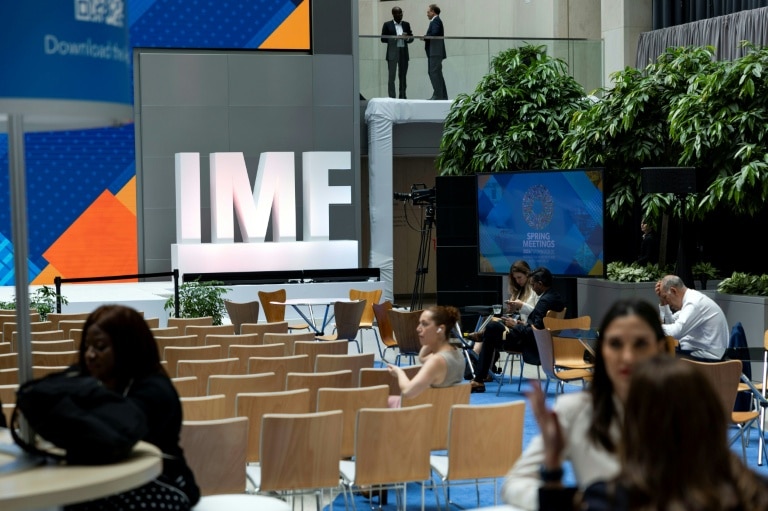
Analysts at Briefing.com said the rally reflects growing market confidence that an end to the US-Iran conflict could be imminent, which would remove a major headwind for global equities. However, lingering risks of sustained inflation and a sharp global economic slowdown are expected to take center stage this week as top finance officials and central bankers gather in Washington for the annual spring meetings of the International Monetary Fund and the World Bank.
Last Friday, official U.S. data showed annual consumer inflation accelerated to 3.3 percent in March, the highest reading since May of last year, putting additional pressure on the Federal Reserve to balance price stability and growth. Russ Mould, investment director at UK-based wealth manager AJ Bell, pointed out that talk of stagflation has reemerged as geopolitical turmoil threatens to suppress global output while pushing up energy and food prices.
Unlike the uptick on Wall Street, most major Asian and European markets ended the session in negative territory. London’s FTSE 100 slipped 0.2 percent, Paris’ CAC 40 fell 0.3 percent, Frankfurt’s DAX dropped 1.3 percent, Tokyo’s Nikkei 225 declined 0.7 percent, and Hong Kong’s Hang Seng Index lost 0.9 percent. Only Shanghai’s Composite index posted a marginal 0.1 percent gain.
David Morrison, senior market analyst at Trade Nation, observed that reopening the Strait of Hormuz — a critical global energy chokepoint — remains the key prerequisite for a sustained rally in risk assets. Even so, many traders hold the conviction that the conflict will conclude sooner rather than later: futures contracts for crude oil deliveries in the second half of the year are currently priced well below spot market rates, indicating expectations that reduced geopolitical risk will bring down energy costs.
“As far as oil traders are concerned, this war may be in its seventh week, but it should be resolved by summer,” Morrison said.
Still, European leaders are bracing for long-term economic fallout from the energy shock. Friedrich Merz, Chancellor of Germany — Europe’s largest economy — warned on Monday that the impacts of the conflict will be felt “for a long time to come, even after it is over”, as his administration unveiled new relief measures including a temporary cut to fuel taxes.
In central European political news that moved local markets, Hungarian stocks jumped 5 percent on Monday after conservative opposition leader Peter Magyar’s Tisza party secured a landslide majority in Sunday’s parliamentary elections, ending 16 years of rule by Viktor Orban. The election result paves the way for improved relations between Budapest and the European Union, and economists at ING predict the new pro-EU government could soon set a target date to adopt the euro.
“If timed perfectly, this could boost market confidence and give the Tisza party more time to work on the Hungarian economy with some tailwinds,” ING analysts wrote in a recent research note.