In a sudden, high-profile shift to long-planned regional military planning, the United States and South Korea have announced an early end to their annual joint defense exercises, cutting the training schedule by roughly one week following direct intervention from former US President Donald Trump. Trump’s order to scale back the drills, which he called “inappropriate and hostile,” has reshaped diplomatic dynamics on the Korean Peninsula just weeks before key US elections, and drawn mixed reactions from regional analysts and North Korean officials.
Trump first made his intervention public on social media platform Truth Social this past Sunday, just one day before the Ulchi Freedom Shield exercises were set to kick off. The former president argued that the drills were an unnecessary provocation of North Korea, noting that he maintains a positive, constructive personal relationship with North Korean leader Kim Jong Un. In his comments, Trump framed the curtailment as a step that makes the entire region “much safer” through diplomatic outreach, rather than military posturing.
Even before the early end was announced, Pyongyang’s state-controlled media released a sharp condemnation of the drills on Wednesday, framing the annual exercises as the “most immediate and open threat” to both North Korean sovereignty and broader regional security. Notably, the commentary made no mention of Trump’s order to scale back the training, or his stated interest in restarting bilateral talks with Kim Jong Un — a choice that regional experts say is a deliberate diplomatic tactic.
Shortly after North Korea’s statement was released, South Korea’s Joint Chiefs of Staff confirmed that the drills would conclude this Friday, rather than the originally scheduled end date of August 27. In an official statement, the Joint Chiefs said, “We have decided to adjust the UFS exercise period to run from the 17th to the 21st,” adding that the change came “at the suggestion of the US side.”
The US Pentagon clarified in its own response that the revised drills are “substantially reduced” in scope, but maintained that the truncated schedule still preserves essential combat readiness for both US and South Korean forces, with “no degradation to US training objectives.” The Ulchi Freedom Shield exercises, which have been held for decades, are designed to prepare allied forces for a potential offensive from North Korea, and were originally structured in two phases. The first phase, focused on defensive operations against potential North Korean incursions, was already scheduled to end Friday. The second phase, which centered on planning for allied counteroffensive operations, was set to run from August 24 to 27, and has now been fully scrapped.
A senior South Korean military official told Agence France-Presse that the sudden change to the long-planned exercise schedule is viewed as “unusual” by Seoul’s defense establishment. North Korea, which has developed an operational nuclear weapons program, has repeatedly decried the joint drills for decades, framing them as a covert rehearsal for a full-scale invasion of the North.
Regional experts say North Korea’s choice to ignore Trump’s order in its official statement is a calculated strategic move. Hong Min, a senior researcher at the Korea Institute for National Unification, explained to AFP that Pyongyang is deliberately acting “as if completely unaware of” Trump’s comments. Hong noted that acknowledging the US move would imply a degree of mutual understanding between the two sides, while feigning ignorance allows North Korea to keep the issue of joint exercises as a key bargaining chip for any future negotiations with Trump.
Seoul’s presidential office attempted to ease tensions earlier this week, releasing a statement affirming that the drills do not reflect “any intention to attack North Korea or escalate tensions on the Korean peninsula.” Trump has repeatedly claimed that his personal rapport with Kim Jong Un has made the region more stable, and confirmed earlier this month that Kim has responded to his outreach for new talks, describing the initial exchanges as “very positive” — though he has offered no further details on the content of the communications.
Many regional foreign policy analysts speculate that the push to cut drills and restart talks is tied to upcoming November US elections, with Trump seeking a high-profile foreign policy win to burnish his diplomatic legacy. The Wall Street Journal reported Tuesday, citing unnamed senior US officials, that Trump has directed his aides to arrange a new meeting with Kim Jong Un as early as this autumn.
Park Won-gon, a professor of international relations at Ewha Womans University, told AFP that scaling back the joint exercises improves the odds of successful US-North Korea dialogue. “The suspension of joint exercises has always been a prerequisite for North Korea to engage in dialogue with the US,” he explained.
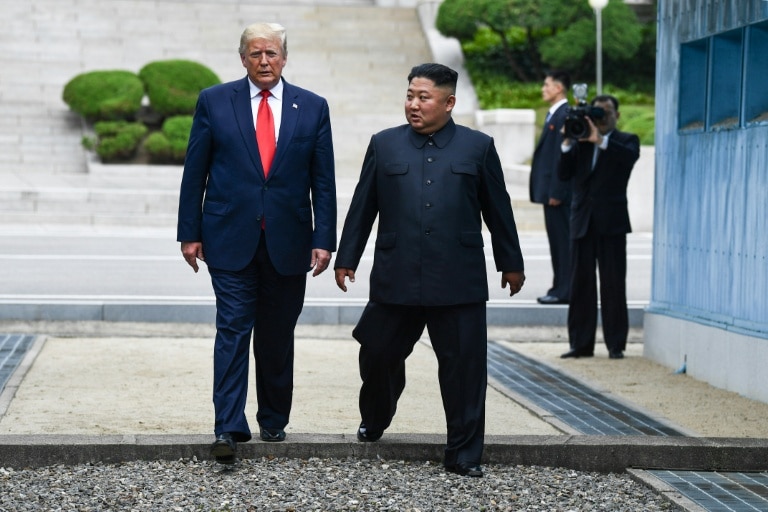
Trump and Kim held three historic in-person summits during Trump’s first term in the White House, but no formal talks have been held since Trump began his second term. The US currently stations roughly 28,500 troops in South Korea, a security commitment that dates back to the 1950-1953 Korean War, which ended in an armistice rather than a formal peace treaty, leaving the Korean Peninsula technically divided. Trump has repeatedly criticized longstanding US alliance commitments in the region, raising repeated doubts about Washington’s commitment to East Asian security and causing unease among regional US partners.