Escalating tensions amid a months-long standoff in the strategic Strait of Hormuz, the United States has launched sweeping new punitive measures against Iran, with senior administration officials openly framing the campaign as an effort to economically asphyxiate Tehran’s ruling regime.
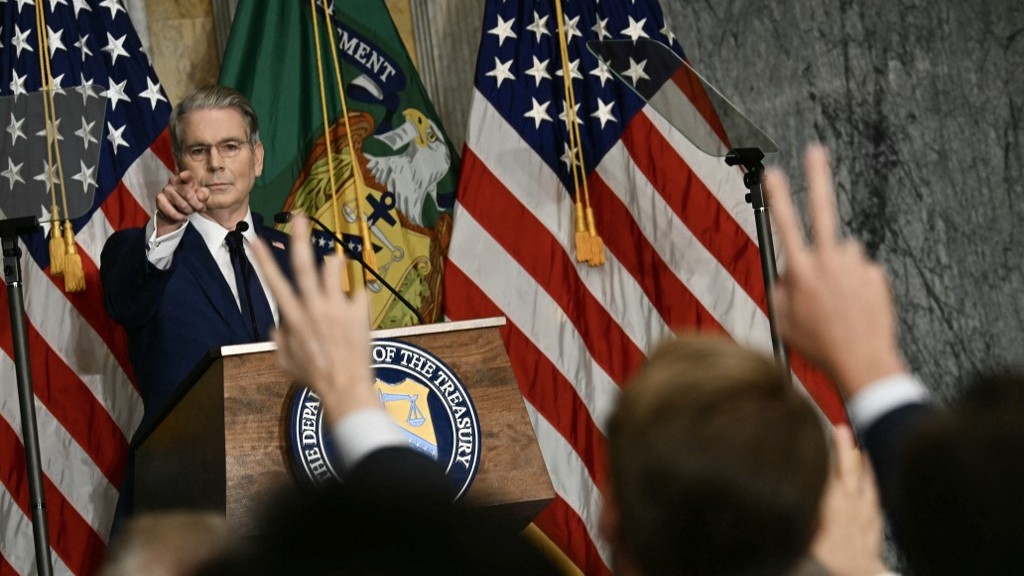
Speaking to reporters in Washington D.C. on Monday, U.S. Treasury Secretary Scott Bessent laid out the details of what the Trump administration has dubbed “Operation Economic Outcast”, which the official described as an “economic D-Day” aimed at ending rather than simply containing the Iranian threat. Bessent stated that the operation eliminates all but two paths forward for Iran: full global diplomatic and economic isolation that leaves the country with only a subsistence-level economy, or a negotiated return to normal engagement that allows Iran to re-integrate into the global economic system. “America is no longer managing the Iranian threat. We are ending it,” Bessent emphasized.
To eliminate avenues for sanctions evasion, the Treasury Department has implemented what it calls a “zero leakage approach”, which involved mapping every smuggling network, financial facilitator, and trade node that Iran has previously used to export oil and skirt international restrictions. President Donald Trump has also personally placed direct calls to global heads of state to request that they cut all economic and commercial ties with Iran, putting additional pressure on third countries to comply with the new measures.
The aggressive new policy has already sparked sharp international pushback. On Tuesday, China, one of Iran’s most critical economic and strategic partners, issued a formal warning that it will “firmly defend” its own legal and commercial interests. Data from analytics firm Kpler shows that prior to the outbreak of the ongoing Iran conflict, more than 80% of Iranian crude oil exports were destined for Chinese markets. Chinese Foreign Ministry spokesperson Lin Jian condemned the new measures as illegitimate “economic warfare”, arguing that the punitive approach will not resolve regional disputes. Instead, Lin said the policy stokes unnecessary tensions and conflict, creates harmful cross-border spillover effects, undermines the stability of the global economic and financial system, and violates the lawful rights and interests of countries unrelated to the standoff.
The months-long on-again-off-again conflict between the U.S. and Iran, which began in late February, has already taken a measurable toll on global energy markets and commercial shipping. New shipping data reveals that just two commercial vessels passed through the Strait of Hormuz on Monday, marking the lowest daily traffic recorded since early May. According to ship-tracking firm Kpler, both vessels were traveling from the Gulf of Oman into the Persian Gulf, comprising one very large crude carrier and one very large liquefied gas carrier. This daily total represents a dramatic drop from the 14-vessel 10-day daily average for the strategic waterway, through which roughly a fifth of the world’s daily oil consumption transits.
Preliminary data from second ship-tracking firm Vortexa puts Monday’s total oil flows through the strait at 5 million barrels per day, down from the seven-day moving average of 6 to 7 million barrels per day recorded as of August 23.
Domestically, the new sanctions have drawn sharp criticism from U.S. political opponents, who argue the aggressive move comes as the Trump administration faces major setbacks in its military campaign against Iran, and that American consumers are already bearing the cost of rising energy prices driven by regional conflict. President Trump and the ruling Republican Party are widely expected to suffer major losses in the November midterm congressional elections, with polling tying widespread voter discontent directly to the economic fallout of the Iran conflict, which has driven up gasoline prices for U.S. households.
Democratic U.S. Senator Chris Murphy issued a scathing rebuke of the new sanctions on Monday, arguing that American citizens are paying “a huge, huge cost” for the administration’s failed policies. In a series of posts on social platform X, Murphy called the “economic D-Day” framing nothing more than desperate political window dressing. He argued that Iran has gained the upper hand in the ongoing conflict, that the Trump administration has failed to achieve its core military objectives, and that Tehran now maintains effective control over the Strait of Hormuz while U.S. military resources, including critical munitions stockpiles, have been severely depleted. “The bottom line: Trump lost the military campaign. And now he’s desperate so in his humiliating defeat, he’s selling this fake economic pressure to keep up the impression we are still fighting,” Murphy wrote. “But the war is basically over. Tragically, Iran won. This is all window dressing.”
This independent reporting was originally published by Middle East Eye, which provides dedicated, unrivaled coverage of the Middle East, North Africa, and surrounding regions.