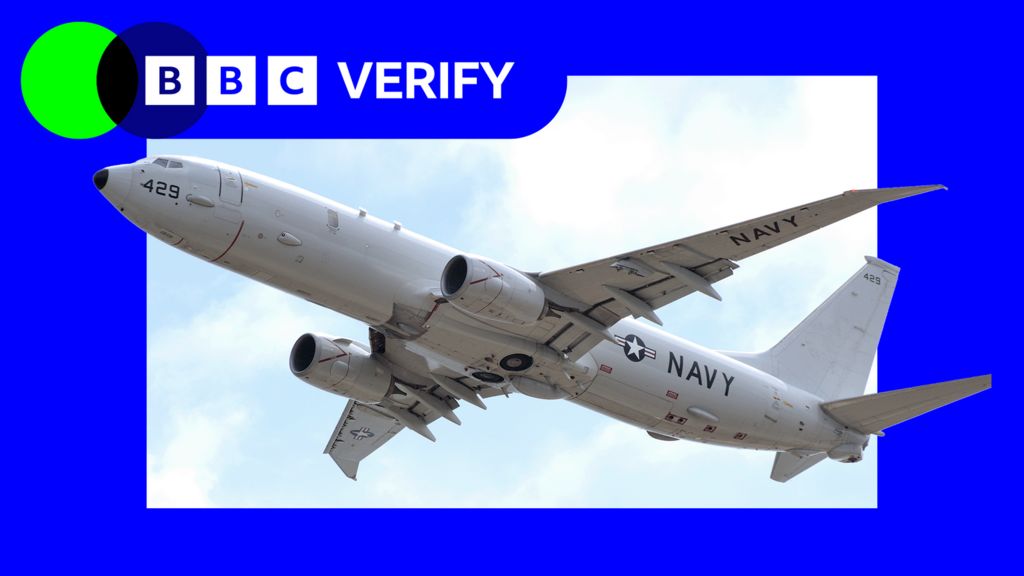
In a deliberate show of pressure targeting Cuba’s communist government, the United States military has openly broadcast the position of its surveillance aircraft operating near the island via public plane-tracking platforms, in a move that comes as bilateral tensions between the two nations surge to multi-year highs. Analysis of open flight data from Flightradar24 conducted by BBC Verify confirms that since May 11, at least five U.S. Navy P-8A Poseidon surveillance planes and three MQ-4C Triton surveillance drones have conducted regular operations in Caribbean airspace close to Cuba, with some missions bringing the aircraft within just 50 miles (80 kilometers) of the island’s coastline.
Military aircraft do not always broadcast their position during all stages of flight, meaning public flight tracking data cannot capture the full scope of U.S. surveillance activity off Cuba’s coast. This stepped-up deployment of intelligence-gathering assets follows a sharp escalation of tensions in recent months, after Washington imposed a de facto oil blockade on the Caribbean island nation. Recent reporting from news outlet Axios has further stoked friction, claiming Havana has obtained drones capable of striking the U.S. mainland. Cuba’s foreign minister has rejected the claim, stating the country “neither threatens nor desires war” and accusing Washington of constructing a “fraudulent case” to justify military intervention.
In a direct address to the Cuban people delivered on Wednesday, the anniversary of Cuba’s independence from the United States, U.S. Secretary of State Marco Rubio framed a “new relationship” for the Cuban public, blaming the island’s “unimaginable hardships” on its communist leadership rather than the U.S.-led fuel blockade. Security analysts say the intentional decision to keep flight transponders active — making the missions visible to the public — is a core part of the U.S. strategy. UK-based drone expert Dr. Steve Wright notes that the move is almost certainly deliberate, designed to send a clear signal that the U.S. maintains constant surveillance to sustain its pressure campaign.
The ongoing oil blockade has already triggered a severe humanitarian and economic crisis on the island, with widespread fuel shortages sparking rolling national power blackouts and small-scale public protests. U.S. President Donald Trump has ramped up pressure on Havana further, calling on the Cuban government to “make a deal” and threatening that the U.S. could intervene in the country just as it did in Venezuela earlier this year, when it captured sitting President Nicolás Maduro.
BBC Verify’s tracking of the flights details the pattern of surveillance operations: on May 11, one P-8A Poseidon reached the 50-mile mark off southern Cuba, continuing operations into the following day when it flew north of Havana before returning to its home base in Jacksonville, Florida. On May 15, two MQ-4C Triton drones carried out operations off southern Cuba, following a flight path nearly identical to one previously used by a P-8A Poseidon.
Mark Cancian, a retired U.S. Marine Corps colonel and senior adviser at the Center for Strategic and International Studies (CSIS), told BBC Verify that the repeated, consistent flight routes are primarily intended to spot incoming fuel ships approaching Cuba from the south, with a secondary focus on vessels approaching from the north. He emphasized that none of the surveillance flights have entered Cuban airspace over land, so the operations do not represent preparation for a full-scale invasion. Cancian also added that the increased frequency of the missions is almost certainly not routine, as the U.S. military has a limited number of P-8A and MQ-4C assets available for deployment globally.
To contextualize the current surge in activity, BBC Verify compared recent data to operations between February 1 and 7 of this year, when only one P-8A flew near Cuba, with no comparable MQ-4C Triton activity recorded off the island’s coast. A U.S. Air Force RC-135V Rivet Joint reconnaissance aircraft did carry out two passes near the island during that February period, but operations were far less frequent than they have been since mid-May.
Wright echoed the broader assessment that the surveillance is targeted at preventing Venezuela — a key ally of Cuba — from breaking the blockade and shipping fuel to the island. Analysts from defense intelligence firm Janes reached the same conclusion, noting that there has been a general uptick in U.S. intelligence, surveillance and reconnaissance sorties near Cuba since February. “The fact that these flights are visible through open-source tracking tools suggests they are intended to deter attempts to break the oil blockade and apply pressure on the Cuban government,” Janes told BBC Verify.