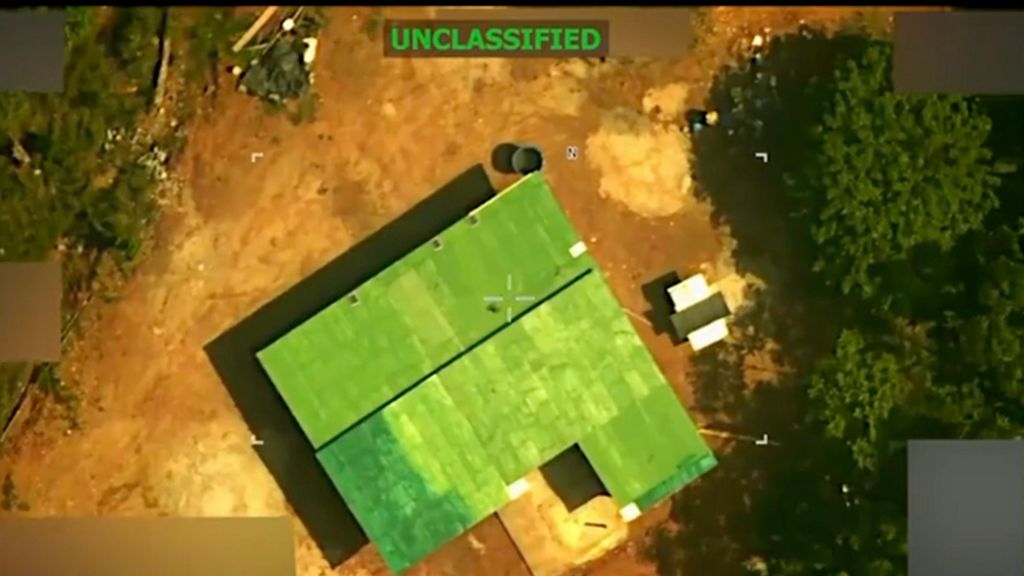
In a Wednesday announcement made via his Truth Social platform, former and current U.S. President Donald Trump confirmed that U.S. military forces have eliminated Héctor Rusthenford Guerrero Flores — widely known as Niño Guerrero, the long-serving leader of Latin America’s most feared transnational criminal syndicate Tren de Aragua — in a targeted airstrike.
“At my direction, the United States Southern Command delivered a swift and lethal kinetic strike to successfully execute Niño Guerrero,” Trump wrote in his social media post. Accompanying the announcement was video footage appearing to capture the strike itself, which shows a green two-story building and an adjacent outbuilding erupting in a massive explosion, with debris hurled into the air in the immediate aftermath of the blast. Trump added that the operation was “coordinated closely with our friends in Venezuela, with whom we are working very well” following January’s raid that removed former Venezuelan president Nicolás Maduro from power.
For years, Niño Guerrero has topped U.S. law enforcement’s most wanted lists, with the State Department offering a multi-million dollar reward for any information leading to his capture. Under his decades-long leadership, what began as a small prison gang inside Venezuela’s Tocorón Prison evolved into a sprawling transnational criminal organization that the Trump administration formally designated as a foreign terrorist group earlier this term, placing it in the same classification as the Islamic State. Trump has repeatedly accused the syndicate of waging what he calls “irregular warfare” against the United States.
A career criminal who cycled in and out of Venezuelan custody for decades, Niño Guerrero first catapulted to notoriety in 2012, when he bribed a prison guard to escape custody, only to be recaptured a year later. Upon his return to Tocorón Prison, located in Venezuela’s northern Aragua state, he transformed the overcrowded, under-governed facility into a self-contained criminal compound equipped with a private zoo, full-service restaurants, a public nightclub, a betting parlor and a swimming pool. It was not until September 2023, when then-president Maduro deployed 11,000 soldiers to retake control of the prison, that Niño Guerrero escaped once again, going off-grid while continuing to direct his sprawling criminal network.
Under Niño Guerrero’s leadership, Tren de Aragua expanded far beyond Venezuela’s borders, establishing operational nodes in eight countries across the Americas including Colombia, Ecuador, Peru, Chile, and the United States. The syndicate diversified its criminal revenue streams away from its origins extorting vulnerable migrants moving through Venezuela, expanding into sex trafficking, contract killing, kidnapping, illicit gold mining, and international drug trafficking. The group seized control of unregulated gold mines in Venezuela’s southern Bolívar state, key drug trafficking corridors along the country’s Caribbean coast, and unpatrolled clandestine border crossings between Venezuela and Colombia, often partnering with established local criminal groups to expand its reach. In Ecuador, the gang has been linked to factions aligned with Mexico’s Sinaloa Cartel, while in Colombia, reports have tied it to fighters from the left-wing National Liberation Army (ELN) guerrilla group.
This targeted killing of Niño Guerrero is the latest escalation in a series of aggressive U.S. counter-criminal operations launched by the Trump administration against Tren de Aragua and other drug trafficking groups. Since September, U.S. forces have launched dozens of airstrikes against maritime vessels the administration claims are smuggling drug shipments bound for the United States, many of which are linked to the Venezuelan syndicate. U.S. media reports estimate that more than 200 people have been killed in these maritime strikes to date.
The campaign has sparked significant controversy and legal scrutiny, however. The U.S. military has yet to release public evidence confirming that the targeted boats were actually carrying drugs or affiliated with drug smuggling operations, leading critics to question the legality and ethics of the ongoing campaign. Multiple international law experts have argued that the strikes violate fundamental norms of international law, as they target individuals — including potentially civilian bystanders — without affording them basic due process protections. The Trump administration has pushed back against these criticisms, asserting that all operations are legally justified. In a formal statement to Congress last year, the White House confirmed that President Trump had formally determined the U.S. is in a state of armed conflict with transnational drug cartels, meaning that crew members of suspected smuggling vessels are classified as enemy combatants, legalizing targeted lethal force against them.