Fresh clashes between United States and Iranian forces have sent tensions soaring in the strategically critical Strait of Hormuz, with a top American military commander confirming that US forces have shot down multiple Iranian missiles and drones and destroyed six small Iranian boats targeting commercial and military shipping. The outbreak of hostilities unfolded as Washington deployed forces to reopen the key oil and gas transit chokepoint under a newly launched initiative dubbed ‘Project Freedom’, announced by former President Donald Trump just one day prior.
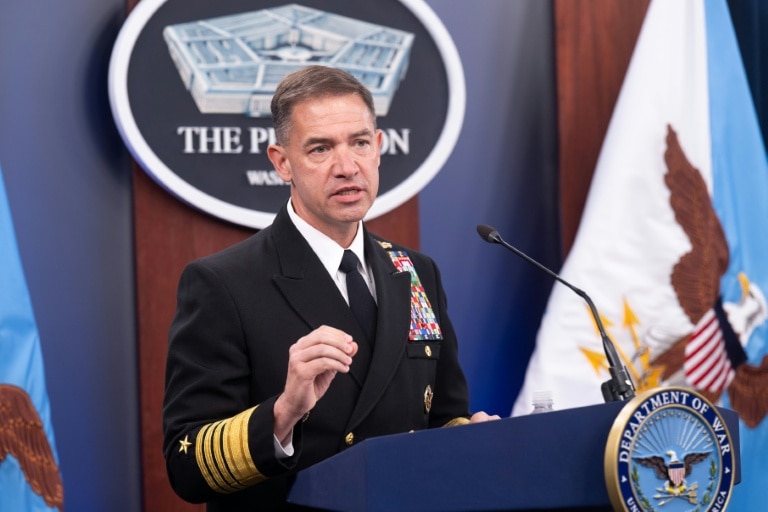
Admiral Brad Cooper, head of U.S. Central Command (CENTCOM), outlined the details of the confrontation to reporters on Monday. He confirmed that American Apache attack helicopters and Seahawk maritime helicopters engaged and destroyed six small Iranian craft that had been posing a direct threat to commercial vessels transiting the waterway. Beyond the destruction of the boats, Cooper added that US forces successfully intercepted and eliminated every incoming missile and drone launched toward both American naval assets and civilian commercial ships passing through the strait.
According to Cooper, most of the Iranian cruise missiles and multiple combat drones were aimed at commercial shipping, with only a smaller number targeting US Navy vessels. “We defended both ourselves and, consistent with our commitment, we defended all the commercial ships,” the CENTCOM chief told reporters. The official account from the admiral contradicts a post Trump made on his Truth Social platform, which put the number of destroyed Iranian boats at seven and noted that one South Korean-flagged ship had been hit, though no further details on that incident were provided. Trump also claimed there had been no other major damage to vessels transiting the strait as of his post.
The current escalation comes against a backdrop of open conflict that began in late February, when US and Israeli forces launched military operations against Iran. In response, Iran closed the Strait of Hormuz, the passage through which roughly 20% of the world’s oil and natural gas exports move daily. American forces subsequently imposed a naval blockade on Iranian ports in the aftermath of the closure.
Earlier on Monday, Iranian state television reported that the country’s navy had fired cruise missiles, rockets and combat drones near US destroyers moving through the strait, framing the action as a deliberate warning shot. For its part, CENTCOM confirmed that two US guided-missile destroyers had completed a transit of the strait into the Persian Gulf as part of Project Freedom, while two US-flagged commercial ships moved in the opposite direction and are now continuing their voyages without incident.
Cooper clarified that the US military operation is not traditional direct escorting of commercial vessels. Instead, Washington has assembled a multi-layered defensive framework that includes surface warships, attack helicopters, fixed-wing aircraft, airborne early warning systems, and electronic warfare capabilities, creating what he described as a much more comprehensive defensive umbrella than simple escort missions would provide. Over the preceding two weeks, Cooper said, US forces used advanced, unspecified “exquisite technology” to clear a transit corridor through the strait, and the current defensive operation is meant to protect that cleared path.
While the long-term goal is to establish a fully open two-way transit route through the strait, Cooper noted that the immediate priority is extracting commercial vessels that have been stuck in the Persian Gulf since the closure. Maritime intelligence firm AXSMarine data as of April 29 shows more than 900 commercial vessels have been stranded in the Gulf during the closure.