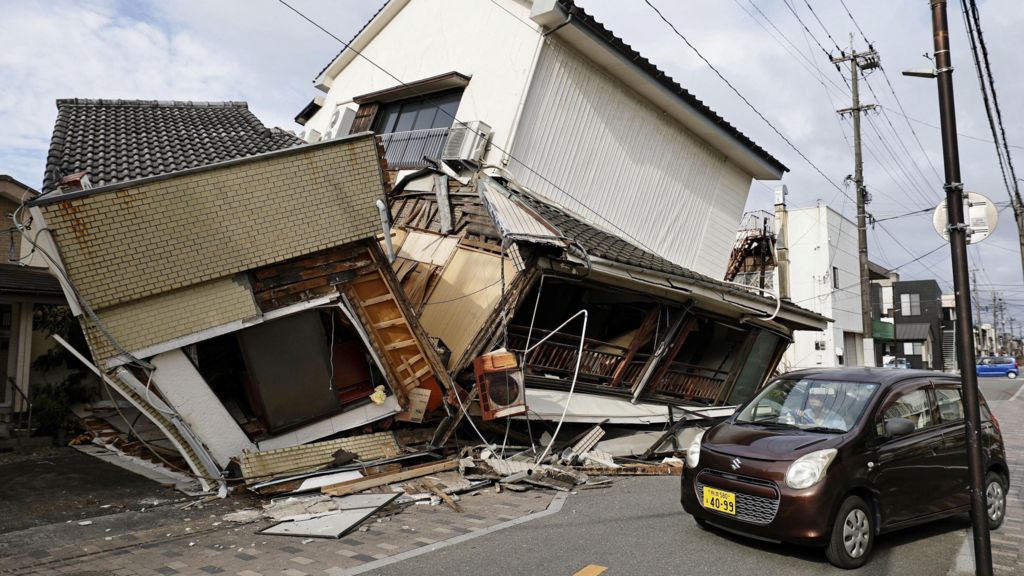
Late on a Tuesday evening, when most local businesses in Japan’s southwestern city of Yatsushiro, Kumamoto Prefecture were preparing to close for the day, a violent 6.8-magnitude tremor tore through the region, turning ordinary routines into a terrifying fight for survival. For 75-year-old Hiroko Ogata, co-owner of the beloved local diner Sendan Shokudo, the quake struck moments after she stepped through the door. In an instant, every dish, utensil and supply stacked on kitchen shelves crashed to the floor, shattering glass and ceramic across the room. Ogata immediately dove under the nearest table for shelter, only to be thrown back and forth as the building lurched violently from side to side.
A lifelong resident of the area, which sits atop an active tectonic fault line that has long made earthquakes a familiar risk, Ogata says this tremor was unlike anything she has ever endured. “I thought I would die,” she recalled, drawing a stark contrast to the devastating 2016 Kumamoto earthquakes that killed 277 people and injured more than 2,800. “The last quake 10 years ago was nothing like this one.”
As of the latest updates, the disaster has claimed at least 13 lives, with three of the fatalities recorded at the Aeon shopping mall in central Kumamoto City, where dozens of people remain trapped beneath collapsed debris. Rescue teams have launched a large-scale operation to reach survivors, but Japanese Prime Minister Sanae Takaichi has warned that responders are in a critical “race against time” to pull people alive from the wreckage before conditions worsen.
Just a few hundred meters from the damaged mall, Yui, a cake shop owner who asked to keep her surname private, was working in her back office when the quake hit. The shaking was so intense that she could not distinguish the roar of the earth from the sound of structural explosions. “All I could do was hold the chair I was sitting in as big jolts came one after another,” she said, still visibly shaken days after the event. “I didn’t know what to feel; I couldn’t even feel scared in such a situation. Even now I don’t know what to feel, and I don’t know how to explain.”
Japanese authorities moved quickly to mobilize resources, deploying 4,600 emergency personnel to the affected region within hours of the initial tremor. Takaichi pledged that teams would work “tirelessly through the night” to map damage, locate missing people and deliver critical aid to displaced residents. Even with this rapid response, however, the scale of the destruction has overwhelmed local infrastructure: tens of thousands of households across Kumamoto City remain without power and clean running water, and at least 45 medical facilities have sustained structural damage that limits their ability to treat the injured.
Beyond human casualties, the disaster has also damaged irreplaceable cultural heritage sites. The iconic outer stone walls of 17th-century Kumamoto Castle, located in the heart of the city, crumbled to the ground in thick clouds of dust, and the main worship hall of 19th-century Yatsushiro Shire collapsed completely.
For locals navigating the aftermath, daily life remains fraught with uncertainty. Michal Posan, a 25-year-old resident who has lived in Kumamoto for two years, says local stores have already been stripped of essential supplies. “There is no water or food left in the stores,” she explained. Posan was at home when the quake hit, where a falling television struck her and her bathroom mirror shattered; nearby roads cracked and buckled from the force. Like many other residents, she has packed an emergency evacuation bag and remains on high alert, as constant aftershocks continue to rattle the region hours after the initial quake.
Memories of the 2016 disaster, when a second major quake struck the region just days after the first, have left communities deeply anxious about what comes next. “People are wary of another earthquake on the way,” one local resident noted. That fear is echoed by experts: Shinji Kiyomoto of the Japanese Meteorological Agency has urged the public to “remain vigilant” for additional large tremors, citing the 2016 sequence as a dangerous precedent.
Even as fear of another major quake lingers, local business owners have begun the slow, exhausting work of clearing debris and rebuilding their livelihoods, balancing the need to return to normalcy with the constant interruption of aftershocks. Ogata began clearing out her damaged diner the day after the quake, even as repeated tremors force her to stop and take shelter every few minutes. “The whole of my place is messy, and I don’t know where to stand – but we have to earn our living by restarting our restaurant as soon as possible, so I am cleaning the place today,” she said. “But when I try to work for a bit, an aftershock occurs and I have to stop – then I do some work and we have another aftershock… So it is going so slowly. If we keep having this many aftershocks it will be very stressful.”
For Yui, the path forward remains unclear. Her cake shop remains closed while she assesses damage to critical equipment, including her commercial oven. “I haven’t checked whether the machines such as the oven are working,” she said. “After I check those, I will have an idea whether I can go back into business or not.” As rescue teams continue their search for trapped survivors and communities pick through the wreckage of their homes and businesses, Kumamoto is grappling with both the immediate physical devastation and the long shadow of uncertainty cast by the relentless aftershocks.