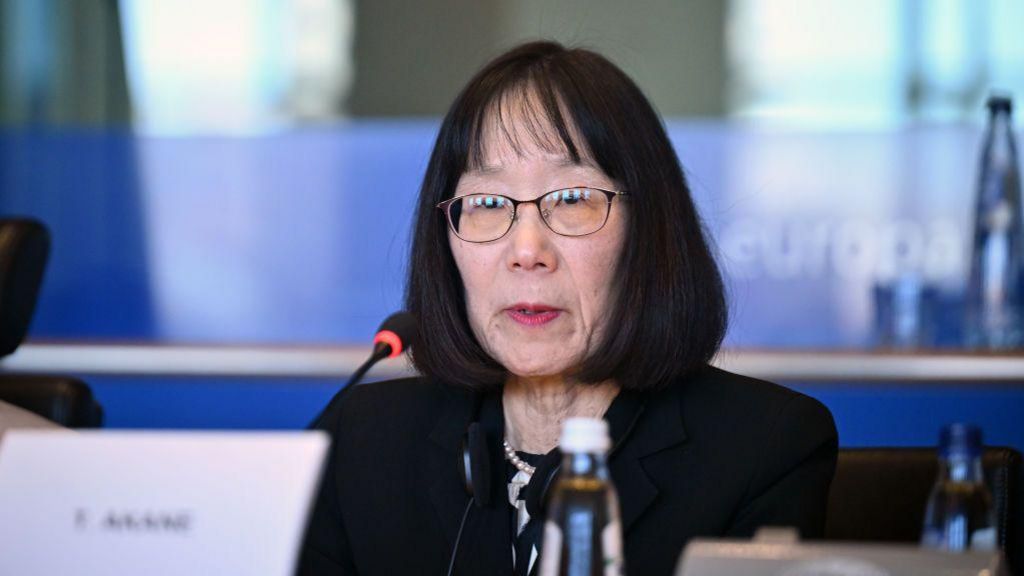
In a sharp escalation of the second Trump administration’s campaign to undermine and dismantle the International Criminal Court (ICC), U.S. Secretary of State Marco Rubio has announced new sanctions against the court’s newly installed president and a senior trial lawyer. The punitive measures, authorized under an executive order Trump issued last year targeting ICC officials, target Japan’s Tomoko Akane, who began her three-year term as ICC president earlier in 2024, and Senegalese senior trial lawyer Abdoulaye Seye.
Rubio accused the two ICC leaders of directly participating in the court’s efforts to investigate, arrest, detain and prosecute officials of countries that have not accepted the ICC’s jurisdiction. In an official statement, he characterized the ICC, a 125-member supranational body tasked with prosecuting genocide, crimes against humanity and war crimes, as a corrupt and irredeemably politicized institution that has abused its authority and overstepped its mandate. He emphasized that the U.S. would not accept what he called the court’s attack on national sovereignty. As of the announcement, neither President Trump nor the White House had issued additional public comment, and the ICC has not yet released a response to the sanctions.
This latest action marks the continuation of a years-long U.S. campaign against the court. The Trump administration has already imposed sanctions on at least 11 other ICC officials, including nine sitting judges and the court’s chief prosecutor. These measures include full asset freezes, travel bans to the U.S. and prohibitions on U.S. companies providing goods and services to the sanctioned individuals. The sanctions were initially imposed in retaliation for two major ICC actions: the opening of an investigation into alleged war crimes committed by U.S. personnel in Afghanistan, and the court’s issuance of arrest warrants for senior Israeli officials, including Prime Minister Benjamin Netanyahu, over alleged war crimes in Gaza. Neither the U.S. nor Israel are member states of the ICC; Netanyahu has denied all war crime allegations and has claimed the court’s actions are driven by antisemitism.
Trump’s opposition to the ICC stretches back to his first presidential term, when he labeled the court a threat to U.S. sovereignty and told the United Nations General Assembly that the institution held no jurisdiction, legitimacy or authority over the United States. Last month, Rubio doubled down on the administration’s stance, calling on all 125 ICC member states to withdraw from the institution as part of the U.S.’s stated goal of dismantling the court “brick by brick.” A senior U.S. official noted that Washington would closely monitor which countries heed the call and which reject it.
Established in 2002, the ICC holds international jurisdiction to prosecute the world’s most serious crimes in situations that occur within a member state’s territory or when a case is referred to the court by the United Nations Security Council. But the Trump administration’s campaign has drawn fierce pushback from human rights organizations, legal groups and current ICC officials, who argue the U.S. is violating international law and enabling global impunity for war crimes and atrocities.
Liz Evenson, international justice director at Human Rights Watch, described the administration’s actions last week as an attempt to secure an unconditional “get-out-of-jail-free card” for any actors the U.S. chooses to protect. Four leading U.S. human rights groups—Human Rights Watch, the Open Society Institute, the American Friends Service Committee and the Center for Constitutional Rights—have already filed a lawsuit against the Trump administration in New York challenging the dismantling campaign, arguing the sanctions regime is unconstitutional. The groups argue that the sanctions block their ability to collaborate with the ICC to pursue accountability for genocide, war crimes and crimes against humanity across the globe.
This legal challenge is not the only one facing the administration: In June, three ICC judges targeted by earlier sanctions also filed a lawsuit in a New York federal court arguing that the punitive measures against them are unlawful. The judges—Kimberly Prost of Canada, Solomy Balungi Bossa of Uganda and Reine Alapini-Gansou of Benin—contend that the sanctions are designed to apply extrajudicial pressure to punish and coerce ICC judges into changing their conduct. The White House has defended its actions, arguing that Trump lawfully exercised his authority under the 1977 International Emergency Economic Powers Act (IEEPA) to impose the sanctions.
The practical impact of the sanctions extends far beyond formal restrictions, as any global bank with ties to the U.S. or that processes transactions in U.S. dollars is required to comply with the measures. This severely limits sanctioned ICC officials’ ability to carry out even basic, routine financial transactions, significantly hampering their work. Since Trump’s return to the White House following the 2024 presidential election, his administration led by Rubio has adopted an increasingly aggressive stance toward the ICC. In a July video statement launching the formal dismantling campaign, Rubio claimed the ICC is “waging a war against our country” through its use of international legal frameworks, and warned that if the court continues to challenge U.S. sovereignty, the U.S. would demonstrate the full weight of its response.