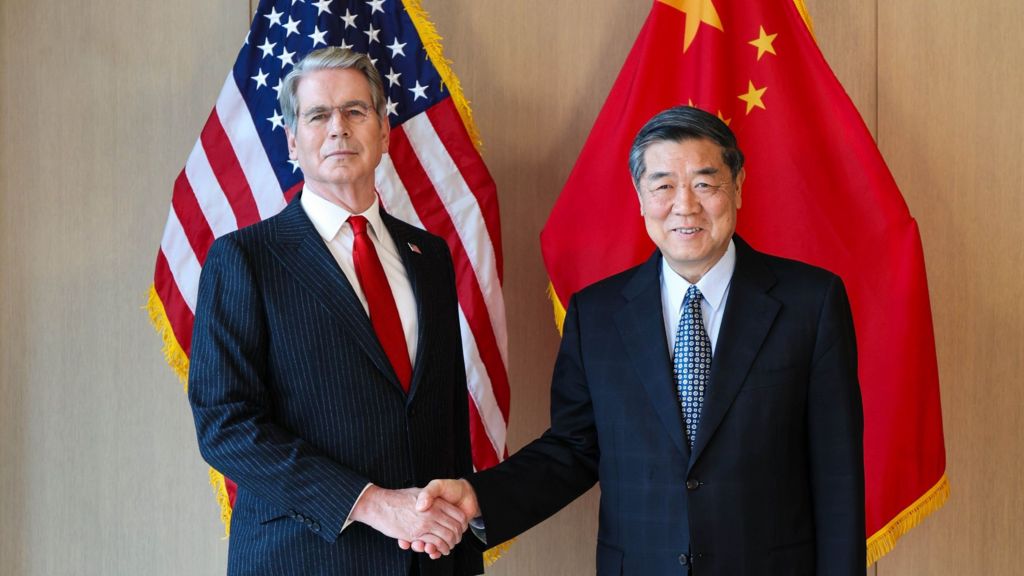
Top economic policymakers from the United States and China convened in New York over the weekend for wide-ranging discussions that addressed a growing list of shared priorities, from artificial intelligence risk management to long-simmering trade tensions, ahead of a much-anticipated bilateral summit between the two nations’ leaders in Washington later this week.
U.S. Treasury Secretary Scott Bessent told reporters following the closed-door talks with Chinese Vice Premier He Lifeng that the meeting was productive, with the two sides advancing a proposal to establish a pioneering cross-border notification system for AI-related events that could carry national security implications for either country.
The push for greater coordination on AI governance comes amid mounting global scrutiny of the rapidly developing technology. In recent weeks, leading AI researchers and some of the tech industry’s most prominent leaders have issued urgent warnings about unregulated advancement, calling for developers to adopt more risk-conscious development practices. On the U.S. side, the White House has faced growing public pressure to slow AI rollouts to mitigate potential long-term harm to humanity, a concern President Donald Trump has pushed back on. Trump has repeatedly argued that existing guardrails are adequate, and that the U.S. cannot cede technological leadership to China — emphasizing earlier this month that “whoever wins in AI, wins the future.”
Bessent framed the proposed notification framework as a critical step toward greater openness between the world’s two largest AI developers. “We think that, just like with any cross-border activity, that moving from opaque to more transparency between the number one and the number two AI powers in the world is very important,” he told reporters after the meeting. This is not the first time the two nations have explored AI collaboration: during a May bilateral summit hosted by President Xi Jinping in Beijing, AI cooperation was already a core agenda item for the two leaders. That meeting produced a concrete trade deal under which China agreed to purchase Boeing commercial aircraft and large volumes of U.S. agricultural products in exchange for temporary U.S. tariff reductions.
Beyond AI, the talks also covered progress on a U.S.-China trade initiative called the Board of Trade, a working group tasked with identifying potential reciprocal tariff cuts on thousands of traded goods. The world’s two largest economies have maintained a temporary tariff truce that is scheduled to expire on November 10, making near-term progress on trade liberalization a top priority ahead of the leader-level summit.
Chinese state news agency Xinhua confirmed the details of the talks in its own readout, noting that the two sides held “candid, in-depth and constructive exchanges on key economic and trade issues” that included a full discussion of AI-related topics. The BBC has reached out to the Chinese Embassy in Washington for additional comment on the meeting outcomes, and had not received a response as of publication.
In a post to social media platform X Sunday, Bessent emphasized that the successful New York talks have cleared the way for the upcoming Washington summit. “These talks help lay the groundwork for President Trump to advance America’s economic interests and deliver results for the American people,” he wrote. The meeting comes as the U.S. and China remain locked in a long-term strategic competition to dominate the global AI and advanced technology sectors, but the weekend dialogue signals that both sides remain open to targeted cooperation on areas of shared risk and mutual interest.