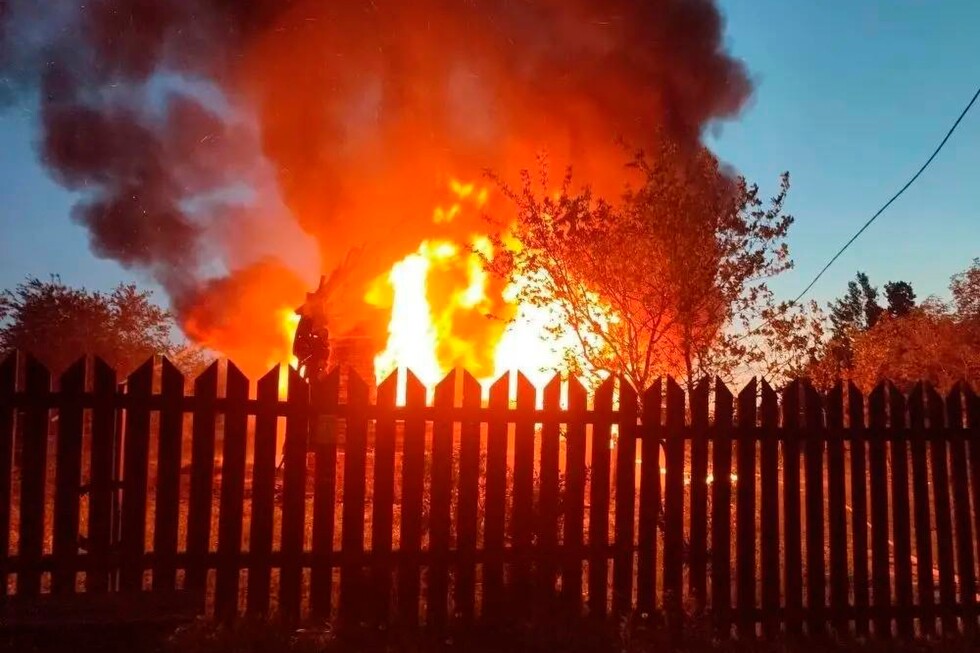
On Sunday, regional Russian authorities confirmed that one of the largest drone offensives Ukraine has launched against Russian territory since the start of the full-scale invasion left at least four people dead and 12 others injured, marking a significant escalation in cross-border long-range attacks.
Casualty reports from local officials confirm three of the fatalities occurred in areas just outside Moscow: a woman died when a drone crashed directly into her residential home in Khimki, a commuter city located just northwest of the Russian capital, while two men were killed in Pogorelki, a small village roughly six miles north of Moscow’s city center. A fourth fatality was recorded in the Belgorod region, which shares a border with eastern Ukraine, after a drone struck a civilian transport truck. Moscow mayor Sergei Sobyanin added that 12 people were wounded in overnight strikes near the city’s main oil refinery, though the facility’s core operational infrastructure was left unharmed. Debris from downed drones also landed on the grounds of Sheremetyevo International Airport, Russia’s busiest air transit hub, but officials confirmed no damage to airport infrastructure and no disruptions to ongoing flight operations. Regional governor Andrei Vorobyev additionally reported that unspecified civilian infrastructure and multiple apartment buildings suffered damage across the Moscow region in the attacks.
Russian defense officials released preliminary figures showing that air defense systems intercepted or jammed more than 1,000 Ukrainian drones across Russian territory over the 24-hour period preceding Sunday midday. Of those, 81 drones were intercepted while headed toward Moscow alone – a scale of attack that ranks among the largest targeting the capital since Russia launched its full-scale invasion in February 2022.
In a public statement confirming the operation, Ukrainian President Volodymyr Zelenskyy framed the strikes as a fully justified response to constant Russian attacks on Ukrainian civilian areas. He noted that the drones used in the attack traveled more than 310 miles from Ukrainian launch points, successfully penetrating the layered Russian air defense systems concentrated around Moscow. “Our responses to Russia’s prolongation of the war and attacks on our cities and communities are entirely justified,” Zelenskyy said. “This time, Ukrainian long-distance sanctions have reached the Moscow region, and we are clearly telling the Russians: their state must end its war.”
Nigel Gould Davies, a senior fellow for Russia and Eurasia at the London-based International Institute for Strategic Studies, said the large-scale attack aligns with retaliatory threats Zelenskyy issued after a recent wave of intense Russian strikes on Kyiv that followed the May 9 Russian Victory Day parade. The attack, he explained, demonstrates Ukraine’s growing ability to carry out large-scale strikes deep within Russian territory, bringing the reality of the war directly to the Russian capital in a move that is deeply destabilizing for the Kremlin.
“It brings home the fact Ukraine has the capacity to strike at very significant scale at or around the Russian capital,” Gould Davies told the Associated Press. He added that the attack will compound growing public anxiety across Russia that has built steadily over the past three to four months, fueled by battlefield setbacks, worsening domestic economic conditions, and the Kremlin’s increasing crackdown on online dissent. While these mounting pressures will erode public comfort with the ongoing conflict, Gould Davies noted he does not expect them to force Russia to pursue the compromises required for meaningful peace negotiations in the near term.
In addition to targeting political and population centers, Ukraine has increasingly used long-range drone strikes to hit Russian oil infrastructure deep inside the country. These strikes, which have generated smoke plumes visible from orbit and even left toxic fallout in Black Sea tourist destinations, are intended to cut into Moscow’s oil export revenue – the single largest source of funding for its invasion of Ukraine. While the overall economic impact of these attacks remains uncertain, as higher global oil prices driven by tensions around Iran and the easing of some U.S. sanctions have boosted Russian government revenues, the strikes have succeeded in bringing the consequences of the war to ordinary Russians living hundreds of miles from the front lines.
The Ukrainian drone attack came on the heels of a massive overnight Russian drone offensive targeting Ukrainian territory, which also left casualties. Ukrainian air force officials reported that Russia launched 287 drones at Ukraine overnight, 279 of which were successfully intercepted or jammed. Eight people were wounded in Russian strikes across the central Dnipropetrovsk region, including three in the regional capital Dnipro, four in Kryvyi Rih – Zelenskyy’s hometown – and one in Synelkove. Multiple residential buildings were damaged in the strikes, Ukraine’s state emergency service confirmed.