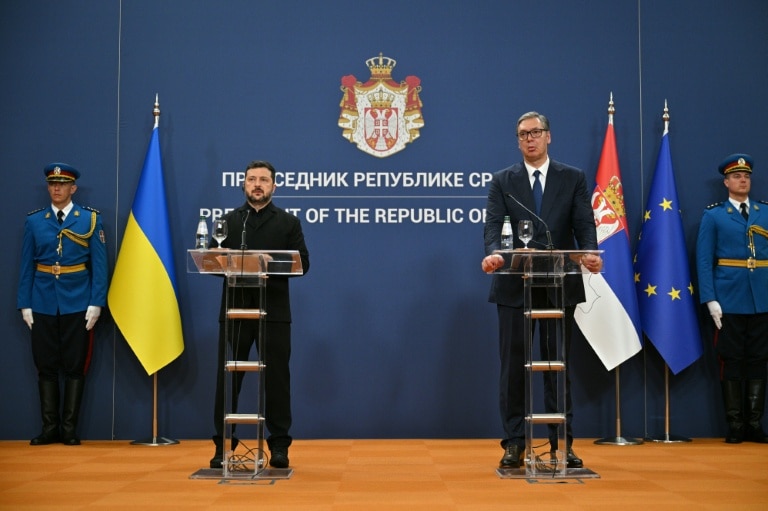
On Saturday, Ukrainian President Volodymyr Zelensky made his first official visit to Belgrade as head of state, where he delivered a stark warning about the coming winter amid a fresh wave of deadly Russian long-range strikes that claimed multiple civilian lives, including a young child, in the Kyiv region.
During a press conference alongside Serbian President Aleksandar Vucic, Zelensky confirmed that Russian overnight missile and drone barrages, paired with intensified shelling across frontline communities, had killed 13 civilians across Ukraine in the 24-hour period. Among the fatalities was a three-year-old boy killed in a strike on a village outside Kyiv; four additional people, including the child’s parents, his 15-year-old brother, and a neighbor who rushed to provide aid, were hospitalized after a follow-up double-tap strike on the residential site. Local reports and on-the-ground accounts from AFP correspondents in Kyiv documented roughly a dozen explosions across the capital region, as Ukrainian air defense units issued urgent alerts for incoming ballistic attacks from the north.
Zelensky emphasized that Russian forces are deliberately targeting Ukraine’s critical energy infrastructure to break civilian morale, leaving the country with virtually no undamaged thermal power plants as it prepares for the winter heating season. Thermal power facilities serve as a critical backup to Ukraine’s nuclear energy fleet, which forms the backbone of the country’s national power grid. With more than three years having passed since Russia launched its full-scale invasion, both sides have sharply escalated long-range strike operations, leading to a steady rise in civilian casualties. Moscow has ramped up attacks on Kyiv in recent months, primarily using salvos of ballistic missiles that are notoriously difficult for existing air defense systems to intercept, prompting repeated Ukrainian appeals for additional U.S.-manufactured Patriot interceptor missiles and other advanced Western air defense systems. In response to the intensified strikes, Kyiv has launched a growing number of drone attacks against targets inside Russian territory.
During his meetings with Serbian leadership, Zelensky renewed his call for tougher international sanctions on Russia, aiming to cut off the flow of missile components that he says are reaching Moscow from nearly every continent, including from some of Ukraine’s closest international partners. “These components arrive, and then missiles strike people, killing children, civilians and soldiers,” he told reporters, reiterating that expanded access to interceptor missiles is a non-negotiable priority to counter the growing wave of long-range attacks.
Serbia, which maintains long-standing close ties to Moscow, remains one of the only European countries that has refused to implement formal sanctions against Russia. While Vucic’s government has provided non-military humanitarian assistance to Ukraine, it has not altered its long-held neutral policy on the conflict. Vucic confirmed that no military cooperation agreements were discussed during Saturday’s meeting, noting that any future arrangements would be addressed only after the war concludes. He reaffirmed that Serbia’s policy of recognizing Ukraine’s territorial integrity remains unchanged, and has repeatedly denied Kremlin accusations that Serbian firms have supplied munitions to Kyiv. Vucic previously traveled to Ukraine for a regional summit in 2025 and visited Kyiv earlier this year, but has declined to sign any formal declaration of support for Ukraine in the ongoing conflict.
Zelensky’s visit to Belgrade comes as part of his years-long global diplomatic tour to rally international support for Ukraine, a campaign he has led consistently since Russia launched its full-scale invasion in February 2022.