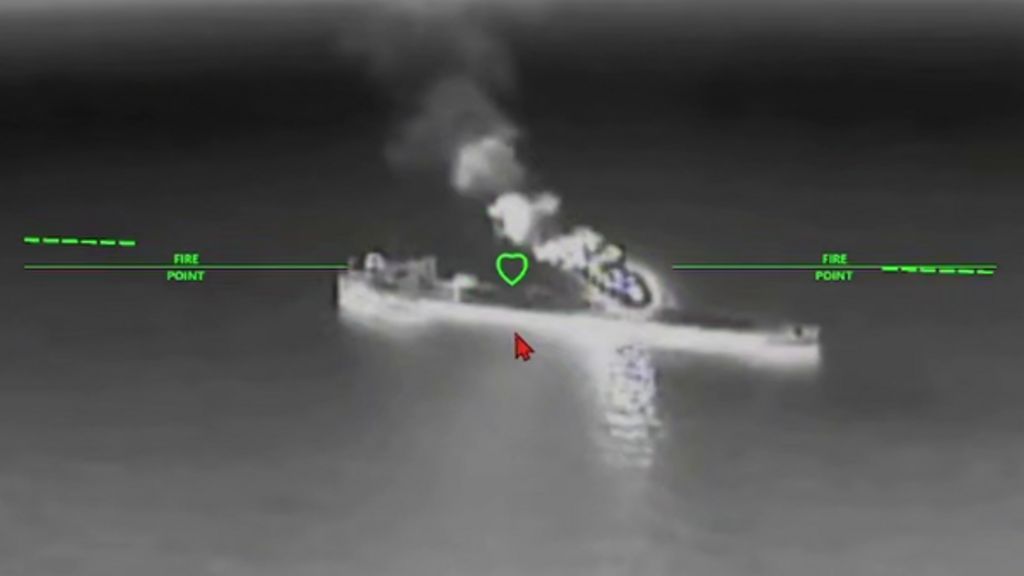
In a dramatic escalation of its campaign to cut off Russian supply lines to occupied Crimea, Ukraine’s unmanned military forces have launched a wave of coordinated naval drone strikes targeting Russian commercial and military shipping in the Sea of Azov and Black Sea, part of Kyiv’s self-declared “logistics lockdown” of the peninsula.
Robert Brovdi, commander of Ukraine’s drone forces who operates under the callsign Magyar, has reported that between July 6 and July 9, at least 25 vessels were hit and set ablaze across the Sea of Azov, an inland body of water connected to the Black Sea via the strategic Kerch Strait. Ukraine’s overall count of damaged or destroyed vessels stands at 36, most of which are part of Russia’s unregulated “shadow fleet” of commercial oil tankers that operate outside international shipping norms to evade Western sanctions. The exact number of damaged vessels remains unconfirmed by independent observers, as some ships may have been struck multiple times.
The Sea of Azov off Crimea’s northeastern coast has long been a hub for Russian oil shipping, anchored by an onshore fuel loading terminal at Kerch port on the Crimean peninsula. After Ukraine launched a strike on Kerch port last month, satellite analysis conducted by BBC Verify confirmed a sharp drop in the number of tankers anchored in the area in the days following the attack. Night-time drone footage of the latest wave of strikes began circulating on social media platforms early Tuesday, with Brovdi confirming daily strikes across the four-day window.
Independent evidence has backed up Ukraine’s claims. Satellite imagery captured on July 9 shows a large column of smoke rising from a vessel roughly 2.5 miles off Crimea’s coast, and NASA fire tracking data confirms an active blaze has burned at that location since July 6, matching Ukraine’s claim of an initial strike on that date. The same satellite image shows roughly 20 other vessels abandoning their positions in the Sea of Azov and moving south toward the Black Sea to avoid attack. Even leaving the Sea of Azov does not guarantee safety, however: On July 9, Ukraine’s general staff released footage of a naval drone strike on the sanctioned Russian tanker Blue off the coast of Yalta, a Black Sea resort city on occupied Crimea. The on-board drone footage shows the unmanned vessel evading defensive fire before approaching the tanker’s hull, where the recording cuts off.
Russia’s regional governor of Rostov, Yuri Slyusar, confirmed that two empty tankers were attacked in Taganrog Bay, the northeastern corner of the Sea of Azov, on July 8, adding that the vessels were still burning the following day. Brovdi confirmed that two tankers hit earlier in the week were carrying roughly 7,000 tons of fuel each from the Taganrog area to supply Russian forces and occupied Crimea. In addition to tankers, strikes have hit other commercial vessels: a passenger ferry named SKS One and a bulk carrier were attacked at Kerch port, with imagery of the damaged ferry posted to social media by Brovdi. Brovdi has also named specific vessels hit in the strikes, including the tankers Venera-3, Sanar-1, Sanar-17, Klimena, Thetis, Alexey Savrasov, and Penelopa.
This wave of maritime strikes coincides with a separate campaign of attacks on Russian oil infrastructure deep inside Russian territory, which has exacerbated widespread fuel shortages across more than 90% of Russia’s regions, including major cities Moscow and St. Petersburg. Ukrainian President Volodymyr Zelensky has defended the strategy, arguing that targeting Russian energy infrastructure is a legitimate response to Russian strikes on Ukrainian territory, and that Russian civilians must “feel that it is their state that is waging war.” Zelensky also confirmed recent attacks on two oil depots in the Tver and Stavropol regions, hundreds of kilometers from the front lines, as well as a major oil terminal in Rostov region, widely reported to be the Yug Rusi terminal near Taganrog Bay. Russia has responded to the ongoing shortages by implementing diesel export bans, and long queues at filling stations have been reported across the country’s largest urban centers.
The strikes mark a major escalation of Ukraine’s campaign to choke off all supply routes to occupied Crimea, which Russia annexed in 2014 in a move unrecognized by most of the international community. Ukraine has already disrupted Russian land supply routes to the peninsula, and the latest attacks target the remaining maritime supply lines that Moscow relies on to meet Crimea’s energy needs. In late June, Russian President Vladimir Putin publicly stated that Crimea requires 70,000 tons of fuel per month, and promised to secure steady supplies via both land and sea corridors. The total volume of fuel carried by the tankers hit in the Sea of Azov strikes exceeds this monthly requirement, representing a significant setback to Putin’s pledge.
Russian pro-military commentators have openly acknowledged the severity of the setback, criticizing the Russian Black Sea Fleet for failing to provide protection for commercial shipping. The popular pro-war Telegram channel “Military Informant” described unescorted tankers as effectively an open “shooting gallery” for Ukrainian drone operators, noting that the Black Sea Fleet is no longer capable of defending commercial traffic in the region. Another prominent pro-military blogger, Mikhail Zvinchuk of the Telegram channel Rybar, confirmed that the Black Sea Fleet has retreated to its base at Novorossiysk and largely abandoned patrols of the Sea of Azov and northern Black Sea around Crimea. For Russian-occupied Crimea, where local authorities already face ongoing disruptions to power and transport networks, the loss of critical fuel supplies is expected to deepen existing crises, with fuel rationing already in place in much of the region.
International reaction to the escalation has been mixed. During a meeting with Zelensky on the sidelines of the NATO summit in Ankara on July 8, U.S. President Donald Trump characterized Ukraine’s naval drone strategy as an escalation of the conflict, but added that “it’s also an escalation that can help lead to an end.” As of mid-July, the intensity of attacks shows no sign of slowing: Brovdi claimed that Ukrainian forces hit 12 separate tankers in a single night between July 8 and July 9, and Russian pro-war sources have not disputed either the details of the claim or the authenticity of the attack footage released by Ukraine.