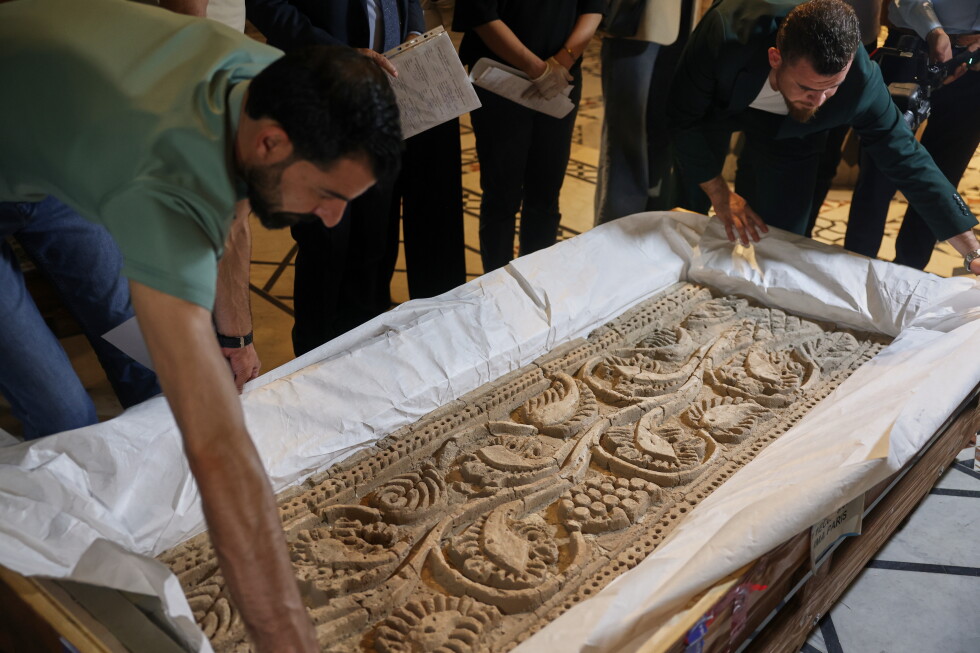
In a historic moment marking a new chapter of diplomatic and cultural engagement between France and post-Assad Syria, France has formally repatriated 23 ancient Syrian archaeological artifacts that were stranded abroad for nearly 15 years. The handover aligned with French President Emmanuel Macron’s groundbreaking trip to Damascus, the first official visit by a leader of a major Western nation since the ousting of Bashar Assad’s government at the end of 2024.
The full collection of relics, transported to Damascus on Macron’s official presidential aircraft on Tuesday, was formally delivered to Syria’s National Museum. The assortment of returned heritage objects spans thousands of years of Syrian history, including bronze artifacts from the Roman era, cultural pieces from the Byzantine and early Islamic periods, and a vividly hued mosaic panel that originally decorated the historic Umayyad Mosque in central Damascus. The artifacts were originally loaned to the Arab World Institute in Paris in 2011 for a temporary exhibition focused on Syrian cultural heritage, not long before Syria’s full civil war broke out.
According to Syria’s Foreign Ministry, the artifacts originated from leading museums across four major Syrian cities: Damascus, Aleppo, Latakia, and the war-ravaged ancient city of Palmyra. They remained in French custody after the two countries severed diplomatic relations during Assad’s decades-long rule. The ministry noted that France is the first nation to formalize such a cultural cooperation agreement with Syria as the new government launches a national campaign to recover all Syrian antiquities held in collections around the globe.
At a special opening exhibition at the National Museum showcasing two of the most prominent returned pieces, Ayman al-Nabo, deputy director-general of Syria’s Directorate-General of Antiquities and Museums, hailed the repatriation as a key milestone for the country’s cultural recovery. Nivine Saadeddine, a lead curator at the National Museum, emphasized that the returned artifacts encapsulate the breadth and depth of Syria’s millennia-long civilization. “They date from the ninth millennium B.C. to the 14th and 15th centuries A.D. Every object represents a distinct chapter in Syria’s history,” Saadeddine explained.
For Maamoun Abdulkarim, Syria’s former director-general of antiquities and museums who now serves as a professor of archaeology at the University of Sharjah in the United Arab Emirates, the long-awaited return closes a difficult chapter marked by years of war, diplomatic deadlock, and multiple failed efforts to bring the artifacts home. The 2011 loan was arranged as part of routine cross-cultural exchange between the two countries before the outbreak of full-scale conflict, Abdulkarim recalled. He first submitted a formal request for the artifacts’ repatriation in 2014, but received no official response from French authorities. Later, French officials clarified that they were unable to engage with representatives of Assad’s government, which had become widely diplomatically isolated and subject to sweeping international sanctions following the regime’s violent crackdown on anti-government protests and the subsequent civil war.
Abdulkarim shared that the United Nations cultural agency UNESCO’s Beirut office attempted to mediate the dispute in later years, but those efforts also fell through. The prolonged standoff even carried severe personal risks for Abdulkarim and his colleagues under the Assad regime. “We were interrogated by Bashar Assad’s security forces,” he said. “We were beaten and accused of being too lenient in protecting Syria’s antiquities. Had it not been for the correspondence we had sent to the institute proving we had repeatedly requested the artifacts’ return, we could have been imprisoned.”
Despite the years of hardship and delay, Abdulkarim welcomed the restart of formal cultural cooperation between the two nations. “I am very happy that, despite everything that happened, the war is over, Syria is reopening to the world and cultural exchange is returning,” he said.
Abdulkarim noted that a small number of Syrian artifacts have been repatriated under existing formal loan agreements even during the war and period of severed diplomatic ties. Around 2017, for example, Italy returned two Syrian artifacts that had been damaged by the Islamic State (IS) group, after completing restoration work for a Rome exhibition focused on the global destruction of cultural heritage. A smaller collection of Syrian artifacts still remains in Japan under a long-standing archaeological cooperation agreement stemming from joint excavation work conducted in the 1980s.
Still, the scale of Syria’s lost cultural heritage remains immense. Abdulkarim estimates that thousands of artifacts looted from archaeological sites across Syria during the 14-year conflict are currently held in private collections and museums across the globe. “Recovering them will require years of diplomatic work,” he said. He added that France’s decision to repatriate the 23 artifacts sends a hopeful signal to the international community and can encourage more widespread global cooperation to recover Syria’s stolen cultural legacy.
Syria’s rich cultural heritage suffered catastrophic damage across the nearly 14 years of conflict. Multiple UNESCO World Heritage sites, including the ancient desert city of Palmyra, were heavily damaged by fighting and intentional destruction by extremist groups. Other iconic landmarks, such as the medieval Crusader fortress of Crac des Chevaliers, still bear visible scars from years of combat. IS militants deliberately destroyed ancient temples, tombs, and monumental sculptures in Palmyra, labeling these irreplaceable cultural artifacts as symbols of idolatry, while the illegal trafficking of looted Syrian antiquities became a major source of funding for armed groups operating in the country.