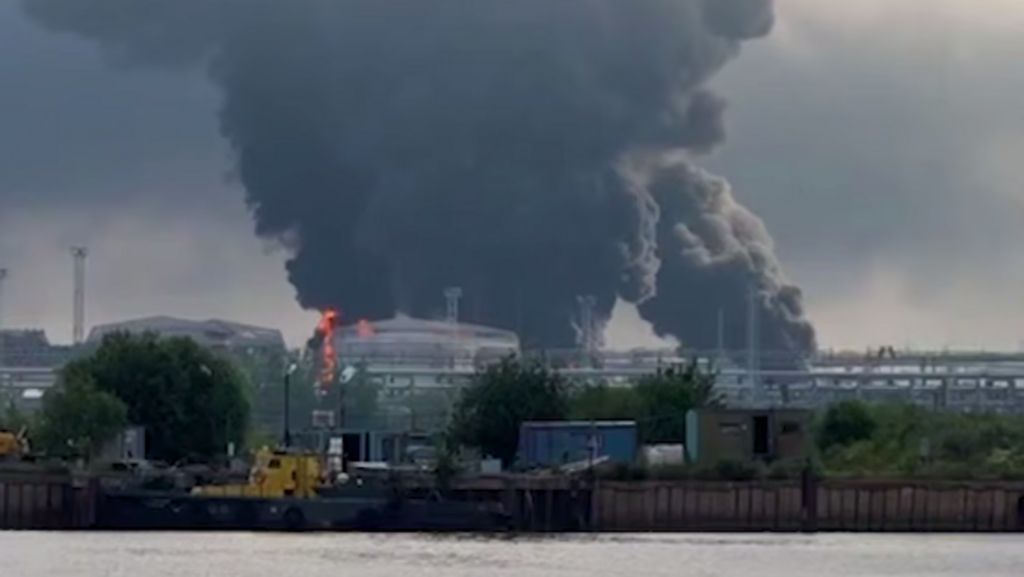
In an escalation of long-range strikes targeting Russian war-related infrastructure, Ukrainian forces launched a major overnight drone attack that hit one of Russia’s largest oil terminals in St Petersburg, President Volodymyr Zelensky confirmed Saturday. The attack also targeted a key Russian Baltic Fleet naval base in the nearby Kronstadt area, marking one of the deepest strikes into Russian territory from Ukraine in the ongoing conflict.
Located roughly 850 kilometers (528 miles) from Ukraine’s border, the St Petersburg oil terminal identified by Ukraine’s military as a critical revenue source for Moscow’s full-scale invasion, which launched in February 2022. Ukrainian military officials describe the facility as one of Russia’s largest oil infrastructure hubs, with an annual output capacity of 12.5 million metric tons of refined petroleum products. Zelensky emphasized the terminal is core infrastructure that directly funds Russia’s military campaign, framing it as a legitimate military target under Ukraine’s rules of engagement.
St Petersburg Governor Aleksandr Beglov acknowledged the oil terminal strike in an official statement, confirming the attack came as part of what he called a “massive” drone assault on the city and surrounding Leningrad region. Beglov claimed Russian air defenses shot down 72 inbound Ukrainian drones during the attack, and reported no fatalities or injuries from the terminal strike. He urged the city’s more than 5 million residents to remain indoors until all drone threats were neutralized, and issued a warning that temporary mobile internet disruptions could occur across affected areas. The BBC has independently verified that the St Petersburg oil terminal was indeed hit, and video published by Zelensky shows a drone approaching the target followed by a large plume of black smoke rising from the site. The full extent of damage to the facility remains unclear as of Saturday afternoon, and Russia has not yet issued any official comment on the reported strike on the Kronstadt naval base.
This attack is part of a recent intensification of Ukrainian long-range drone operations targeting Russia’s critical energy infrastructure. Kyiv estimates that these strikes have disabled nearly 43 percent of Russia’s total oil refining capacity, a claim that has not been independently verified by third-party observers. Ukrainian officials have repeatedly stated that Russian fossil fuel facilities are valid military targets, as export revenue from oil and gas remains the largest source of funding for Moscow’s war effort.
In a separate development Saturday, Ukraine’s military directly refuted Russian claims that the strategically important eastern town of Kostyantynivka in Donetsk Oblast has fallen under full Russian control. Andriy Kovalyov, a major and spokesperson for Ukraine’s military, told the BBC that Kostyantynivka remains firmly under the control of Ukrainian defense forces. Kovalyov acknowledged that small Russian infantry groups have carried out infiltration attempts into frontline Ukrainian combat formations, but added that these incursion teams are being rapidly identified and eliminated.
Kovalyov’s statement came one day after Russian President Vladimir Putin claimed Russian forces established full control over Kostyantynivka back in June, a claim Putin made without providing any supporting evidence. Responding to Putin’s claim on his official Telegram channel Saturday, Zelensky issued a sharp rhetorical challenge. “If Kostyantynivka is now under Russian control, then Putin will probably have no problem meeting me there and finding diplomatic solutions to finally end the war,” Zelensky wrote. “But still, he will not cross the front line: the truth is very different from Putin’s words.”
Kostyantynivka is a key fortified node in Ukraine’s so-called “fortress belt” of defensive positions in the Donetsk region, most of which is currently under Russian occupation.