A sustained and increasingly effective campaign of drone strikes by Ukrainian forces has plunged the Russian-occupied Black Sea peninsula of Crimea into its most severe fuel crisis since Moscow’s illegal 2014 annexation, delivering a fresh blow to the Kremlin’s claim of progress in its four-year full-scale invasion of Ukraine.
The coordinated strikes have targeted critical energy infrastructure deep inside Russia, supply routes along the land corridor connecting mainland Russia to Crimea, and key transport links into the peninsula, leaving tanker trucks charred along highways, stranding motorists in multi-hour queues at gas stations, and forcing occupied authorities to implement strict fuel rationing. As the crisis unfolded as Russia marked its annual Russia Day holiday, the unofficial kickoff to the summer tourist season that Crimea’s economy depends heavily on, the damage has already rippled through the region’s vital hospitality sector.
To understand the stakes of this escalation, it is necessary to contextualize Crimea’s long-standing strategic and symbolic importance to the Kremlin. First seized by the Russian Empire from the Crimean Tatars in the 18th century following a victory over the Ottoman Empire, the peninsula was transferred from Soviet Russia to Soviet Ukraine in 1954 by then-leader Nikita Khrushchev. When the Soviet Union collapsed in 1991, Crimea became part of the newly independent Ukrainian state, though Moscow maintained a large naval base at Sevastopol under a long-term lease. In 2014, following the ousting of a pro-Moscow Ukrainian president by a popular pro-European uprising, Putin deployed unmarked troops to seize control of Crimea, and oversaw a widely unrecognized referendum to formalize its annexation. The move triggered a separatist insurgency in eastern Ukraine that simmered until Russia launched its full-scale invasion in February 2022; early in that invasion, Russian forces based in Crimea seized large swathes of southern Ukraine and secured the overland corridor to the peninsula that remains Moscow’s primary supply route today.
Since the start of the full-scale war, Ukraine has systematically targeted Russian assets in and around Crimea to erode Moscow’s control. Ukrainian strikes have sunk multiple Russian warships at Crimean bases, severely degrading Russia’s Black Sea Fleet capabilities and forcing most of the fleet to redeploy to the far eastern Russian port of Novorossiysk. Ukraine has also repeatedly targeted the Kerch Strait Bridge, the iconic fixed span that directly connects mainland Russia to Crimea, which Putin has long framed as a symbol of his regime’s success in annexing the peninsula. An October 2022 truck bombing on the bridge killed five people, destroyed two large spans, and required months of reconstruction, with additional successful strikes following in 2023 and 2025.
After repeated attacks on the Kerch Bridge left it unsafe for large-scale fuel shipments, Russia shifted most fuel and critical supplies to the overland highway and rail corridor running through occupied territories along the Sea of Azov coast, a route that Russian military planners once considered far more secure than the bridge. That assumption has proven catastrophic: last month, Ukrainian drones struck a convoy of fuel trucks traveling the corridor, leaving dozens of vehicles burned out. In recent weeks, the strikes have only intensified. This week alone, Ukrainian forces repeatedly hit the Chonhar Bridge, another key crossing linking occupied mainland Ukraine to Crimea, disrupting all movement across the span and forcing occupation authorities to deploy temporary pontoon bridges to restore limited access. Ukrainian military officials confirmed the Chonhar strike was intended to cut off Russian military movements of troops, ammunition and fuel into and out of the peninsula.
Compounding the supply crunch, Ukraine’s long-range drone campaign has targeted refineries, oil storage depots and pipeline infrastructure hundreds of kilometers inside Russian territory, eroding Russia’s total domestic fuel production capacity even as demand rises ahead of the summer travel season. The U.S.-based Institute for the Study of War (ISW) has highlighted the strategic synergy of Ukraine’s dual strike campaign: long-range attacks cut Russia’s ability to produce fuel, while mid-range strikes on supply lines disrupt what little fuel Russia is still able to route to occupied Crimea.
“The long-range strike campaign is therefore reducing Russia’s production capacity, while the midrange strike campaign is hurting Russia’s ability to transport the gasoline Russia is still able to produce,” the ISW explained in its recent analysis.
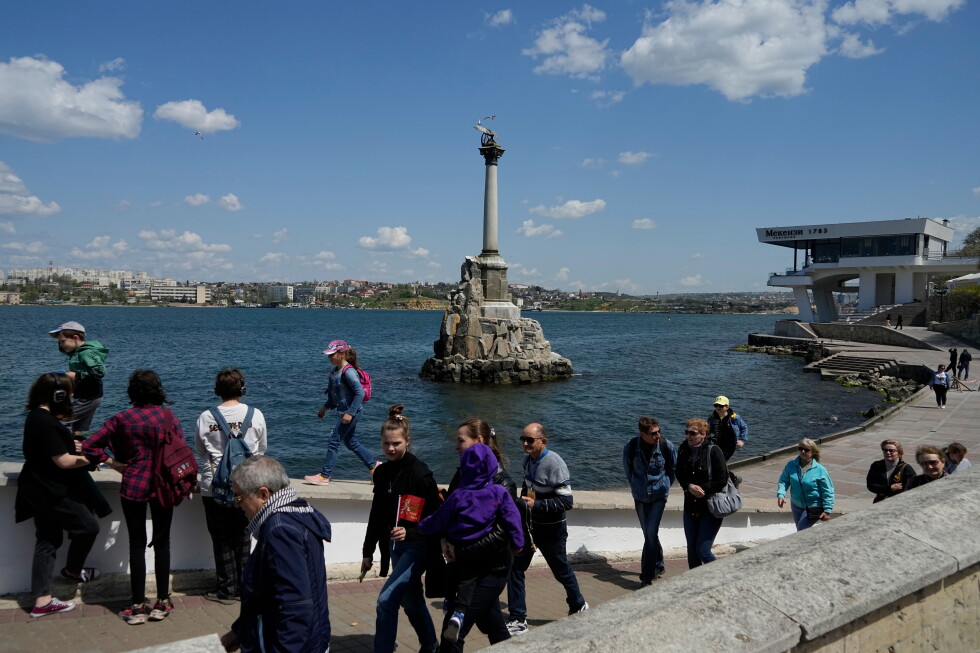
The acute fuel shortage is already being felt acutely by civilian residents and tourists in Crimea. While the peninsula has experienced periodic supply disruptions from Ukrainian strikes in past years, current shortages represent the worst crisis since the 2014 annexation. In late May, occupation authorities introduced strict rationing, capping sales at just 20 liters of gasoline per vehicle per week, distributed via prepaid coupons. The entire allocation of coupons sold out within minutes of being released on an official government messaging channel, leaving motorists waiting for hours in snaking lines at the few stations still selling fuel.
Social media platforms have been flooded with residents sharing tips for locating scarce fuel and pleas for assistance, while authorities have launched a dedicated hotline to assist tourists who have found themselves stranded without fuel. While ferries have supplemented fuel shipments from mainland Russia after Kerch Bridge traffic was restricted, and private motorists are allowed to bring up to 100 liters of fuel into Crimea per vehicle from the mainland, the additional supply has been far too little to meet demand. Unregulated black market speculators are now selling gasoline at twice the official market price.
The crisis has already delivered a severe blow to Crimea’s tourism sector, which is the backbone of the local economy. The peninsula drew nearly 7 million Russian tourists in 2024, and occupation officials had projected an even higher number for the 2025 summer season. However, business daily Kommersant reports that roughly 80% of hotel bookings were canceled in late May and early June as travelers avoid the unstable region. Some hotels have even begun offering free gasoline as a booking incentive to attract hesitant visitors, offers that were immediately taken up by the few travelers still planning trips.
Recent attacks on passenger rail lines have further eroded traveler confidence. Earlier this week, a Ukrainian drone strike hit a passenger train traveling from Moscow to Crimea, wounding the engineer and killing his assistant, forcing a temporary suspension of all rail service and the evacuation of passengers by bus. A prior strike on a commuter train in Crimea killed one person and injured three others, prompting occupation authorities to cut daytime service over security concerns.
In a rare public acknowledgment of the scope of the crisis, Kremlin spokesman Dmitry Peskov confirmed this week that widespread fuel shortages exist and pledged that authorities are taking urgent measures to resolve the issue. The Russian Defense Ministry has remained publicly silent on the repeated strikes along the Crimean land corridor, but prominent Russian pro-war military bloggers have fiercely criticized the military establishment for failing to anticipate the Ukrainian campaign and mounting a glacial, ineffective response. Some bloggers have called for mandatory military escorts for all fuel convoys traveling the corridor, while others have urged the Russian military to escalate strikes on Ukrainian energy and transport infrastructure in retaliation.
As the fuel crisis and internal criticism continued to unfold, Ukraine delivered an additional symbolic blow to Moscow this week, striking a historic landmark in Sevastopol that houses a massive panoramic painting commemorating the 19th century Russian defense of the city during the Crimean War. According to Mikhail Razvozhayev, the Kremlin-appointed mayor of Sevastopol, the painting was completely destroyed in the fire that followed the strike. Given Putin’s long-standing framing of the 2014 annexation of Crimea as a fulfillment of Russian imperial and historical destiny, pro-war blogger Valery Shiryayev noted the attack would be particularly infuriating to the Russian leader.
“It’s hard to find another work of art, another part of national heritage, whose destruction would be as painful for Putin,” Shiryayev said.
As of Thursday, the full-scale Russian invasion of Ukraine entered its 1,569th day, surpassing the total duration of World War I, with Russian frontline advances having ground to a near standstill even as Ukraine demonstrates growing capability to strike deep into Russian-held and Russian territory.