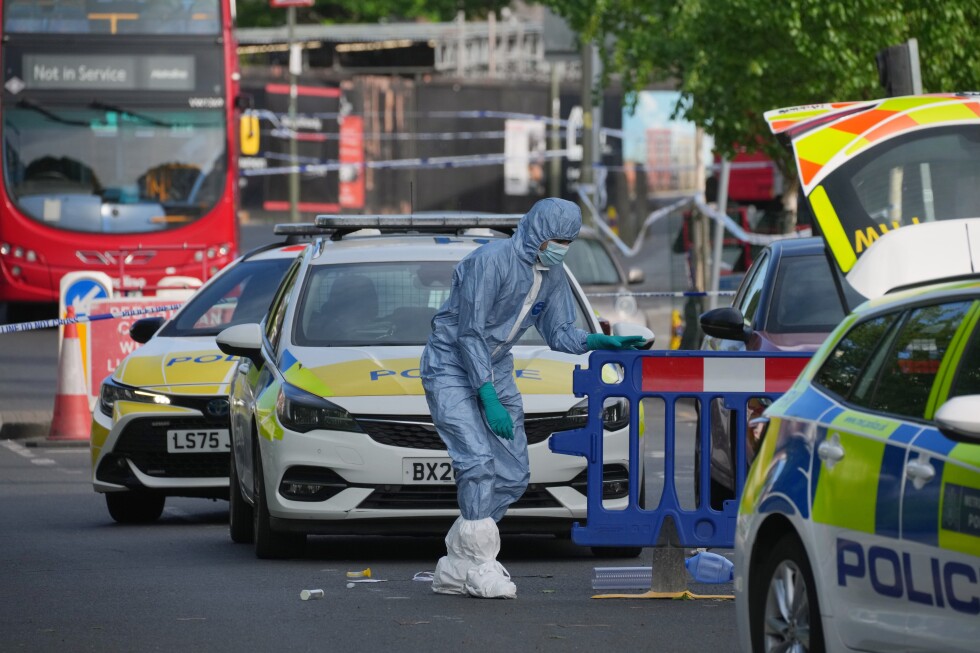
LONDON – In the wake of a fatal terror stabbing last year and a double stabbing that left two Jewish men seriously injured this week, the British government formally declared antisemitism a national emergency on Thursday, committing £25 million ($34 million) to boost security at Jewish community sites across the country.
The latest violent incident unfolded Wednesday in Golders Green, a northwest London neighborhood widely recognized as one of the hubs of British Jewish life, home to dozens of synagogues, Jewish schools, and kosher businesses alongside diverse Asian and Middle Eastern communities. Two men, aged 34 and 76, were stabbed in the attack; both remain in stable condition as of Thursday.
Counterterrorism police took a 45-year-old suspect into custody on suspicion of attempted murder, and have officially classified the stabbing as a terrorist act. Law enforcement officials confirmed the suspect, who has not been publicly identified, has a documented history of severe violence and mental health conditions. Detectives executed a search warrant at a property in southeast London Thursday, following reports the suspect was involved in a local altercation in the area hours before the Golders Green attack. Investigators are still working to confirm a definitive motive, and are assessing unverified claims of responsibility and potential links to Iranian-backed proxies.
The stabbing is also being examined for possible connections to a recent string of arson attacks targeting synagogues and other Jewish sites across London, which began after the outbreak of the Iran war on February 28. No injuries have been reported in the arson incidents, and multiple suspects ranging from teenagers to people in their 40s have been arrested and charged in connection with the attacks. A little-known group calling itself Harakat Ashab al-Yamin al-Islamia (Islamic Movement of the Companions of the Right) has claimed responsibility for the arsons online, and also claimed the Golders Green stabbing. Israeli officials describe the group as a newly formed militant organization with ties to an Iranian proxy, which has also carried out synagogue attacks in Belgium and the Netherlands. Home Secretary Shabana Mahmood noted Thursday that authorities are still working to determine whether the group’s claim is legitimate or an opportunistic false claim of responsibility.
For the British Jewish community, which numbers roughly 300,000 people – less than 0.5% of the UK’s total population – this recent violence marks the latest escalation in a surge of antisemitic activity that began nearly two years ago. Data from the Community Security Trust (CST), a charity that monitors antisemitism and protects Jewish communities, shows reported antisemitic incidents jumped from 1,662 in 2022 to 3,700 in 2025, a surge that followed the October 7, 2023, Hamas attack on southern Israel and the subsequent Gaza war. The violence reached a deadly peak in October 2025, when an attacker drove a vehicle into a crowd gathered outside a Manchester synagogue on Yom Kippur, fatally stabbing one person; a second person died during the response after being inadvertently shot by police.
The sharp rise in antisemitic hostility has ignited fierce political debate over the role of widespread pro-Palestinian protests held across the UK since the Gaza war began. While the vast majority of these demonstrations have remained peaceful, many Jewish community members and political leaders argue that some rhetoric and chants used at the protests – most notably the slogan “From the river to the sea, Palestine will be free” – cross the line from criticism of Israeli policy to open incitement of antisemitic hatred. A small number of protesters have been arrested for openly expressing support for Hamas, which is classified as a banned terrorist organization in the UK.
Jonathan Hall, the UK’s former independent reviewer of terrorism legislation, has publicly called for a temporary ban on large pro-Palestinian marches, arguing that the demonstrations have created an environment that “incubates” antisemitic violence. Kemi Badenoch, leader of the opposition Conservative Party, has backed the call for a ban, claiming the protests are routinely used as cover for violence and intimidation targeting Jewish communities.
Speaking Thursday, Mahmood emphasized that the government is treating the current antisemitism crisis as a top national security priority. “I am treating antisemitism as an emergency – it is the top pressing issue in relation to security that I face,” she said. The new £25 million security funding will be used to expand visible police patrols and upgrade physical protection at synagogues, Jewish schools, and Jewish community centers across the UK. In addition to the new security investment, the government announced Thursday it will introduce new legislation to allow prosecution of individuals and groups that operate on behalf of state-sponsored terrorist organizations, a move widely seen as targeted at Iranian-linked groups operating in the UK.