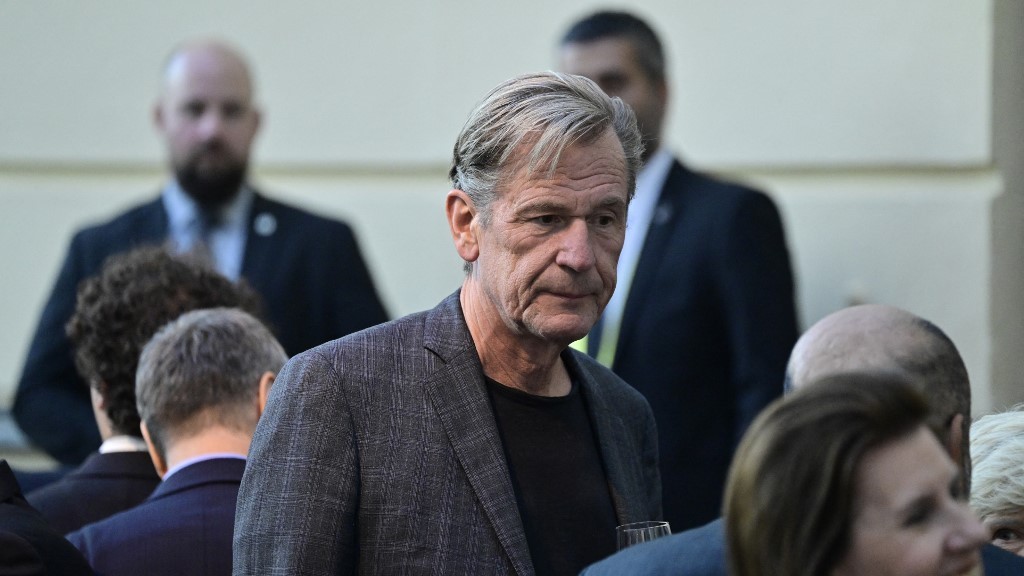
A fierce debate over journalistic independence has erupted across global media properties owned by German media giant Axel Springer, after CEO Mathias Dopfner explicitly told staffers that unwavering support for Israel is a non-negotiable core condition of employment at the company’s outlets, including Politico and the newly acquired Telegraph. The confrontation has thrown a harsh spotlight on the ideological direction of Axel Springer’s expanding international media empire, raising urgent questions about whether top-down political demands will skew impartial news coverage of the ongoing Israel-Gaza conflict.
The controversy came to a head this week during a charged internal company meeting, convened after a group of Politico journalists submitted an open letter to incoming editor-in-chief Jonathan Greenberger. In the letter, the journalists accused Dopfner — a media magnate long nicknamed “Germany’s Rupert Murdoch” for his outsized political influence and consolidated media holdings — of leveraging the publication to advance his personal partisan political agenda. The letter noted that Dopfner’s recent public opinion pieces have already put Politico’s hard-won reputation as an impartial, trusted political news outlet at serious risk, according to reporting from Jewish Insider.
Axel Springer first acquired Politico, the leading U.S. and European political news platform, in a 2021 deal, and only secured regulatory approval to purchase the iconic UK title The Daily Telegraph earlier this month. That acquisition has amplified industry and newsroom concerns that the ideological mandates set by company leadership will reshape editorial standards and coverage lines across all of Axel Springer’s properties, particularly its coverage of Israel. Israel is currently facing allegations of genocide at the International Court of Justice, stemming from its military campaign in Gaza that has killed at least 72,599 people and injured more than 172,410 others to date.
During the meeting, Dopfner doubled down on his stance, framing loyalty to Israel as a central component of the company’s five publicly stated core values, which it calls the “essentials”: freedom, free markets, individual autonomy, freedom of speech, and explicit support for Israel. He placed support for Israel immediately after the four foundational principles, and made clear that anyone who questions this mandate is not aligned with the company’s identity. “If that is something that somebody wants to question, then we are really reaching the very fundamental principles of our values,” Dopfner told assembled staff. “And that then may lead simply to the decision that, because we are very transparent about it, it is then an individual decision whether Axel Springer and somebody who has so fundamentally different beliefs is really a good fit.”
This mandate is far from an out-of-character statement for Dopfner: it follows a years-long pattern of provocative pro-Israel rhetoric that has sparked controversy. Last year, a leaked internal email published by German outlet Die Zeit ended with the line: “Zionism uber alles. Israel my country.” The phrase “Zionism uber alles” carries uniquely toxic baggage in Germany, as the identical wording opened the national anthem during the Nazi era, and became a symbol of ideological supremacism. The remark drew widespread condemnation across German political and media circles when it was leaked.
The controversy has also drawn attention to Dopfner’s close ties to the Israeli government: in October 2023, Israeli President Isaac Herzog awarded Dopfner the Israeli Presidential Medal of Honor, alongside Miriam Adelson, a prominent casino billionaire, major pro-Israel political donor, and owner of the NHL’s Dallas Stars.
During the internal meeting, journalists pushed back directly against Dopfner’s pattern of editorial intervention, calling for stricter fact-checking and evidentiary standards for opinion pieces written by the CEO himself. In one specific exchange, staffers criticized Dopfner for an opinion piece that referred to Iran as an aggressor systematically pursuing nuclear weapons, arguing the claim was misleading and required additional context and clarification. Iran has consistently and repeatedly denied any plans to develop a nuclear weapon, a fact that went unmentioned in Dopfner’s piece. Notably, while Dopfner described the claim that America is the world’s largest democracy as a self-evident fact that requires no proof, global demographic rankings widely recognize India, with a population of 1.4 billion, as the world’s largest democracy.
Dopfner rejected the criticism entirely, arguing that his claims about Iran were beyond debate. “I think you have to qualify or prove arguments or points if they are new or if they are debatable – but for me at least, these two facts – that the Iranians are working on the nuclear bomb and that they are aggressors for decades – are so obvious, so proven for many times, they are almost – it’s like saying America is the biggest democracy in the world,” he said. “I don’t have to prove that.” He closed by confirming that he plans to expand his opinion writing, not scale it back, telling staff he intends to “write more in the future, not less.”
The ongoing confrontation has intensified broader scrutiny of media consolidation and top-down ideological control in global news, as newsroom advocates warn that mandatory loyalty oaths for journalists set a dangerous precedent that undermines the public’s trust in independent news coverage.