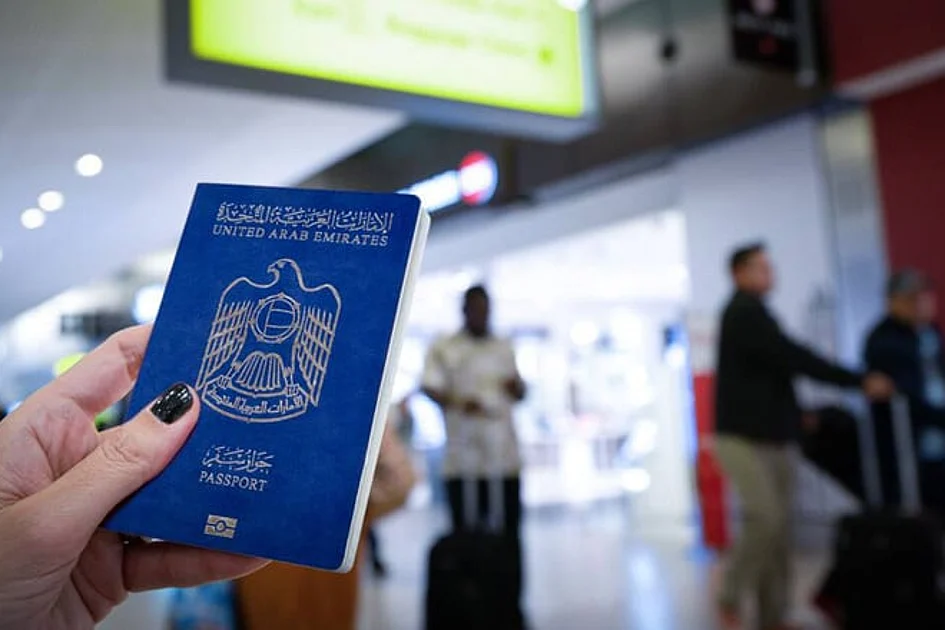
The United Arab Emirates has achieved a landmark position in global mobility rankings, with its passport now ranked as the world’s fifth most powerful according to the 2026 Henley Passport Index. This represents a significant five-spot climb from the previous year, continuing the nation’s remarkable ascent in global passport rankings.
The Emirates passport now provides visa-free or visa-on-arrival access to 184 destinations worldwide, placing it alongside European nations Hungary, Portugal, Slovakia, and Slovenia in the fifth position. Notably, the UAE passport now surpasses those of traditional Western powerhouses including the United States, United Kingdom, Canada, Australia, and New Zealand in terms of global access.
Singapore maintained its top position with access to 192 countries, followed by Japan and South Korea in second place. The third position was shared by Denmark, Luxembourg, Spain, and Sweden.
The UAE’s transformation represents the most dramatic success story in the index’s two-decade history. Since 2006, the Emirates has added an unprecedented 149 visa-free destinations to its passport privileges, climbing 57 positions from its 62nd place ranking twenty years ago. This extraordinary ascent is attributed to sustained diplomatic engagement and strategic visa liberalization policies.
Despite this expanded access, UAE passport holders still require visas for 42 global destinations.
Historical ranking data reveals the consistent upward trajectory:
– 2016: 38th
– 2020: 18th
– 2024: 11th
– 2025: 10th
– 2026: 5th
Industry experts highlight the broader implications of these shifts. Dr. Juerg Steffen, CEO of Henley & Partners, noted: “We’re witnessing a fundamental transformation in how globally mobile individuals perceive access and security. In an era of geopolitical uncertainty, residence and citizenship planning has evolved into an essential strategy for building resilience across multiple jurisdictions.”
Misha Glenny, Rector of the Institute for Human Sciences in Vienna, emphasized the diplomatic significance: “Passport power ultimately reflects political stability, diplomatic credibility, and the ability to shape international rules. The erosion of mobility rights for countries like the US and UK signals deeper geopolitical recalibration.”
The trend has sparked increased interest in alternative residence options, particularly among Americans. Professor Peter J. Spiro of Temple University Law School observed: “What was once seen as an extreme contingency has become mainstream risk management—a durable Plan B that offers security and peace of mind in an increasingly unpredictable world.”