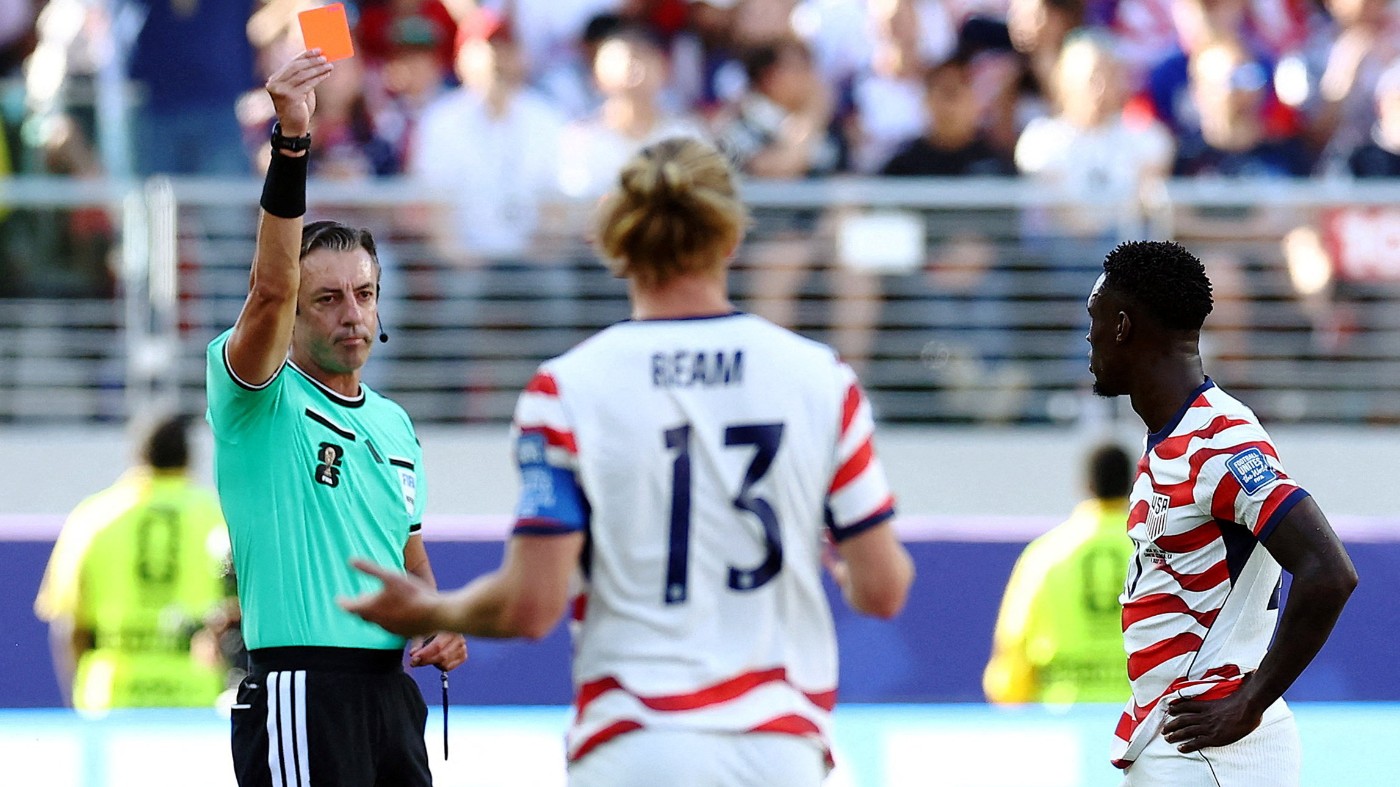
A bombshell report from The Times of London has thrown global football governance into chaos, after revealing that a single Emirati member of FIFA’s disciplinary committee acted alone to overturn a mandatory suspension for United States forward Folarin Balogun in an unprecedented World Cup decision.
Balogun was sent off during the United States’ Round of 32 knockout match against Bosnia and Herzegovina, which under standard World Cup rules triggered an automatic one-match suspension that would have forced him to miss the Americans’ next clash against Belgium. But just days after senior U.S. officials – including then-President Donald Trump – reached out to FIFA leadership, the governing body reversed the suspension using Article 27 of its Disciplinary Code, a provision that is almost never invoked to overrule automatic red card penalties.
Trump later confirmed he had contacted FIFA president Gianni Infantino to request a review of the red card, arguing that the original sending-off was unfair, but denied placing any formal pressure on the global football body to reverse the ban. Contrary to FIFA’s initial statement that the decision was handled by an independent judicial panel, The Times’ reporting confirms that Mohammad al-Kamali, the chairman of FIFA’s disciplinary committee, made the call entirely on his own, without consulting any of the committee’s 17 other members.
The revelation has sparked new questions about potential conflicts of interest, coming shortly after the U.S. government announced a major loosening of export controls on the United Arab Emirates, a close U.S. diplomatic ally. The relaxed rules open the door for easier exports of sensitive military hardware, commercial satellites, advanced artificial intelligence chips, and unmanned aerial vehicles to the Gulf state.
Additional reporting from the Financial Times further undercuts claims of collective procedural fairness, revealing that 110 of the disciplinary committee’s most recent published decisions were also issued solely by al-Kamali. Notably, the Balogun decision itself has never been made public, a departure from standard transparency protocols. When contacted by the BBC for comment on the case over the weekend, al-Kamali declined to answer any questions.
This decision marks the first time an automatic red card suspension has been reversed since the rule was introduced for World Cup play, a break with precedent that has sparked fierce backlash across European football. UEFA, the European governing body for the sport, issued a rare public rebuke, calling the overturn “unprecedented, incomprehensible and unjustifiable.” For his part, Infantino acknowledged that Trump had reached out about the case but maintained that the process was handled independently by competent FIFA bodies.
Despite the reprieve that allowed Balogun to play against Belgium, the United States ultimately exited the tournament after a lopsided 4-1 defeat to the European side. Many football commentators have noted that the controversial decision appeared to galvanize the Belgian squad, who channeled public anger over the ruling into their dominant on-pitch performance.