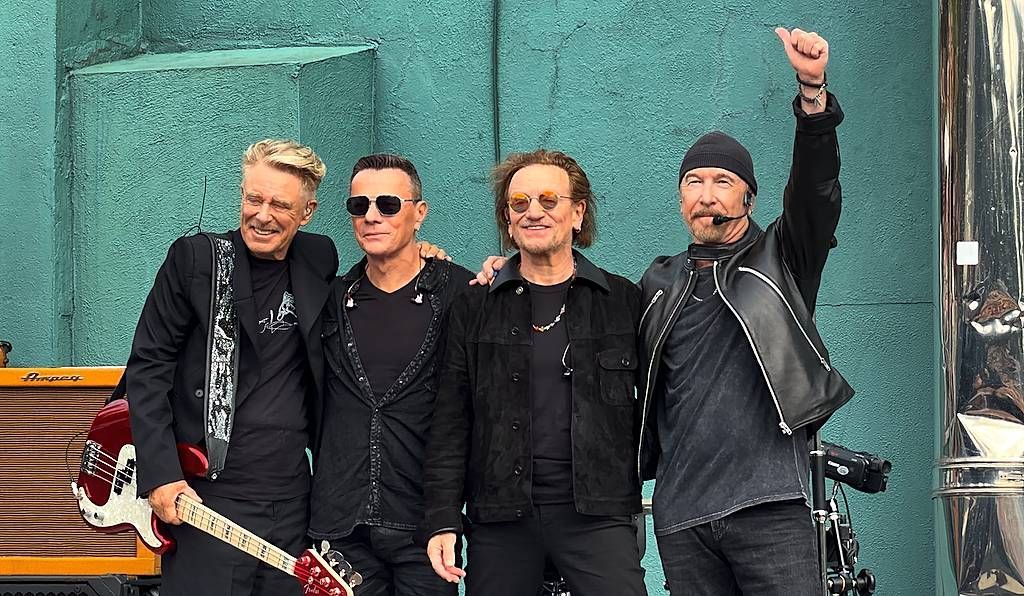
Half a century after four teenage strangers gathered around a Dublin kitchen to form what would become the world’s most iconic rock bands, U2 has returned to where their journey started. On September 25, 2026, exactly 50 years after their first audition, the legendary quartet played a surprise seven-song set for current students on the playground of Dublin’s Mount Temple Comprehensive School – the same institution where all four members were pupils in the mid-1970s.
Stepping onto the temporary stage built in the playground, frontman Bono greeted the cheering crowd with a playful quip: “We’ve escaped from the lab. How’s the experiment working for you?” Though most of the school’s current students were not alive when U2 reigned as the world’s biggest band, the reception was nothing short of hero worship. Young fans waved hand-painted signs reading “I love U2”, “It’s a beautiful day – no school”, and “Bono, my mum says hi!” as the band launched into a career-spanning set that pulled from five decades of hits, alongside their brand-new single *Silencio*.
The set included staples *I Will Follow*, *Vertigo*, *With Or Without You*, *Beautiful Day*, *Out of Control* and *One*, and even featured guest accompaniment from student musicians of Ireland’s Music Generation education programme – an initiative U2 helped found and fund 15 years ago. During the performance, teachers at first had to pull down students who had climbed onto their classmates’ shoulders for a better view, but many soon dropped their discipline and joined in the dancing. Standing on the ground where U2 played their very first debut gig in 1976, Bono was visibly overcome with emotion, pausing mid-speech before managing to express his gratitude: “Thanks for, er… Yeah… I didn’t… Wow.”
The band’s origin story, shared in new interviews with BBC News, is equal parts messy chance encounter and happy accident. It all began when 14-year-old drummer Larry Mullen Jr pinned a handwritten note to Mount Temple’s noticeboard that read simply: “Drummer seeks musicians to form band.” Mullen Jr. revealed the idea was never actually his – it was his frustrated father, tired of his son practicing alone at home, who pushed him to find collaborators. “I wasn’t very good at many things, and playing the drums was included in that. So I think he, out of frustration, said I should try and play with other people,” Mullen Jr. explained, with Bono joking in response: “And unfortunately, he got the three of us.”
Auditions were held just a few days later, on 25 September 1976, in the Mullen family kitchen. Bono, then going by his birth name Paul Hewson, was 16 and nearly skipped the audition entirely – he thought he was too old to fit in with a group of younger students. It was only a ride from his friend Reggie Manuel on a rickety old Yamaha DX100 motorbike (which Bono jokes he still tells people was a Harley Davidson) that convinced him to attend. The first rehearsal was far from promising: there was more chatting than playing, future bassist Adam Clayton was selected more for his “best hair” than his (non-existent) bass skills, and Bono – who hoped to play guitar – forgot to bring his instrument. But even that chaotic first day had a hint of what was to come: halfway through the rehearsal, a group of screaming young fans already tried to climb the Mullen family garden wall. Clayton recalled that moment sealed the deal for him: “Larry already had a fan club, and we thought, ‘Well, if he’s got a fan club, that looks pretty good to us. Maybe if we hang out with this guy, it might stretch a little further.’” Mullen Jr. infamously turned a garden hose on the crowd, a move he still defends as playful kindness on a hot day, leading Bono to joke: “It’s been the story of our lives ever since. He doesn’t even want to have fans, but we quite like them.”
From that humble kitchen starting point, the band that was first called Feedback, then The Hype, and finally U2 would go on to conquer the world. They have sold more than 175 million records worldwide, packed stadiums across every continent, and reinvented rock stadium touring with boundary-pushing productions like the 1992 Zoo TV Tour, which revolutionized the use of large video screens and multimedia backdrops for live shows. Over decades, they shifted from scrappy punk upstarts to arena rock icons, then embraced electronic and dance experimentation on 1990s albums *Achtung Baby*, *Zooropa* and *Pop*, never sticking to one sound. Guitarist The Edge, born Dave Evans, credits the band’s 50-year longevity to their lack of formal musical training: “It’s been a guiding light, in some ways, the limitations of the band. We’re in this place where, musically, we never know what’s about to happen. It can fall apart or it can become something extraordinary. And that’s the beauty of U2.” A core decision to split all earnings equally among the four members has also helped them stay close for five decades.
Back at Mount Temple on Friday, Bono paid tribute to the school that nurtured the band’s early days, dedicating the performance to the late school councillor Jack Heaslip, who later served as a traveling chaplain for U2’s tours before passing away from motor neurone disease in 2015. He noted that the support of teachers allowed the band to realize their potential right where they were: “maybe all we needed was around us, just under our feet.”
The surprise homecoming gig also doubled as a launch pad for U2’s next chapter. Ahead of the show, the band officially announced their 16th studio album, *Carnaval de Luz*, set for release this November. The record will cap off a three-part project that began with February’s fiery *Days of Ash* EP, which addressed global crises including ICE killings in the U.S., the war in Ukraine and the Israel-Palestine conflict, followed by April’s softer *Easter Lily* EP. The band describes *Carnaval de Luz* as “a messy, provocative, sacred collection of songs”, with Bono promising “loud guitars, deep bass [and] ecstatic rhythms.” The album’s closing track, *Torn*, holds extra historic weight: it was co-written with country icon Dolly Parton, and marks Parton’s final recorded performance before her death last month. The track is described as “a tender country song detailing broken family ties, that holds wider resonances.” BBC News will publish a full interview with the band about the new album and *Torn* in the coming weeks.