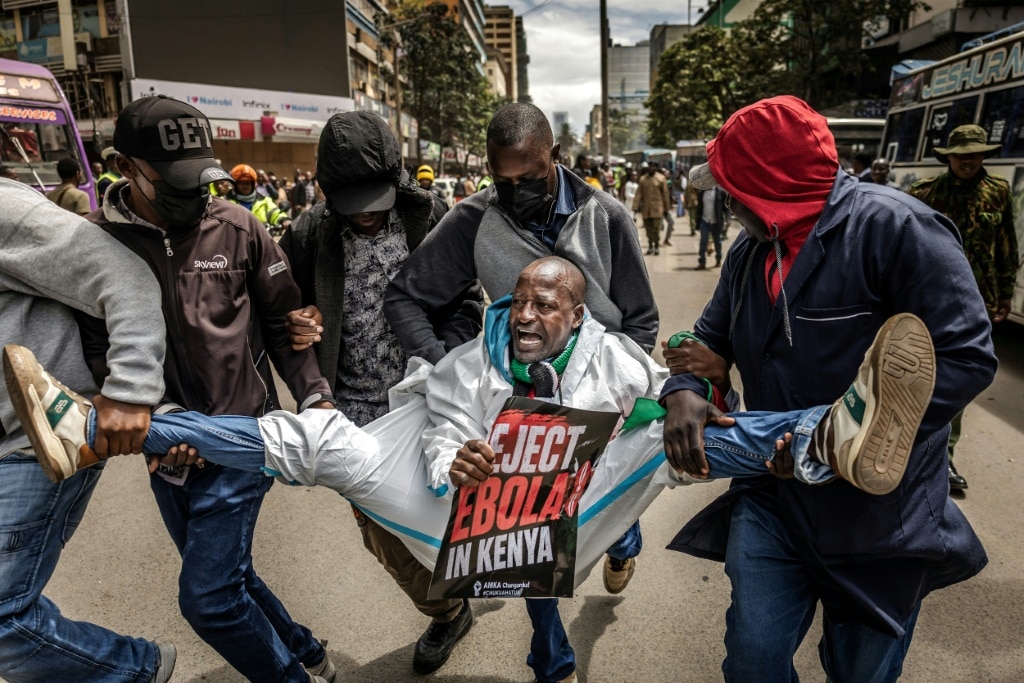
Tensions over a proposed U.S.-built Ebola quarantine facility for American citizens in Kenya boiled over into deadly violence this week, leaving at least two people dead amid widespread public anger over the project, a regional human rights group has confirmed. The unrest has thrown the future of the planned site into question, after Kenya’s High Court ordered an immediate pause to construction and implementation amid mounting legal and public pushback.
The facility, constructed on Laikipia Air Base in central Kenya roughly 200 kilometers from the capital Nairobi, was scheduled to open last week. Developed with U.S. backing, the site was designed to hold up to 50 people for quarantine, with all operations to be managed by U.S. medical personnel. Its stated purpose was to isolate American travelers arriving from the Democratic Republic of the Congo (DRC), which is currently grappling with a large, ongoing Ebola outbreak that has been declared a major public health emergency. In addition to building the facility, the U.S. State Department announced last week it would allocate $13.5 million to support Kenya’s broader national Ebola preparedness and response initiatives.
Despite the public health framing of the project, it sparked immediate public outrage across Kenya. Many Kenyans argued that allowing the U.S. to operate a quarantine center for potentially Ebola-exposed patients on Kenyan soil posed an unacceptable public health risk to local communities, particularly since Kenya has not recorded any confirmed Ebola cases to date despite rigorous screening of incoming travelers. Neighboring Uganda has recorded 15 confirmed cases and one death from the current outbreak, stoking regional anxiety about the virus’s spread.
Violent protests erupted near the Laikipia facility on Monday, with local media footage showing clashes between demonstrators and security forces. Police deployed tear gas to disperse the crowd of protesters, who had gathered to oppose the center. Hussein Khalid, a leader with Kenyan human rights organization VOCAL Africa, announced via a post on X Tuesday that a 27-year-old man had been shot and killed during the clashes, dying instantly at the protest site. Khalid told Agence France-Presse (AFP) that a second fatality had also been confirmed, though the identity of the second victim was still being finalized as of Tuesday. Kenyan police have so far declined to confirm the two deaths when contacted by AFP.
As unrest grew, Kenyan President William Ruto issued a public defense of the project this week, seeking to calm public fears. In a post on X Tuesday, Ruto argued that the U.S. facility was “neither unique nor exceptional” and instead framed it as one component of Kenya’s broader national Ebola preparedness infrastructure. Ruto added that the facility would “serve the people of Kenya and our friends, including the Americans,” and told the public, “We are a responsible government. We know what we are doing. So people should relax.”
The legal challenge to the facility, filed by Kenyan human rights organization Katiba Institute, resulted in a major win for opponents this week. The Kenyan High Court extended an existing temporary halt to the project on Tuesday, and ordered the Kenyan government to disclose all formal agreements related to the facility within seven days, increasing transparency around the controversial deal.
On Tuesday, a new wave of peaceful demonstrations unfolded in central Nairobi. Protesters wore white protective medical gear, carried a mock coffin marked with the word “Ebola,” and held signs reading “Reject Ebola in Kenya” to demand the project be scrapped entirely.
The current Ebola outbreak in the DRC has grown significantly since it was first declared in mid-May. The World Health Organization (WHO) updated its case count Tuesday, confirming 321 total confirmed cases and 48 deaths linked to the outbreak. So far, one U.S. citizen – a medical missionary working in the DRC – has contracted Ebola during the outbreak; he was evacuated from the region and is currently receiving treatment in Germany.
The controversial quarantine plan has also drawn criticism from U.S. political leaders. Democrats on the House Foreign Affairs Committee criticized the initiative in a post on X, arguing that the U.S. government should take responsibility for repatriating and treating American citizens exposed to Ebola rather than outsourcing that responsibility to a foreign government.