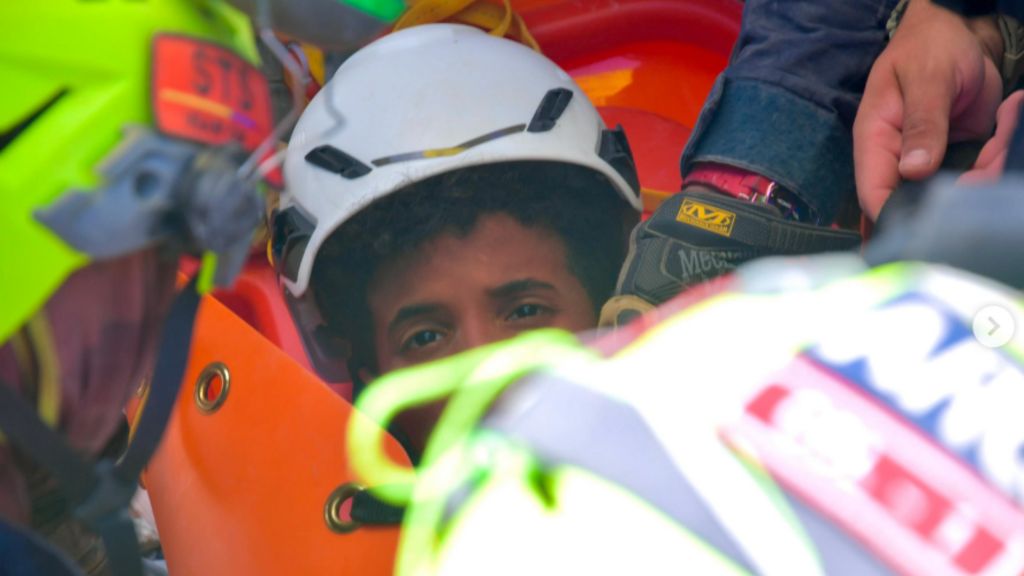
Just days after a pair of powerful back-to-back earthquakes devastated large swathes of coastal Venezuela, two 11-year-old boys have been pulled alive from the rubble of collapsed buildings, separated by only hours in dramatic rescue operations that have reignited hope across the disaster zone.
The first child, identified as Moises, was extracted from roughly 3 meters of compacted debris on Saturday following six hours of meticulous, high-risk work by rescue teams, Colombia’s National Unit for Disaster Risk Management confirmed. Video of the rescue captured the moment Moises was lifted from twisted concrete and metal beams, his eyes covered to shield them from sudden sunlight, as onlooking rescuers erupted in applause. Reuters reported that the boy was located close to the bodies of his mother and sister, who did not survive the disaster.
Within hours of Moises’ rescue, Venezuela’s interim President Delcy Rodríguez announced that a second 11-year-old boy had been pulled from wreckage in the hard-hit coastal town of Caraballeda. Rodríguez shared a video of the operation on X, showing the child carried on a stretcher down a towering mound of rubble. “In these hours, every life is hope for Venezuela,” she wrote in the accompanying post.
The twin disasters, registering magnitude 7.2 and 7.5, struck just 39 seconds apart last Wednesday, reducing hundreds of structures to rubble and leaving untold numbers trapped beneath. As of Sunday, official reports have confirmed at least 1,430 deaths, with tens of thousands more still unaccounted for. More than 85 hours have passed since the initial quake, but rescue teams have refused to abandon search efforts, saying survivors can still hold on if they have access to water and food under the debris.
Desperate family members have led informal search efforts alongside professional teams, digging through wreckage by hand when heavy equipment has not arrived. Multiple survivors told the BBC they can hear calls for help from trapped people, but are unable to move heavy concrete slabs on their own.
La Guaira state, the coastal region home to Caraballeda, has suffered the worst damage. Rescue operations have been slowed by ongoing aftershocks, which have added to the terror of displaced residents. “To be honest, it makes you feel kind of nervous. Any little noise… horrible,” 64-year-old bus driver Jesús Andueza told BBC Mundo.
Thousands of people left homeless by the quakes have taken shelter in open spaces, sleeping in their cars or setting up informal camps at local sites including the state airport and Caraballeda’s 18-hole golf course. What was once a carefully maintained recreational space has now been transformed into the main hub of the region’s emergency response: its manicured fairgrounds host a makeshift hospital, a centralized donation sorting center, and a helicopter landing pad that receives supplies and rescue personnel from across Venezuela and around the world. Near the small course lagoon, displaced survivors sift through stacks of donated clothing and boxes of food and medicine to meet their basic needs.
Milagros González, a resident of the badly damaged Caribe neighborhood whose apartment building escaped full collapse, fled to the golf course immediately after the quakes with her two young daughters and two elderly relatives. “I left with my two young daughters and my two elderly relatives. But thank God we got out alive. The building can’t be lived in. But we’re alive, which is what matters,” she said. Like many other survivors, González continues to struggle with psychological aftereffects: every time she lies down, she wakes up dizzy, convinced another quake is starting. “A psychologist just told me that it’s part of the process,” she explained, as her daughters played with dolls on a mattress spread across the grass.
In a Sunday video address, Rodríguez confirmed that a second large emergency hub has been set up at the José María Vargas sports complex in La Guaira, where armed forces are organizing the distribution of relief supplies. “everything is functioning as well as possible during these terrible moments, these terrible hours, that our people are enduring,” she said. “Let them know that no one here is alone, not a single family or individual need feel alone. Our people and our state are here, the social protection system is here, and international solidarity is here.”
Despite official reassurances, frustration has mounted among survivors and local residents, who criticize the government’s initial response as slow and inefficient. Entire neighborhoods in the worst-hit areas of Caribe and Tanaguarena have not yet seen any debris removal work begin, days after the disaster.
In recent days, international rescue teams from Mexico, Spain, Qatar, the United States, and the United Kingdom have arrived to reinforce local search efforts. Tom Fletcher, representing the United Nations, said Saturday that 39 search and rescue teams totaling almost 2,000 personnel and 111 search dogs have been deployed across the disaster zone, alongside specialized medical teams. High-tech tools including small “cockroach drones” are being used to locate signs of life deep in collapsed buildings, boosting the chances of pulling more survivors out alive more than three days after the quakes hit.