In a historic legislative vote that marks a turning point for Turkey’s decades-long armed conflict with the Kurdistan Workers’ Party (PKK), Turkish lawmakers on Monday approved a controversial bill that offers a limited legal path for PKK militants to reintegrate into civilian life. The vote, which drew 468 votes in favor, 88 against, and six abstentions, comes 18 months after jailed PKK founder Abdullah Öcalan issued a landmark call for his followers to lay down their arms and pursue Kurdish minority rights through democratic political channels.
Supported by both President Recep Tayyip Erdoğan’s ruling Justice and Development Party (AKP) and the pro-Kurdish DEM Party, the legislation does not grant a blanket amnesty to PKK members. Instead, it suspends prosecutions and custodial sentences for qualifying offenses for a period of five to 10 years. If beneficiaries avoid criminal activity during this suspension window, all related investigations will be dismissed and their sentences will be considered fully served. Notably, individuals convicted of severe violent crimes such as murder are explicitly excluded from the program’s protections. Lawmakers estimate that approximately 3,500 PKK-linked detainees, roughly one-third of all such prisoners currently held in Turkish correctional facilities, could be released in the program’s initial phase.
The most striking omission from the new law is any explicit reference to the status of 77-year-old Öcalan, who has been held in solitary confinement on Istanbul’s Imrali Prison Island for 27 years. Öcalan’s 2025 disarmament call laid the groundwork for the current peace process, and he has remained a central figure in negotiations between the PKK and the Turkish state. Last week, Turkish Vice President Cevdet Yılmaz confirmed to CNN Turk that Öcalan’s case does not fall under the scope of the new legislation, though he added that the aging leader would still be able to contribute to ongoing peace efforts without offering additional specifics.
The legislative debate, broadcast live on public broadcaster TRT, exposed deep divisions within Turkish politics over the peace initiative. For millions of Turkish citizens who lost loved ones to PKK violence over 40 years of conflict, Öcalan is viewed as a violent terrorist responsible for widespread bloodshed. Conversely, many of Turkey’s 15 million-plus Kurdish residents see Öcalan as a heroic champion of Kurdish political and cultural rights, adding a layer of visceral public division to the policy debate.
Nationalist opposition lawmaker Turhan Çömez of the İyi Party fiercely criticized the legislation during debate, challenging the government: “How can you negotiate with terrorists? … You said they would be laying down their weapons unconditionally.” Despite opposition from nationalist blocs, the bill secured cross-bloc support: Özür Özel, leader of Turkey’s new main opposition force the Republican People’s Party (CHP, referenced in the original text as Yeni Parti), backed the bill, arguing that “only peace, democracy and justice will serve as a remedy” for Turkey’s long-running ethnic conflict.
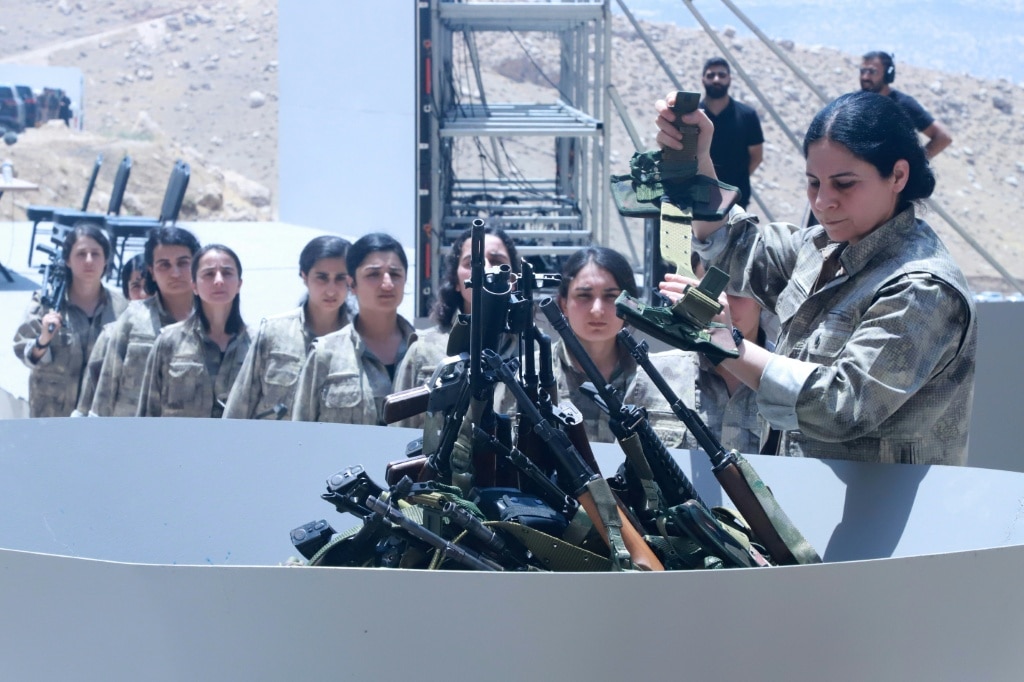
The DEM Party has been instrumental in backchannel negotiations, shuttling between Öcalan on Imrali Island and Turkey’s ruling political establishment since diplomatic outreach restarted in October 2024, with party delegations making regular trips to the prison to facilitate dialogue. Following Öcalan’s disarmament call earlier this year, the PKK formally announced its dissolution in May, and in July, PKK militants held a public historic disarmament ceremony in the mountains of northern Iraq, where they symbolically destroyed stockpiles of weapons.
Even with the legislative breakthrough, significant hurdles remain for the peace process. The PKK leadership has repeatedly stated that excluding Öcalan from the reform is a non-negotiable red line. On the eve of the parliamentary vote, the PKK warned that nearly all of the bill’s provisions would remain a “dead letter” if Öcalan is not granted release from his decades-long solitary confinement.