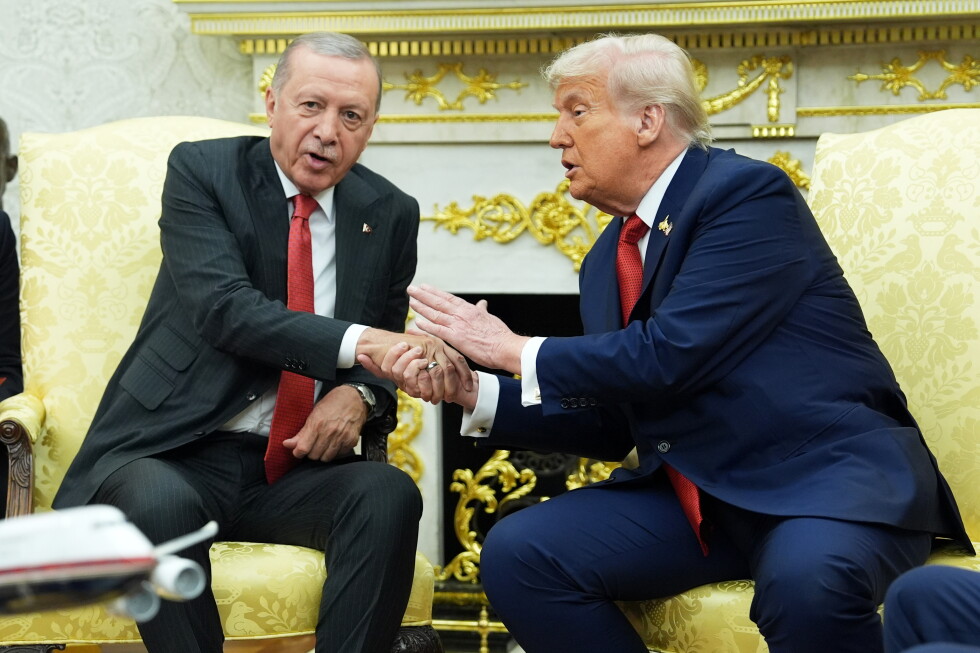
As next week’s NATO summit in Turkey approaches, a unique dynamic between U.S. President Donald Trump and Turkish President Recep Tayyip Erdogan has reshaped expectations for the alliance gathering, with the Turkish leader turning his close personal ties to the American president into both a guarantee of Trump’s attendance and the prospect of a landmark U.S. defense sale.
Unlike many European NATO leaders who have faced repeated public criticism and scorn from Trump in recent years, Erdogan has cultivated a warm rapport that has convinced Trump to make the trip to Ankara. Trump, who has openly admitted he would skip the event for most other heads of state, confirmed his attendance out of personal respect for Erdogan, who personally reached out to lobby for his presence.
The Turkish president’s successful push to secure Trump’s attendance has averted a major crisis for the 31-nation alliance. For years, Trump has repeatedly threatened to withdraw U.S. military forces from Europe and scale back Washington’s longstanding commitment to NATO’s collective defense framework, stoking deep uncertainty among allies. He has also regularly chastised fellow NATO members for failing to meet alliance-mandated defense spending targets, and has more recently clashed with European counterparts over their refusal to back his administration’s hard-line stance against Iran. A Trump no-show would have amplified already existing fears about the future of U.S. engagement with the bloc.
Beyond securing his attendance, Erdogan stands to gain a far more concrete reward: Trump has openly hinted that he will announce progress on long-blocked sales of U.S. defense technology, including F-35 stealth fighter jets and F-110 jet engines, during his visit.
Turkey was removed from the F-35 program in 2019 after moving forward with a purchase of Russia’s S-400 air defense system. U.S. defense officials have long warned that operating the Russian S-400 alongside American stealth aircraft would give Moscow access to sensitive data that could compromise the F-35’s stealth capabilities. Still, Trump suggested as early as last September that he was open to reversing that ban, and confirmed last week that he expects to make an announcement that will please Erdogan on the issue.
On the jet engine front, the Trump administration has already moved to advance a $700 million sale of F-110 engines that Turkey plans to use to power its domestically developed KAAN fighter jet. The State Department recently notified key congressional leaders that it plans to bypass existing bipartisan opposition to the sale, a move that drew swift condemnation from top lawmakers. House Foreign Affairs Committee ranking member Gregory Meeks accused the administration of failing to provide any legal or strategic justification for the move, and of ignoring concerns over Turkey’s continued possession of the S-400 system and broader regional security risks. Bipartisan opposition to F-35 sales remains entrenched on Capitol Hill, with even influential Republican leaders like Senate Foreign Relations Chairman Jim Risch opposing the move as long as Turkey retains the Russian missile system.
Analysts say Erdogan’s close relationship with Trump fits a broader pattern of the U.S. president’s well-documented affinity for authoritarian strongman leaders. Erdogan, who has consolidated power over 13 years as Turkey’s president following his tenure as prime minister, has faced widespread international criticism over democratic backsliding, increased restrictions on freedom of expression, and the widespread prosecution of opposition figures, journalists, and human rights activists. During the Biden administration, Washington kept Erdogan at arm’s length over these human rights and governance concerns, a posture that stands in stark contrast to Trump’s warm embrace of the Turkish leader.
“His relationship with Erdogan, which is pretty strong, is consistent with what seems to be a pattern of his preference,” said Philip Gordon, a former national security adviser to Vice President Kamala Harris and current senior fellow at the Brookings Institution. “It has often been pointed out he seems to have better relationships with adversaries and autocrats, and he certainly says nicer things about them than with allies.” Gordon added, “Erdogan is taking full advantage of it.”
The personal chemistry between the two leaders first developed during Trump’s first term in office, according to Soner Cagaptay, a Turkey expert at the Washington Institute. Cagaptay noted that when the Biden administration invited Erdogan to Washington in 2024 after Turkey approved Finland and Sweden’s accession to NATO, Erdogan declined the invitation — a deliberate snub of the sitting Democratic president that he framed as a gesture of support to Trump ahead of the 2024 U.S. election. Cagaptay said Trump interpreted the move as a significant show of support.
Trump will become the first sitting U.S. president to visit Turkey since Barack Obama’s 2015 trip, and he is scheduled to hold a one-on-one bilateral meeting with Erdogan on the sidelines of the summit. The warming of ties between the two leaders under Trump’s second term extends beyond defense: earlier this year, the U.S. Justice Department dropped a major sanctions-evasion case against Turkey’s state-owned Halkbank, a longstanding point of friction between the two countries. Trump has also appointed his longtime close ally Tom Barrack, who chaired his inaugural committee, as U.S. ambassador to Ankara, a move that Erdogan has welcomed.
The two leaders have maintained steady contact through regular phone calls, covering a range of regional issues including the conflict in Syria, the war in Gaza, and tensions with Iran. Turkey joined Trump’s Gaza Board of Peace, a body tasked with overseeing the ongoing ceasefire in the Palestinian territory. Trump has even publicly claimed that he convinced Erdogan to stay out of the recent conflict between Israel and Iran, a request Erdogan honored, though there is no public evidence that Turkey ever planned to join the fighting.
Erdogan has publicly praised the speed and openness of his communication with Trump, noting that any call between the two leaders is returned within 24 hours. “With my friend Trump, we are opening the door to a new era in Turkish-American relations,” Erdogan said last year after meeting Trump at a previous NATO summit in The Hague. “The process of telephone diplomacy between us has never exceeded 24 hours so far. When we call, the other side responds within 24 hours.”
Even during meetings with other world leaders who have tense relations with Ankara, Trump has made his admiration for Erdogan clear. Last year, during a joint press conference with Israeli Prime Minister Benjamin Netanyahu — whose government is locked in a bitter dispute with Turkey over regional influence — Netanyahu hoped to win Trump’s support for pushing back against Turkish activity in Syria. Instead, Trump publicly lavished praise on Erdogan and urged Netanyahu to take a more conciliatory approach to Ankara.