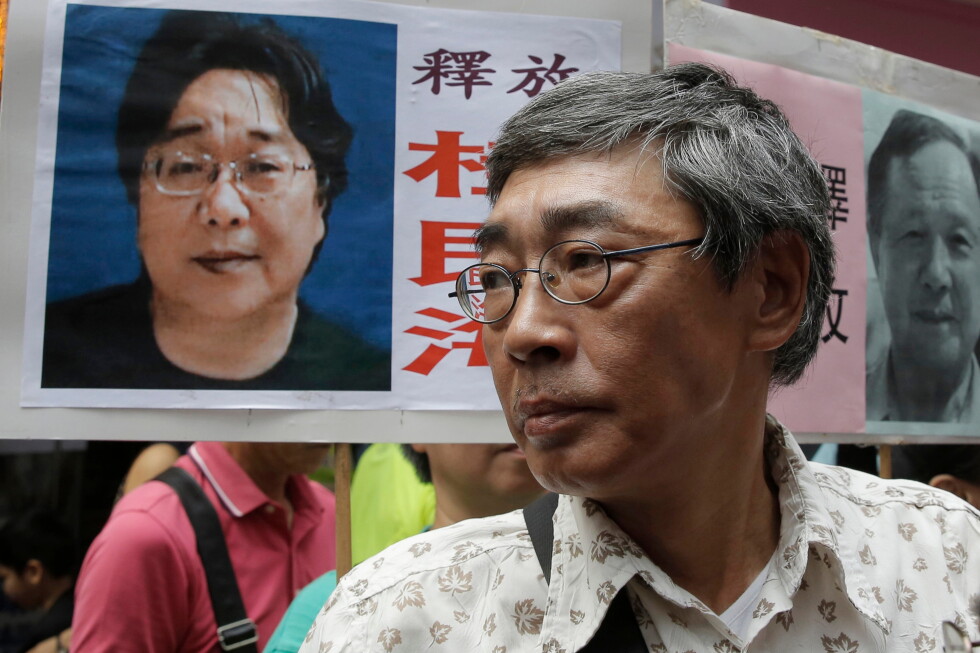
Veteran Hong Kong bookseller Lam Wing-kee, who became a globally recognized symbol of resistance against Beijing’s tightening restrictions on free speech after his 2015 abduction by Chinese authorities, has passed away in Taipei, Taiwan, Taiwan’s official Central News Agency reported Friday, citing an anonymous familiar source.
No official cause of death has been released, but details shared by the outlet indicate the 70-year-old had experienced a recurrence of cancer last year, and was admitted to Taipei’s MacKay Memorial Hospital earlier this week. After slipping into a coma on Wednesday, Lam died on Thursday evening, the report added.
Lam, who spent years working at Hong Kong’s iconic Causeway Bay Books, fled to Taipei in 2019 amid growing fears that he would face politically motivated legal charges under Hong Kong’s new national security law. A year after relocating, he fulfilled his long-held goal by reopening the iconic bookstore under the same name in the Taiwanese capital. Earlier this year, in June, Lam told the Central News Agency he had been forced to temporarily shut down the Taipei store due to his declining health, and could not confirm when or if the shop would welcome customers again.
News of Lam’s death drew immediate condolences from Taiwanese leadership. President Lai Ching-te shared a statement on his official Facebook page honoring Lam’s legacy. “The passing of Mr Lam Wing-kee is deeply saddening, but the courage he left behind would not fade,” Lai wrote. “Taiwan will remember that a Hong Kong bookstore worker once told us in the most ordinary yet most steadfast way how precious freedom is and reminded us that democracy requires the efforts of generation after generation to defend it.”
Lam’s rise as an international figure for free expression began in late 2015, when he became one of five people connected to Causeway Bay Books who disappeared within a span of months. The bookstore had long drawn the ire of Chinese authorities for selling texts that alleged to expose unreported details of Chinese Communist Party leadership’s personal lives and alleged political scandals. Among the five missing booksellers was publisher Gui Minhai, who vanished from his vacation home in Thailand before ultimately being sentenced to 10 years in prison in China on charges of illegally providing state intelligence overseas.
In a bold act of defiance that shocked Beijing’s official narrative, Lam spoke publicly in 2016 to share a firsthand, explosive account of his abduction that directly contradicted the Chinese government’s official version of events. He told reporters that plainclothes Chinese agents seized him in October 2015, immediately after he crossed the border from Hong Kong into the mainland city of Shenzhen. He was blindfolded for a 13-hour train ride to Ningbo, a coastal city in eastern China, where he was held in solitary confinement in a small room for five months, with two-person surveillance teams rotating around the clock to monitor his every move, Lam said. He added that after months of detention, he was forced to deliver a scripted televised confession to criminal charges to be broadcast across mainland China.
Lam’s death comes as authorities in Beijing and Hong Kong have continued to ramp up restrictions on political and press freedom in the semi-autonomous territory, following mass pro-democracy protests that swept Hong Kong in 2019. Just this past June, Hong Kong police arrested two individuals under the sweeping national security law, accusing them of selling seditious publications and receiving funding from foreign political organizations, marking the latest in a years-long crackdown on independent speech in the city.