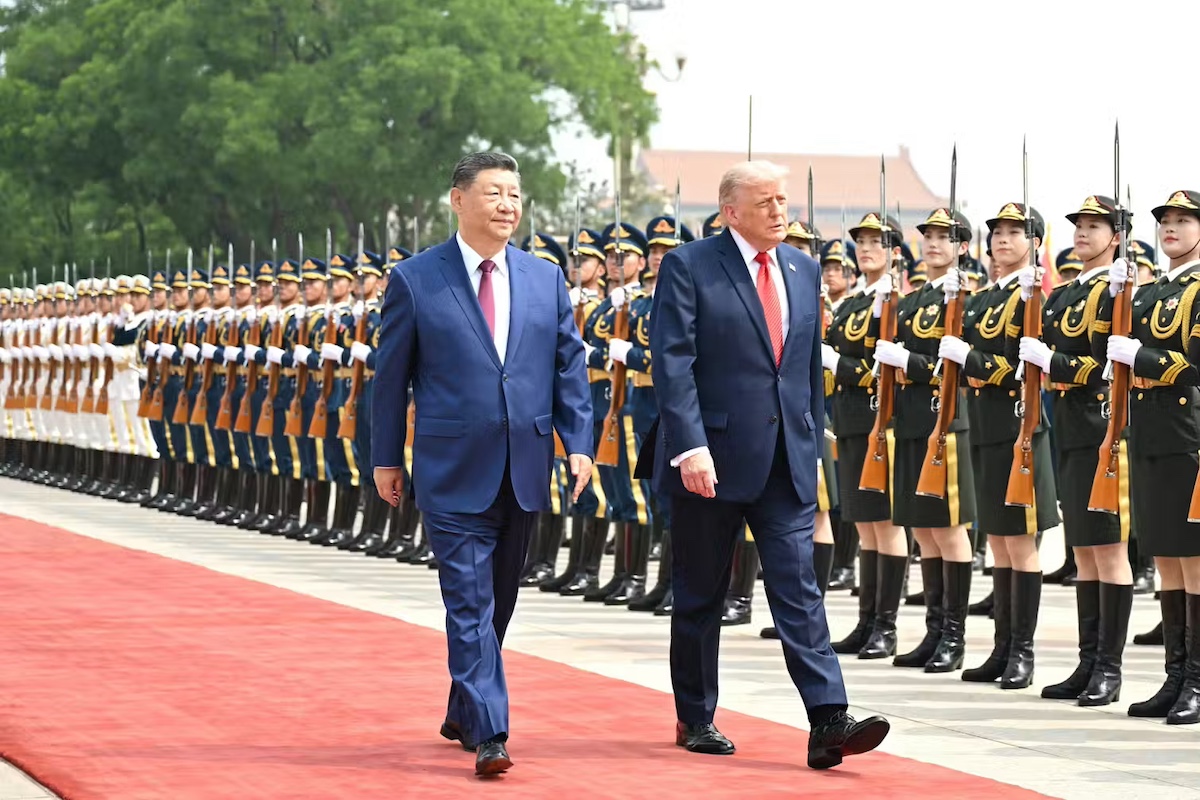
On May 15, 2026, US President Donald Trump concluded his two-day visit to China, wrapping up a high-stakes summit with Chinese leader Xi Jinping that drew global scrutiny for signals about the future of the world’s most consequential bilateral relationship. Trump praised the meetings as “incredible,” while Xi framed the talks as a milestone that opened the door to a “new bilateral relationship.” Yet independent analysts struck a more cautious tone, pointing out that the highly anticipated gathering of the leaders of the globe’s two most powerful nations produced no major tangible breakthroughs.
Yan Bennett, a leading scholar of US-China relations and author of *American Policy Discourses on China*, breaks down her three core observations from the historic summit in this analysis.
### Taiwan: Firm Rhetoric, Unchanged Status Quo
Few observers predicted any major shifts on the Taiwan issue, over which mainland China asserts sovereignty, even as Beijing has long pushed for a clearer US commitment opposing the island’s formal independence and explicitly supporting eventual reunification. What emerged from the summit aligned with expectations: Beijing reaffirmed that Taiwan remains its non-negotiable core priority. Xi emphasized on the first day of talks that the Taiwan “question” is the single most critical issue in US-China ties, warning that any mismanagement could spark “clashes and even conflict.”
This firm rhetoric served two key audiences. First, it addressed domestic political expectations: for decades, Taiwan has held a central place in Chinese political messaging, and the 100 million members of the Chinese Communist Party (CCP) widely expected Xi to take a strong stance on the issue. Second, it delivered a clear warning to Washington against backing Taiwanese independence — a message that did not upend existing US policy. The 2025 US National Security Strategy already explicitly opposes unilateral changes to the status quo from “either side,” signaling to Beijing that Washington also opposes a formal Taiwanese declaration of independence.
Trump did raise the topic of US arms sales to Taiwan during the talks, but long-standing US policy — dating back to the Reagan administration — has barred foreign interference in Washington’s decisions on what defensive weapons it sells to the island. This policy remained entirely unchanged, as did the US’s 1979 commitment to provide Taiwan with sufficient defensive capabilities to maintain its self-defense capacity.
Ultimately, both sides have a shared interest in preserving the status quo on Taiwan, with no party poised to benefit from an immediate shift. That said, Xi’s push to modernize the People’s Liberation Army (PLA) has stirred uncertainty in Washington. Xi has set military modernization milestones that include having the capacity to invade Taiwan by 2027, a timeline that has fueled misinterpretation in the US under the “Davidson window” framework, which claims China intends to launch an invasion by that date.
In reality, China currently lacks the capacity to carry out a successful full-scale invasion of Taiwan. The PLA does not yet possess a blue-water navy capable of sustained independent operations far from Chinese ports, and Taiwan’s rugged geography — with only two suitable landing zones accessible at limited times of year — makes an amphibious invasion extraordinarily challenging. Taiwan has also steadily built up its defensive capabilities, drawing lessons from Ukraine’s resistance to Russia to develop a strategy that would make any occupation cost-prohibitive for Beijing.
Xi’s broader military modernization goal targets turning the PLA into a “world-class military” on par with the US by 2049. Still, the fact that China spends more on domestic internal security than on national defense indicates the CCP’s core priority remains maintaining domestic control, not expanding external military capability.
### Trade: Modest Progress, Tamed Expectations
For years, the US and China have worked to repair and re-stabilize bilateral economic ties, which were once deeply integrated but have grown strained in recent years. Both sides bring clear priorities to the table: Beijing aims to regain the large access to the American market it enjoyed in the 1990s and early 2000s, reversing the fragmentation that followed the 2018 US-China trade war. Since his first term in office, Trump has framed Chinese control of key supply chains and the bilateral trade imbalance as pressing national security concerns, while Washington has also pushed to end unfair trade practices such as requirements that foreign companies share proprietary blueprints, trade secrets, customer data and marketing strategies to operate in the Chinese market.
What tangible outcomes came from the summit? On the surface, results were limited. Small progress was made on allowing US beef exports to resume, and Trump announced that Beijing would purchase 200 Boeing aircraft — a figure far lower than the 500-plane deal that had been rumored in pre-summit media reports. Several Chinese firms also agreed to purchase microchips from US semiconductor giant Nvidia, a continuation of a trade arrangement that launched in late 2025.
Notably, Trump himself tempered pre-summit expectations, avoiding the bold, sweeping promises that have marked his past trade announcements. The most meaningful outcome was a structural agreement: Xi and Trump committed to establishing a new bilateral Board of Trade and Board of Investment, designed to create a structured framework for advancing trade liberalization in coming months.
Semiconductor trade has emerged as a central point of focus in bilateral tech ties. China currently trails the US by roughly 18 months in advanced microchip development, and some US policymakers have raised questions about selling chips to Beijing, warning that China could steal intellectual property and adapt high-end chips for military use. Current US policy restricts chip sales to prevent Chinese telecom firm Huawei from dominating the Chinese chip market, only allowing exports of Nvidia chips that Washington deems appropriate for non-military use.
### Military Ties: Washington Pushes for Open Communication Lines
During the Cold War, the US and Soviet Union maintained permanent open lines of military communication to prevent accidental escalation and catastrophic miscalculation. No such reliable channel has existed between Beijing and Washington, a gap that led to dangerous standoffs during the 2001 EP-3 spy plane collision and the 2023 Chinese spy balloon incident.
At the 2026 summit, Washington prioritized establishing a formal military communication channel, a goal that explains the unusual presence of US Secretary of Defense Pete Hegseth in Beijing for the talks — a rare attendance for a defense secretary at a head-of-state summit. While Trump has publicly downplayed the need for Chinese cooperation on military matters, stating as much ahead of the summit, the inclusion of Hegseth signals the US’s commitment to building this critical guardrail against conflict.
The summit also produced little public news on cooperation around the ongoing Iran conflict. While Beijing has publicly criticized US policy amid the war, it has privately pressured Tehran to halt airstrikes on neighboring Gulf states. Contrary to commentary that claims China benefits from the US being bogged down in the Middle East, Xi prioritizes reaching a diplomatic resolution to prevent economic fallout from spiking oil prices. China’s current stockpile of discounted Iranian oil will only last a few more weeks, leaving the country exposed to sharp price increases that would damage its domestic economy.
*Yan Bennett is a Professorial Lecturer at American University and holds a contract position at the US Department of State’s Foreign Service Institute, where she trains US diplomats on transnational issues. Her views are her own and do not represent the official position of the US government. This article is republished under a Creative Commons license from The Conversation.*