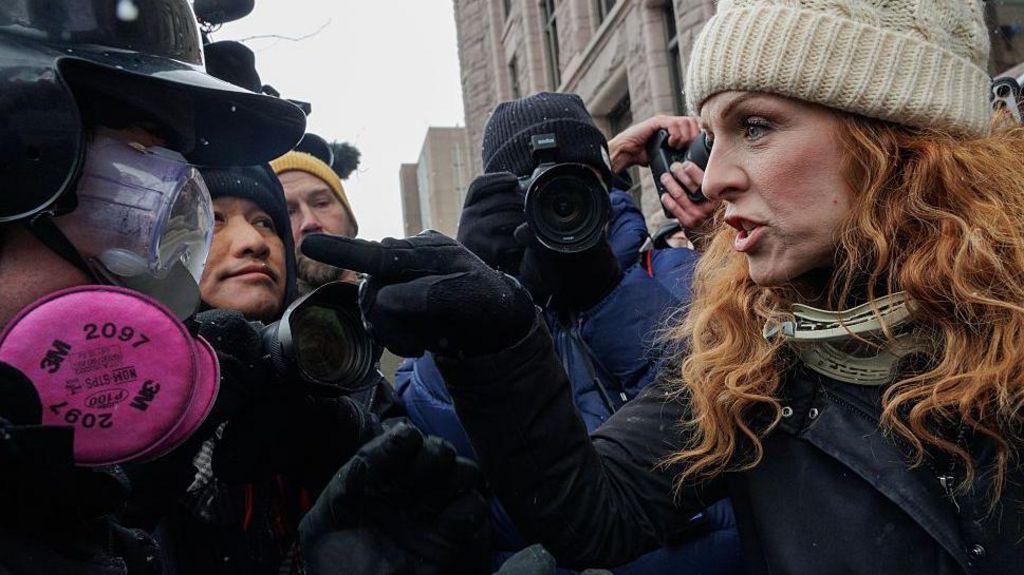
Minnesota has become the epicenter of a mounting constitutional crisis as federal immigration enforcement operations trigger widespread civil unrest and prompt military deployment preparations. The state faces unprecedented tensions with approximately 1,500 troops reportedly standing ready for deployment amid escalating protests against President Trump’s aggressive immigration enforcement campaign.
In the Twin Cities of Minneapolis and St. Paul, civilian monitoring groups have organized to track and document the activities of U.S. Immigration and Customs Enforcement (ICE) agents. One activist, operating under the pseudonym ‘Sunshine’ due to safety concerns, explained her daily routine of tracking unmarked ICE vehicles through city streets. ‘We have the legal right to observe [ICE agents], but they seem to have forgotten that,’ she stated while navigating the icy roads of St. Paul.
The conflict reached a critical juncture following the January 7th fatal shooting of 37-year-old Minneapolis resident Renée Good by an ICE agent. The circumstances remain fiercely contested, with federal authorities claiming self-defense while local officials maintain the victim posed no danger. This incident has galvanized community resistance and intensified protests outside federal buildings, despite freezing temperatures.
Federal judicial intervention has attempted to de-escalate tensions. U.S. District Judge Katherine Menendez issued a restraining order prohibiting ICE agents from arresting or using pepper spray against peaceful demonstrators monitoring immigration enforcement activities. However, clashes persist, with authorities deploying tear gas and pepper balls to disperse crowds.
The Department of Homeland Security maintains that operations target ‘the worst of the worst,’ but documentation reveals numerous instances of non-criminal immigrants and even U.S. citizens being detained. The administration’s approach has proven particularly controversial in Minnesota, home to America’s largest Somali immigrant community, whom President Trump previously described as ‘garbage’ and suggested should ‘return to where they came from.’
The political dimension has intensified with the Justice Department opening criminal investigations against Minnesota Governor Tim Walz and Minneapolis Mayor Jacob Frey, accusing them of obstructing federal immigration operations. Governor Walz, who recently abandoned his re-election bid amid unrelated fraud scandals, condemned the probes as ‘weaponizing the justice system against your opponents.’
President Trump has threatened to invoke the Insurrection Act—a 19th-century statute permitting domestic military deployment—to quell resistance to his immigration campaign. Meanwhile, counter-protests have emerged, including attempts by pardoned January 6th participant Jake Lang to organize pro-ICE rallies, though these have been overwhelmingly outnumbered by opposing demonstrators.
As temperatures plummet and tensions escalate, Minneapolis residents like ‘Sunshine’ continue their vigilante monitoring efforts, despite reporting intimidation tactics from federal agents. ‘If they’re doing this with me, they’re not putting their hands on someone,’ she remarked, acknowledging the personal cost in time and resources. ‘I think that I’m doing what I’m doing because I love my neighbors.’