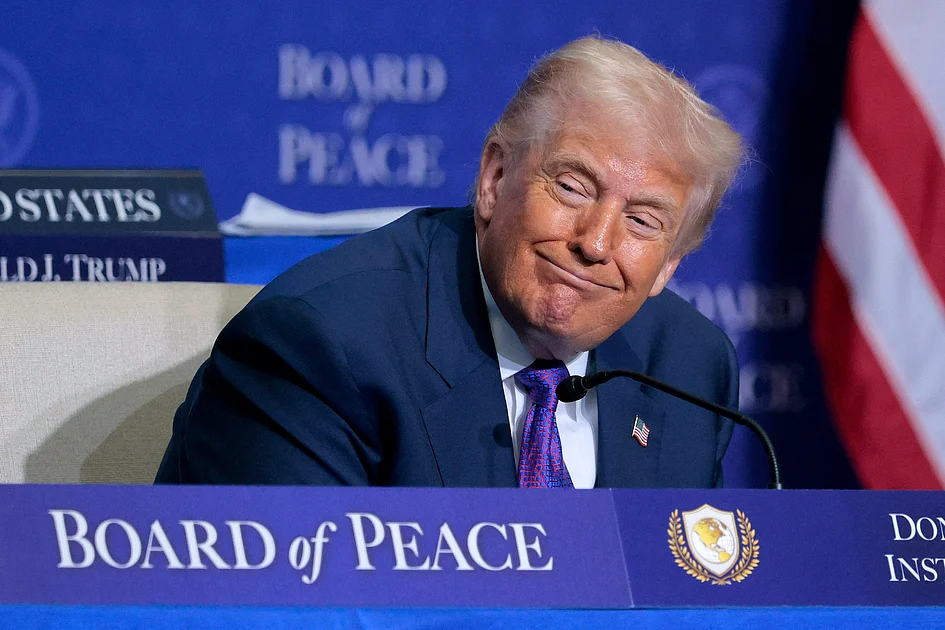
In a landmark event marked by ambitious financial commitments and geopolitical tensions, former U.S. President Donald Trump convened the inaugural session of his proposed Board of Peace on Thursday. The gathering concluded with a significant announcement: a collective $7 billion has been secured as an initial fund dedicated to the reconstruction of the Gaza Strip, contingent upon the complete disarmament of Hamas militants.
The newly established board, which includes Israeli representation but notably excludes Palestinian delegates, faces immediate and formidable challenges. Key among these are ensuring Hamas relinquishes its weapons, facilitating the subsequent withdrawal of Israeli Defense Forces, and effectively channeling humanitarian aid to Gaza’s war-ravaged population. These objectives form the core of Trump’s 20-point peace plan, which previously brokered a fragile ceasefire in October, ending a devastating two-year conflict.
Concluding a lengthy address, Trump declared a substantial U.S. contribution of $10 billion to the board’s efforts. He further detailed additional international support, including a FIFA pledge of $75 million for soccer-related projects in the region and a $2 billion commitment from the United Nations for humanitarian assistance.
The board’s creation has sparked international concern regarding its potential to undermine the United Nations’ traditional role in global diplomacy. Trump sought to assuage these fears, stating, ‘We’re going to strengthen the United Nations. It’s really very important.’
The meeting’s backdrop was dominated by escalating tensions with Iran. Trump issued a stark ultimatum, threatening military action and initiating a substantial military buildup in the region should Tehran refuse to abandon its nuclear program. He indicated that the prospects for a diplomatic resolution would be clear within a ten-day window, emphasizing the necessity for a ‘meaningful deal.’
On the ground, a stark disconnect persists. While Hamas has expressed a conditional willingness to discuss disarmament, it insists any international force must primarily prevent further Israeli aggression. The group also claims Israel is blocking a U.S.-backed committee of Palestinian technocrats, led by Ali Shaath, from assuming administrative control in Gaza—an allegation Israel has not yet addressed. Israeli Prime Minister Benjamin Netanyahu remained resolute, asserting that Hamas would be disarmed ‘peacefully or forcefully.’
Senior U.S. officials indicated that plans are advancing for an International Stabilization Force, with several nations prepared to deploy thousands of troops to maintain peace in Gaza upon its eventual deployment. The event itself, infused with the atmosphere of a campaign rally complete with music and signature red hats, underscored Trump’s unique approach to statesmanship and conflict resolution.