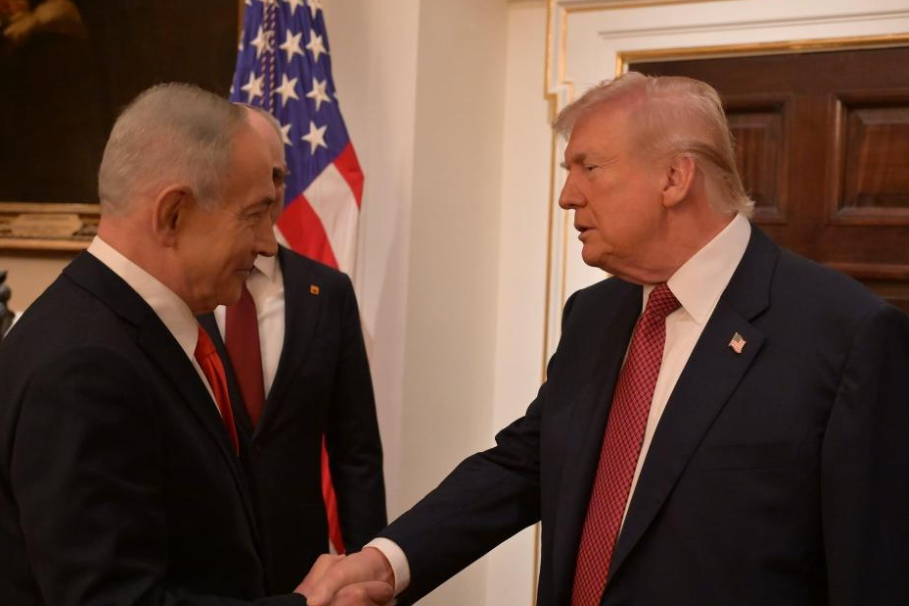
In a significant development in Middle East diplomacy, U.S. President Donald Trump has announced that negotiations with Iran will proceed conditionally, following an extensive three-hour private meeting with Israeli Prime Minister Benjamin Netanyahu at the White House on Wednesday. The closed-door discussion, marking their seventh encounter since Trump’s second term began, concluded without a press conference or official statement.
Trump revealed through his Truth Social platform that while no definitive agreements were reached during the Netanyahu meeting, he emphasized the continuation of U.S.-Iran negotiations. The President articulated a clear preference for achieving a diplomatic resolution, while simultaneously maintaining military options should talks falter. “I insisted that negotiations with Iran continue to see whether or not a Deal can be consummated,” Trump stated, adding that he informed Netanyahu that a successful agreement “will be a preference.”
The meeting occurred against a backdrop of heightened regional tensions and substantial U.S. military deployments near Iran. Earlier discussions between Washington and Tehran took place indirectly in Muscat, Oman, on Friday, attempting to bridge substantial differences. Trump acknowledged in a Fox Business Network interview that any agreement must meet strict conditions: “No nuclear weapons, no missiles.”
Netanyahu’s office outlined Israel’s non-negotiable principles for any Iran agreement, including stringent limits on Tehran’s ballistic missile program and the severance of Iranian ties with militant groups Hamas and Hezbollah. Before traveling to Washington, Netanyahu emphasized his intention to present “essential principles that are important not only to Israel but to anyone who wants peace and security in the Middle East.”
Meanwhile, Iranian leadership presented a contrasting perspective during celebrations marking the 47th anniversary of the Islamic Revolution. President Masoud Pezeshkian denounced what he characterized as a “wall of distrust” created by Western powers, vowing that Iran “will never surrender to excessive demands and aggression.” Iranian Foreign Minister Seyed Abbas Araghchi expressed optimism about reaching a superior agreement compared to the 2015 Joint Comprehensive Plan of Action, while firmly rejecting negotiations on Iran’s missile program or regional alliances.
The diplomatic maneuvering occurs alongside continued U.S. military preparations, with Trump confirming consideration of deploying a second aircraft carrier strike group to the region for potential military actions should negotiations ultimately fail.