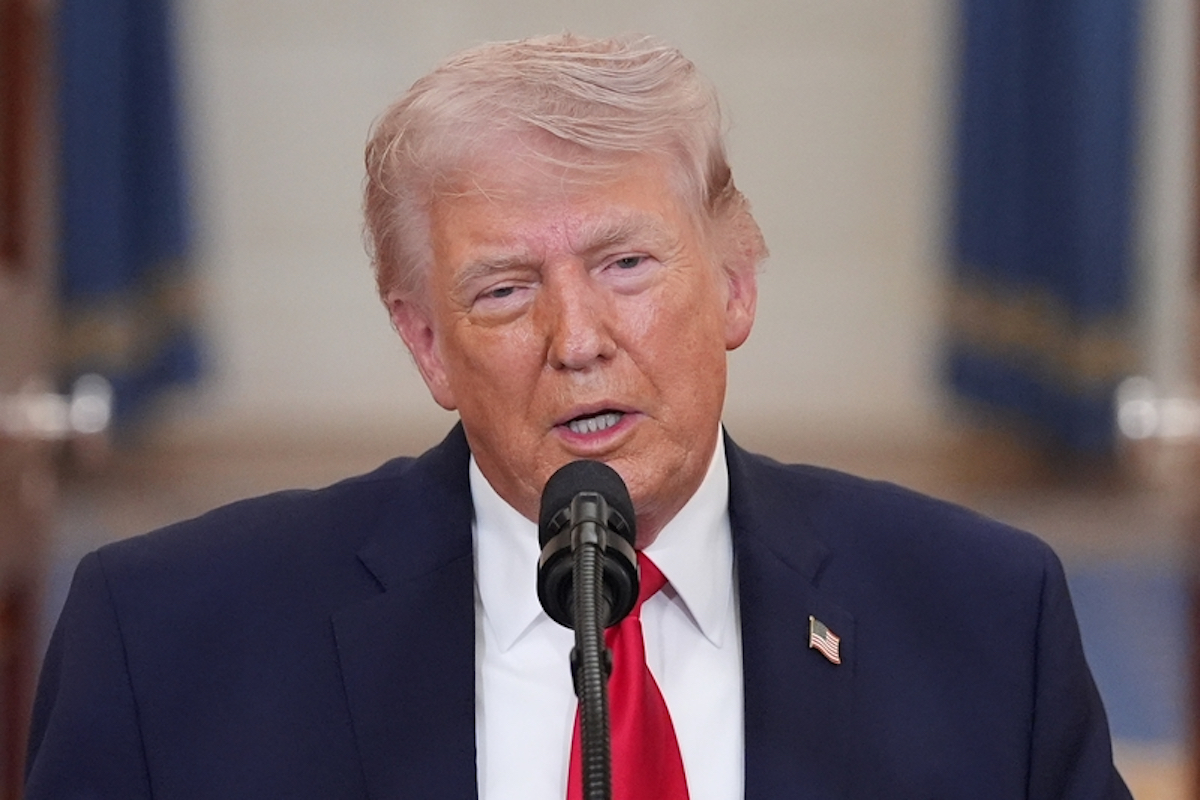
WASHINGTON — In a highly anticipated primetime national address Wednesday, former President Donald Trump announced that the U.S. military’s month-long military campaign in Iran is approaching a swift conclusion, framing the operation as an unprecedented success in degrading the Islamic Republic’s military capabilities.
During the 18-minute televised speech, Trump defended the ongoing conflict, claiming U.S. forces had systematically dismantled Iran’s ability to project power across the Middle East and threaten American interests. “We are systematically dismantling the regime’s ability to threaten America or project power outside of their borders. That means eliminating Iran’s navy, which is now absolutely destroyed, hurting their air force and their missile program at levels never seen before, and annihilating their defense industrial base. We’ve done all of it,” Trump told the nation. He added that the scale of military damage inflicted on Iran is unmatched in modern military history, noting that core strategic goals of the campaign are nearly complete.
The White House’s advance announcement of the address Tuesday had sparked widespread speculation that the president would share major new developments about the costly, deadly conflict, now entering its fourth week. However, analysts and observers quickly noted that most of Trump’s remarks recycled aggressive rhetoric and claims he and his Cabinet have repeated for weeks, including his threat to pummel Iran into what he called the “stone ages” over the next two to three weeks. This echoed prior comments he has shared on social media and with press outlets in recent weeks.
The conflict has already sent shockwaves across the Middle East and the U.S. domestic economy, leaving a trail of death and destruction that has eroded public support for Trump’s decision to launch the war. The campaign has killed 13 U.S. service members and wounded 350 more, according to Pentagon data. On the Iranian side, a U.S.-based Iran human rights group HRANA reports that 1,598 Iranian civilians, including 244 children, have been killed in U.S. and Israeli strikes as of Tuesday. The humanitarian crisis extends far beyond Iran’s borders: concurrent Israeli operations in southern Lebanon have killed 1,240 people, wounded 3,680, and displaced more than 1.1 million Lebanese people as of Monday, according to Lebanese government data. Across the broader Middle East, Al Jazeera English has recorded more than 185 additional deaths in nations including Bahrain, Iraq, Jordan, Syria, and the Palestinian territories.
The disruption of global energy markets has also hit American consumers directly. After Iran seized control of the Strait of Hormuz, the strategic chokepoint through which roughly one-fifth of the world’s global petroleum supplies flow, international crude prices spiked, pushing average U.S. gasoline prices above $4 per gallon. This economic pressure has translated to plummeting public support for the war: a recent Reuters/Ipsos poll conducted within the last week found that roughly two-thirds of Americans want the Biden administration – now the Trump second-term administration – to move quickly to end the conflict.
Trump’s public statements on exit strategy and war aims have shifted repeatedly, sometimes even on a daily basis. On Tuesday, he told reporters that the Iranian regime had already been successfully changed, and that he planned to wrap up military operations within two to three weeks. But the new Iranian Supreme Leader, Majtaba Khamenei, who succeeded his father Ali Khamenei – killed by U.S. and Israeli forces at the start of the war – is reportedly no less hardline, and may hold even more radical views than his predecessor.
In comments to Reuters Wednesday, Trump also downplayed concerns about Iran’s nuclear program, saying he “doesn’t care” about near-weapons-grade enriched uranium buried under rubble at a nuclear site bombed by the U.S. and Israel in June, per International Atomic Energy Agency data. This marks a notable shift from Trump’s original justification for launching the war: in his February 28 video announcement of the initial attack, the president explicitly stated that the core goal of the operation was to ensure Iran “can never have a nuclear weapon.”
Earlier Wednesday, Trump made an unsubstantiated claim on his social media platform Truth Social that Iran’s new radicalized president had requested a ceasefire. He wrote, “We will consider when Hormuz Strait is open, free, and clear. Until then, we are blasting Iran into oblivion or, as they say, back to the Stone Ages!!! President DJT.” Iran’s Foreign Ministry spokesperson Esmaeil Baghaei quickly rejected the claim as “false and baseless,” according to Iranian state-run English broadcaster PressTV.
Hours before Trump’s primetime address, Iranian President Masoud Pezeshkian – who took office in 2024 – released an open letter directly to the American public, pushing back against the Trump administration’s framing of the conflict. Pezeshkian argued that the White House has lied to Americans about Iranian aggression, framing Iran’s military actions as “a measured response grounded in legitimate self-defense, and by no means an initiation of war or aggression.” He questioned the moral and strategic value of the campaign, writing, “Does the massacre of innocent children, the destruction of cancer-treatment pharmaceutical facilities, or boasting about bombing a country ‘back to the stone ages’ serve any purpose other than further damaging the United States’ global standing?” The reference was to an early U.S. missile strike that killed 168 elementary school children on the first day of the invasion. Pezeshkian also blamed Trump for his 2018 decision to withdraw the U.S. from the multinational Iran nuclear deal, noting that the Iranian people hold no inherent enmity toward the American public. Footage of Iranian lawmakers burning American flag prints and chanting anti-U.S. slogans in parliament following the 2018 withdrawal has circulated widely online.
Longstanding tensions between the U.S. and Iran predate the 2026 conflict: the U.S. Department of Defense and U.S. intelligence agencies have linked Iran to dozens of attacks on American military bases across the Middle East over decades. Most notably, a 2020 Iranian strike on Iraq’s Ain al-Asad airbase, launched in retaliation for a U.S. drone strike that killed top Iranian commander Qassem Soleimani, caused traumatic brain injuries for more than 100 U.S. service members. During his 2024 presidential campaign, Trump dismissed these injuries as nothing more than “headaches.” Earlier this year, a federal jury convicted an Iranian Revolutionary Guard Corps operative of plotting to assassinate Trump and other high-profile U.S. political figures during the 2024 election cycle, confirming Iran’s long-standing efforts to carry out attacks on U.S. soil.