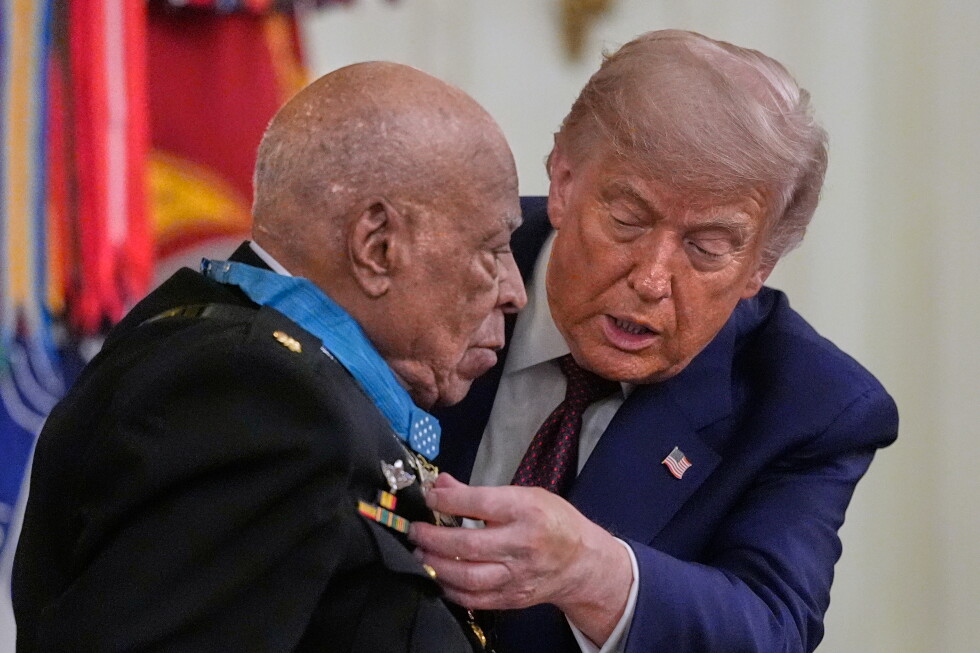
WASHINGTON, D.C. – In a solemn and moving White House ceremony Thursday, former President Donald Trump presented the Medal of Honor, the U.S. military’s highest decoration for valor, to three veterans whose extraordinary acts of bravery saved countless lives and turned the tide of enemy advances during conflicts in Vietnam and Afghanistan.
Two of the honorees, retired Marine Corps Maj. James Capers Jr. and Army Maj. Nicholas Dockery, accepted the award in person, while the third, retired Marine Corps Col. John W. Ripley, received the honor posthumously more than 15 years after his 2008 passing. Opening the ceremony, Trump paid tribute to the three men, saying, “These are great men, great people. We thank you and we will never, ever forget you.”
At 88 years old, Capers was recognized for his selfless leadership during a fatal 1967 Vietnam ambush. What began as a routine reconnaissance mission targeting a suspected North Vietnamese Army base camp quickly devolved into days of brutal close-quarters combat in the thick, unforgiving Vietnamese jungle. On the fourth day of the operation, Capers’ small team was surrounded and outnumbered by enemy fighters, and a hidden land mine blast left the major with a broken leg and severe abdominal wounds. Despite his life-threatening injuries, Capers insisted on retaining command after receiving a dose of morphine, Trump recounted. “He took over like nobody’s ever seen before,” the former president said.
Capers immediately called in targeted air support to repel the attacking force, and when a rescue helicopter arrived to evacuate the unit, he insisted all wounded Marines be loaded onto the aircraft before he boarded himself. A heartfelt, unscripted moment unfolded during the medal presentation: after pinning the Medal of Honor around Capers’ neck, Trump adjusted the decoration to sit straight against the veteran’s chest, pulling him forward in a gesture of respect. The 88-year-old, who had held a composed expression up to that point, broke into a warm smile when Trump grinned back at him.
The second posthumous honor went to Ripley, celebrated for a one-man mission that halted a massive North Vietnamese advance in 1972. When more than 30,000 enemy troops and 200 tanks advanced toward a critical strategic bridge in the village of Dong Ha, Ripley took on the high-risk task of destroying the crossing single-handedly. Over five grueling hours, he repeatedly climbed across the bridge’s exposed steel beams while under constant enemy fire, placing a total of 500 pounds of explosives in key positions. “John completed not one, not two, but five such trips,” Trump noted, calling Ripley a “very strong guy.” After placing the final charge, Ripley said a prayer before triggering the detonation, sending the entire bridge collapsing into the river below and stopping the enemy advance in its tracks. Ripley’s three sons and other extended family members attended the ceremony to accept the medal on his behalf.
The final living recipient, Dockery, was honored for his extraordinary courage during a 2012 Taliban ambush in Afghanistan’s Kapisa Province, where his platoon was tasked with guarding a local compound. Outnumbered by an estimated 150 attacking insurgents, Dockery immediately sprinted across open, enemy-exposed ground to rally his scattered troops, then set out to locate missing service members. After carrying one wounded soldier out of active gunfire, he spotted two enemy fighters moving to kill a second wounded American troops trapped in an alley. Dockery eliminated the two insurgents before administering CPR to the wounded soldier, restoring his breathing, according to his official citation.
After calling in mortar support to target enemy positions, Dockery used his own body to shield the wounded soldier from incoming blast shrapnel. After hours of intense urban combat, Dockery deployed smoke grenades to mark enemy positions for U.S. attack gunships, and he refused to leave the battle site until every last wounded service member had been evacuated to safety. “You were the last man to depart the battlefield that day,” Trump told Dockery. “and you left it a legend and a hero.”